RAMALLAH: Jordan’s King Abdullah met Palestinian President Mahmoud Abbas in the Israeli-occupied West Bank on Monday for the first time in five years to discuss tensions at a Jerusalem holy site and wider political developments.
While the two leaders meet fairly frequently in Amman and other regional capitals, Abdullah has not visited Ramallah, the seat of the Palestinian Authority, since December 2012.
The king flew in by helicopter, with the visit coordinated with Israeli authorities which control all entrance and exit points to the West Bank, including its 150 km (93 mile) border with Jordan and the air space above.
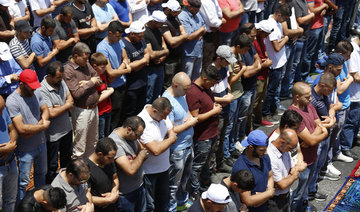
The visit comes two weeks since a surge in violence in Jerusalem after Israel installed metal detectors at Muslim entrances to the Al Aqsa mosque compound, following the killing of two Israeli policemen.
The change in security led to days of protests and clashes between Palestinian worshippers and Israeli security forces before Israel, after consultations with Jordan, decided to remove the metal detectors and other measures.
Jordan has been the custodian of Jerusalem’s Muslim holy sites since the 1920s. The compound, which sits on a tree-lined plateau in the Old City, is also revered by Jews, who call it Temple Mount, the site of two destroyed ancient Jewish temples.
“We discussed all issues of mutual interest and we agreed to form a crisis committee that will continue contacts to evaluate what has happened, the lessons to be learned and the challenges we may face at Al Aqsa mosque,” Palestinian Foreign Minister Reyad Al-Maliki told reporters after the meeting.
Jordan, which signed a peace treaty with Israel in 1994 and has growing, if little discussed, economic ties with its neighbor, often plays a mediating role in the region.
With a large percentage of Jordan’s population made up of Palestinians, and Jordan sharing a border with the West Bank, which the Palestinians want for their own state together with East Jerusalem and Gaza, its position is sensitive.
Maliki said Abbas and Abdullah also discussed US-led efforts to restart Israeli-Palestinian peace talks, which have been suspended for the past three years, and stated that Israel must “recognize the principle of a two-state solution and end provocative settlement activity that is designed to prevent the establishment of a viable, contiguous Palestinian state.”
President Donald Trump’s regional envoy, Jason Greenblatt, has made several trips to Amman, Ramallah and Jerusalem this year to try to find common ground and Al-Maliki said US envoys were expected to visit again in the coming days but there is little sign of enthusiasm on anyone’s part to restart talks.
Abdullah is also playing a role in liaising with Egypt and others to see if long-standing differences between Abbas’s Western-backed Fatah party and the rival Hamas Islamist movement can be resolved and Al-Maliki said the issue was discussed.
Hamas, which won the last parliamentary elections held in the Palestinian territories in 2005, seized full control of Gaza after a struggle with Fatah in 2007.
Over the past several months, Abbas, as head of the Palestinian Authority, has stepped up pressure on Hamas, cutting off salaries for civil servants in Gaza, limiting payments for electricity imports and some medicines.
The aim appears to be to oust Hamas from power, but there is little sign of that happening and efforts are being made by regional powers to resolve the internal fighting.


![]()

Jordan’s King Abdullah discusses holy site tensions in Ramallah
Jordan’s King Abdullah discusses holy site tensions in Ramallah


Latest updates


© 2026 SAUDI RESEARCH & PUBLISHING COMPANY, All Rights Reserved And subject to Terms of Use Agreement.