AMMAN: The excitement in Jerusalem’s Old City began when two trucks belonging to the Israeli-run Jerusalem Municipality arrived to pick up the metal sidings and the hanging scaffolds with cameras that were the latest obstacles to the return of Muslims to pray in their mosque.
Video images of Israelis dismantling metal bars and scaffolding with cameras spread on social media and, within minutes, the Old City of Jerusalem returned to life. Palestinians crowded every gate, even before the Lions’ Gate and Bab Al-Majles were opened. Celebrations and songs filled the air and were immediately broadcast live on various social media networks.
The removal of the metal barriers was the fulfillment of the final condition set by the newly-established Islamic Religious Reference Group for Muslims to return and pray in the Al-Aqsa Mosque.
It would still be another 15 hours before proper prayers would commence in Al-Aqsa Mosque. The mosque has been closed since 7 a.m on July 14, a total of 13 days and eight hours. During this period, the faithful continued to carry out their five daily prayers in the streets outside the mosque.
Naser Abu Sharifa, senior guard at the mosque, along with those taking turns outside Bab Al-Majles, waited for a chance to enter and resume their positions in the 144-dunum compound known as Haram Al-Sharif, which is a UNESCO world heritage site. He could not control his excitement.
“Today is a wonderful day that has brought back a sliver of our pride and dignity and allowed us to reunite with our beloved mosque,” he said.
Bernard Sabella, an elected Palestinian member for the Christian seat, told Arab News that the crisis had brought Palestinian Christians and Muslims together in defense of Al-Aqsa Mosque and made sure that Israel understood that its actions had crossed a red line.
“You cannot play with religious sensitivities,” he told Arab News by phone from Jerusalem.
“Such provocations come back like a boomerang and hit you in the face.”
The morning of July 27 began with a visit by the mufti of Jerusalem — detained by the Israelis for a few hours on July 14 — along with the governor of Jerusalem, Adnan Husseini, to Ramallah for a meeting with Palestinian President Mahmoud Abbas. Abbas had received the day before a phone call from King Abdallah of Jordan in which both sides had agreed that Israel must allow everything to return to the status quo before July 14.
The Waqf lawyer, Jamal Abu Toumeh, who was the connection between Israel and the Jordanian Waqf, helped ensure that all sides understood what was agreed to, which paved the way to the understanding that led to the breakthrough. Arab News learned this from a source in Jerusalem’s Waqf.
Upon the return of the mufti from Ramallah, the newly-established Islamic Religious Reference Group held a press conference in which a carefully-worded four-page statement was read out. It began with condolences for those who had been killed and wishes for the recovery of those injured in the past two weeks of protests. Thousands had to endure relentless Israeli security attempts to break up the nonviolent act of prayer on the streets of Jerusalem.
The statement also included praise for all those who stood with Al-Aqsa and the Palestinians and called on all to join them in Asr (afternoon) prayer in Al-Aqsa. As much as they wanted to enter the mosque immediately, both young and old waited until their leaders led the way to a cleared entrance to the mosque and they prayed the afternoon prayer together.
The victory, however, was not left undisturbed by Israel. Although hundreds of Israeli police are deployed in the Old City, Israel said it could not find a mere dozen to man the various gates of Al-Aqsa and therefore, they left them closed.
The young Palestinians who had entered the mosque and prayed would not have any of it and they broke open the doors from inside to the anger of the Israelis who rushed in with tear gas and stun grenades.
Ekrima Sabri, a leading cleric and mosque preacher at Al-Aqsa, told Sky News that Israel could not accept that they had lost this battle and that Palestinian perseverance had won.
All eyes will be on Al-Aqsa Mosque this morning as Friday prayers are set to resume after two weeks.


![]()
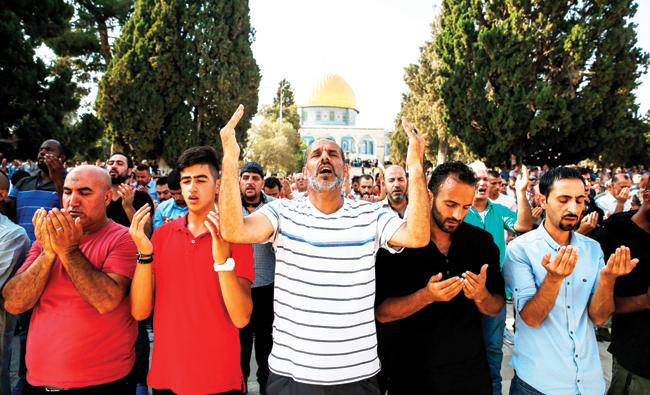
Old City of Jerusalem returns to life as Israelis back off
Old City of Jerusalem returns to life as Israelis back off
Latest updates


© 2026 SAUDI RESEARCH & PUBLISHING COMPANY, All Rights Reserved And subject to Terms of Use Agreement.