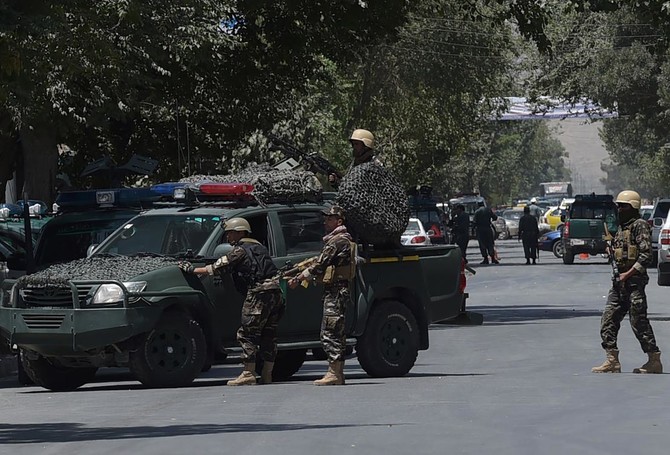
KABUL: Afghan authorities are tightening security in the central area of Kabul housing foreign embassies and government offices after a string of suicide attacks that have caused hundreds of casualties and hit confidence in the Western-backed government.
Two months after a truck bomb killed at least 150 people on May 31 in the biggest such attack since the US-led campaign to oust the Taliban in 2001, a series of scanners and cameras have appeared at intersections around the heart of the capital.
“In this security plan, our priority is the diplomatic area,” Salem Ehsaas, acting police chief of Kabul, told Reuters. “The highest threat level is in this area and so we need to provide a better security here,“
Underlining the threat, security forces seized a truck in Kabul on Saturday carrying 16.5 tons of ammonium nitrate hidden in chicken feed and intended to be used for making explosives, the National Directorate for Security said.
The new measures, which come as the US administration wrestles with formulating a new strategy for Afghanistan, show how serious the security situation has become since the NATO-led coalition ended its main combat mission in 2014.
Although Kabul has never had a formal “Green Zone” to match the one in Baghdad, over the years the center of the Afghan capital has become an increasingly militarized zone of armed checkpoints and blast walls.
The city is now one of the most dangerous places in Afghanistan for civilians, with 209 killed and 777 injured in suicide and complex attacks in the first half of the year, according to United Nations figures.
This year alone, attacks have included the main military hospital near the US Embassy in Kabul, the Supreme Court, the Iraqi embassy, as well as the May 31 truck bomb, just in front of the German embassy.
A number of foreign aid organizations and embassies, including the German mission which was heavily damaged in the attack, have sent some of their international staff home over the raised security fears.
The new measures will see 27 permanent checkpoints installed on the 42 roads through the zone, supported by mobile explosives scanners, sniffer dogs and security cameras. Nine other streets will normally be closed and the remaining six roads will be permanently closed to cars.
Trucks will be searched at a special external checkpoint and enter the central zone via the main road in from the airport, with around 1,200 police on duty in the area, including special motorbike patrols.
The measures will be introduced progressively and should be complete within six months, officials said.
Additional checkpoints are unlikely to be popular with motorists who already have to put up with long delays on Kabul’s notoriously choked roads but at the same time, there has been a growing clamour for more security.
The attacks, added to the thousands of casualties suffered by Afghan troops, have piled pressure on the government of President Ashraf Ghani, leading to street demonstrations and demands by parliamentarians for security officials including the ministers of the interior and defense to be impeached.


Kabul “Green Zone” tightened after attacks in Afghan capital
Kabul “Green Zone” tightened after attacks in Afghan capital

EU should consider forming combined military force: defense chief
- Kubilius floated creating a “powerful, standing ‘European military force’ of 100,000 troops” that could eventually replace US forces
- Trump has heightened fears among NATO allies over Washington’s reliability by insisting he wants to take over Greenland
BRUSSELS: EU countries should weigh whether to set up a combined military force that could eventually replace US troops in Europe, the bloc’s defense chief said Sunday.
EU defense commissioner Andrius Kubilius floated creating a “powerful, standing ‘European military force’ of 100,000 troops” as a possible option to better protect the continent.
“How will we replace the 100,000-strong American standing military force, which is the back-bone military force in Europe?” he asked in a speech in Sweden.
The suggestion comes as US President Donald Trump has heightened fears among NATO allies over Washington’s reliability by insisting he wants to take over Greenland.
Worries over Trump’s commitment to Europe have already spurred countries to step up efforts to bolster their militaries in the face of the threat posed by Russia.
Ideas about establishing a central European army have floated around for years but have largely failed to gain traction as nations are wary of relinquishing control over their militaries.
The US has pushed its European allies to increasingly take over responsibility for their own security, and raised the prospect it could shift forces from Europe to focus on China.
“In such times, we should not run away from the most pressing questions on our institutional defense readiness,” said Kubilius, a former Lithuanian prime minister.
In his speech Kubilius also advocated for the creation of a “European Security Council” of key powers — including potentially Britain — that could help the continent take decisions over its own defense quicker.
“The European Security Council could be composed of key permanent members, along with several rotational members,” he said.
“In total around 10-12 members, with the task to discuss the most important issues in defense.”
He said the first focus of such a body should be trying to change the dynamics in the war in Ukraine to ensure that Kyiv does not end up losing.
“We need to have a clear answer — how is the EU going to change that scenario?,” he said.
“This is the reason why we need to have a European Security Council now!“


