Lack of remorse could bite ‘Pharma Bro,’ say experts

1 / 2
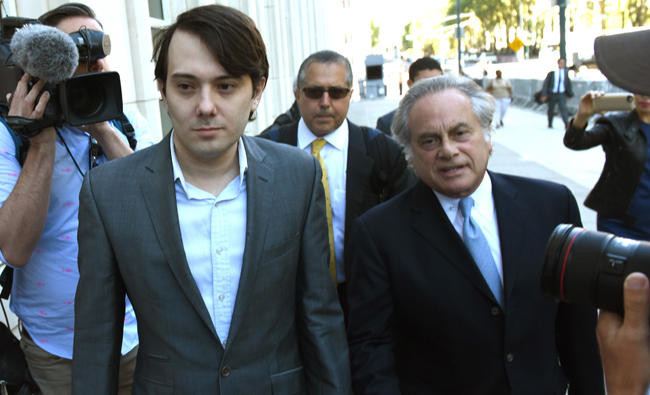
This file photo taken on June 26, 2017 shows Martin Shkreli, the former Turing Pharmaceuticals executive who became known as "Pharma Bro" arriving for the first day of jury selection in his federal securities fraud trial at United States District Court Eastern District of New York in Brooklyn. (AFP)
2 / 2
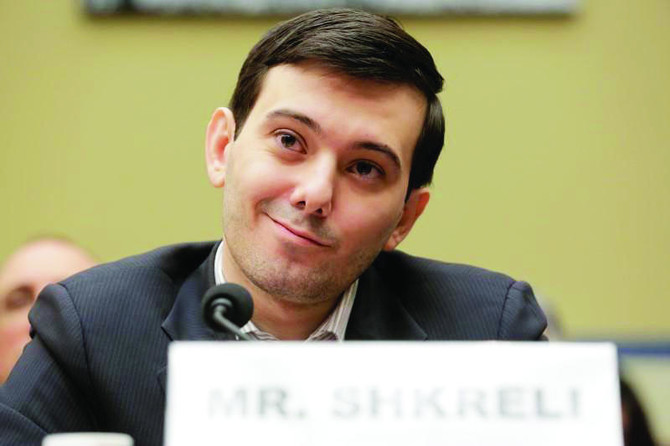
Less than an hour after a US jury convicted Martin Shkreli of securities fraud, the so-called ‘Pharma Bro’ was back at his New York City apartment trash talking in a live-stream on YouTube. (Reuters)
Updated 06 August 2017
Follow

Lack of remorse could bite ‘Pharma Bro,’ say experts

NEW YORK: Less than an hour after a US jury convicted Martin Shkreli of securities fraud, the so-called “Pharma Bro” was back at his New York City apartment doing what comes naturally: Trash talking in a live-stream on YouTube.
The brash former pharmaceutical CEO, who’s still out on bail, joked he won’t be going to a hard-core prison — “No shanks” — and predicted his acquittal on some charges Friday will help him recover tens of millions of dollars he claims he’s owed from a drug company he started.
“It doesn’t seem like life will change much for Martin Shkreli,” he said. “I’m one of the richest New Yorkers there is, and after today’s verdict, it’s going to stay that way.”
Shkreli’s trolling of his own trial has amused some onlookers. But legal experts say it could have serious consequences when it comes time for sentencing.
“No real good can come from going on YouTube after a guilty verdict,” said Robert Mintz, a former federal prosecutor now in private practice. “This is exactly the kind of behavior that got him in trouble in the first place.”
US District Judge Kiyo Matsumoto likely will factor in any lack of remorse and contrition at sentencing in federal court in Brooklyn, said Matthew Schwartz, a defense lawyer and former federal prosecutor who once worked for a Securities and Exchange Commission task force.
“Going into the trial, he had an audience of 12. Now he’s got an audience of one,” Schwartz said, referring to the jury and judge. “He’s putting himself at great risk for a higher sentence.”
The 34-year-old defendant faces up to 20 years in prison for his conviction on the most serious counts, though the term could be much lower under sentencing guidelines. Shkreli’s lawyer, Ben Brafman, said he would argue for no jail time. No sentencing date was set.
Shkreli was arrested in 2015 on charges he looted a drug company he founded, Retrophin, of $11 million in stock and cash to pay back investors in two failed hedge funds he ran.
Investors took the witness stand to accuse him of keeping them in the dark as his scheme unfolded, while the defense argued there wasn’t any harm done because all of them got rich off of Retrophin stock.
Before his arrest, Shkreli was best known for buying the rights to a life-saving drug at another company in 2014 and promptly raising the price from $13.50 to $750 per pill. He also had a reputation for attacking critics on social media and was barred from Twitter for posts about a female journalist.
Even during his trial, when most criminal defendants would lay low, Shkreli stayed online commenting about his own case.
After the verdict, Brafman once again raised hopes he could rein in his client.
“There is an image issue that Martin and I are going to be discussing in the next several days. Martin is a brilliant young man, but sometimes people skills don’t translate well,” he said.
Not much later, Shkreli’s was on YouTube, answering questions about the case and cracking jokes. During his lengthy livestream, he invited one reporter up to his apartment to ask him questions on camera.
“Ben probably wants me to act and look like your average CEO, but I’m a very individualistic person and I don’t sort of conform to what folks want me to do and not want me to do, and that’s what being an individual is all about,” he said. “As long as it doesn’t interfere with the legal case, it’s my life to live.”
Without more conformity, Shkreli’s lawyer will have his work cut out for him trying convince the court that he should be cut some slack as “someone who is not entirely normal,” said Schwartz, the former prosecutor. “Whether the judge will buy it or not is another question.”
The judge’s last words to the defendant as she left the bench offered no clues.
“I wish you well, Shkreli,” she said. “See you soon.”


AI will never replace human creativity, says SRMG CEO 

Updated 30 January 2026
Follow

AI will never replace human creativity, says SRMG CEO 

  • Speaking to Maya Hojeij, senior business anchor at Asharq with Bloomberg, Jomana R. Alrashid expressed pride in SRMG platforms that had absorbed and adopted AI

RIYADH: Jomana R. Alrashid, CEO of Saudi Research and Media Group, highlighted how AI cannot replace human creativity during a session at The Family Office’s “Investing Is a Sea” summit at Shura Island on Friday. 

“You can never replace human creativity. Journalism at the end of the day, and content creation, is all about storytelling, and that’s a creative role that AI does not have the power to do just yet,” Alrashid told the investment summit. 

“We will never eliminate that human role which comes in to actually tell that story, do the actual investigative reporting around it, make sure to be able to also tell you what’s news or what’s factual from what’s wrong ... what’s a misinformation from bias, and that’s the bigger role that the editorial player does in the newsroom.”

Speaking on the topic of AI, moderated by Maya Hojeij, senior business anchor at Asharq with Bloomberg, the CEO expressed her pride in SRMG platforms that had absorbed and adopted AI in a way that was “transformative.”

“We are now translating all of our content leveraging AI. We are also now being able to create documentaries leveraging AI. We now have AI-facilitated fact-checking, AI facilities clipping, transcribing. This is what we believe is the future.”

Alrashid was asked what the journalist of the future would look like. “He’s a journalist and an engineer. He’s someone who needs to understand data. And I think this is another topic that is extremely important, understanding the data that you’re working with,” she said.

“This is something that AI has facilitated as well. I must say that over the past 20 years in the region, especially when it comes to media companies, we did not understand the importance of data.”


The CEO highlighted that previously, media would rely on polling, surveys or viewership numbers, but now more detailed information about what viewers wanted was available. 

During the fireside session, Alrashid was asked how the international community viewed the Middle Eastern media. Alrashid said that over the past decades it had played a critical role in informing wider audiences about issues that were extremely complex — politically, culturally and economically — and continued to play that role. 

“Right now it has a bigger role to play, given the role again of social media, citizen journalists, content creators. But I also do believe that it has been facilitated by the power that AI has. Now immediately, you can ensure that that kind of content that is being created by credible, tier-A journalists, world-class journalists, can travel beyond its borders, can travel instantly to target different geographies, different people, different countries, in different languages, in different formats.”

She said that there was a big opportunity for Arab media not to be limited to simply Arab consumption, but to finally transcend borders and be available in different languages and to cater to their audiences. 


The CEO expressed optimism about the future, emphasizing the importance of having a clear vision, a strong strategy, and full team alignment. 

Traditional advertising models, once centered on television and print, were rapidly changing, with social media platforms now dominating advertising revenue.

“It’s drastically changing. Ultimately in the past, we used to compete with one another over viewership. But now we’re also competing with the likes of social media platforms; 80 percent of the advertising revenue in the Middle East goes to the social media platforms, but that means that there’s 80 percent interest opportunities.” 

She said that the challenge was to create the right content on these platforms that engaged the target audiences and enabled commercial partnerships. “I don’t think this is a secret, but brands do not like to advertise with news channels. Ultimately, it’s always related with either conflict or war, which is a deterrent to advertisers. 

“And that’s why we’ve entered new verticals such as sports. And that’s why we also double down on our lifestyle vertical. Ultimately, we have the largest market share when it comes to lifestyle ... And we’ve launched new platforms such as Billboard Arabia that gives us an entry into music.” 

Alrashid said this was why the group was in a strong position to counter the decline in advertising revenues across different platforms, and by introducing new products.

“Another very important IP that we’ve created is events attached to the brands that have been operating in the region for 30-plus years. Any IP or any title right now that doesn’t have an event attached to it is missing out on a very big commercial opportunity that allows us to sit in a room, exchange ideas, talk to one another, get to know one another behind the screen.” 

The CEO said that disruption was now constant and often self-driving, adding that the future of the industry was often in storytelling and the ability to innovate by creating persuasive content that connected directly with the audience. 

“But the next disruption is going to continue to come from AI. And how quickly this tool and this very powerful technology evolves. And whether we are in a position to cope with it, adapt to it, and absorb it fully or not.”