BANGKOK: It is a royal tradition that has proved bountiful through the ages and one that Thailand’s fruit carvers are determined to keep alive — even as young people peel away from the unique art form.
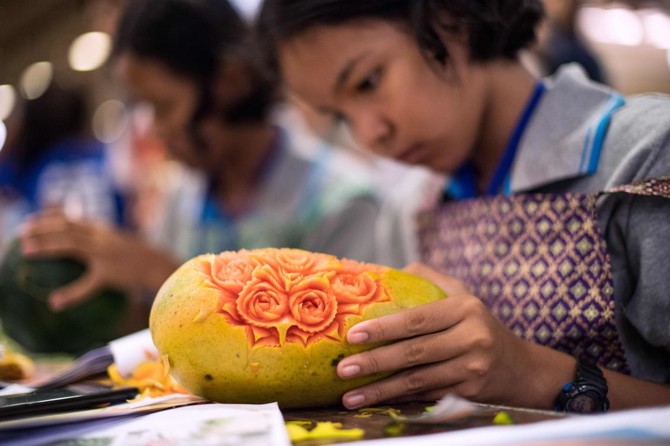
From beetroots carved into roses to fruity floats made from papayas and melons, the most important fruit carving competition in Thailand took place in Bangkok Friday.
But for competitor Piyanat Thiwato, carving is about more than just winning.
“Carving can improve our mind because it requires concentration and enhances our imagination, it’s a way to relax,” he said.
The tradition has been traced back to Thailand’s royal Sukhothai dynasty, in the 14th century.
“The art of food carving started hundreds years ago. Thailand is rich with arts and crafts. It’s like a very beautiful treasure that we have,” said Araya Arunanondchai, the event’s organizer.
“In the old days, it was done in the royal palaces for the royal family,” she added.
Dozens of Thai artists competed in the famous fruit and vegetable carving competition, which was organized in honor of Queen Sirikit, who turns 85 on August 12.
More than 20 teams carved anything from owls to elephants or intricate Thai designs onto fruits including taros, melons, and papaya.
Fruit carving is still popular as an offering in temples or as a decoration for weddings. Fine arts students can still choose to learn it at university, as they would take painting lessons. But the tradition is fading away.
“Not so many young people are interested in it or the ones who studied it in art schools cannot make a living out of it,” Manirat Svastiwat na Ayutthaya, food carving expert said.

Fruit carving, a meticulous art in Thailand
Where We Are Going Today: Joontos restaurant
While staying at Dar Tantora: The House Hotel in AlUla recently, I kept coming back for seconds at the establishment’s restaurant, Joontos, awarded a Bib Gourmand distinction in the Michelin Guide 2025.
If you are also staying at the hotel, this is the breakfast option that is conveniently provided — with no buffet in sight.
On my first breakfast there, on a crisp cool morning, I overheard several guests ask if there was a buffet and each was told no, it was a la carte.
That special attention to each plate made sense moments later when my selection arrived. I did not need to be distracted or stuff my plate with a mismatch of items but focus on one decadent dish at a time.
Even if you are not a hotel guest, you can — and perhaps should — also dine there. Seating is limited, so it is best to book ahead.
You can enter either from outside the building or via the labyrinth within the hotel. Like in life, the path there seems complicated at first, but very easy once you know where to go.
The aptly-named Joontos derives from the Spanish word “juntos,” meaning “together.”
While the staff told me they tend to skirt around using the overused word fusion, the food is indeed a tasty mix of this and that.
It serves what they call “modern Saudi cuisine” from chef Jaume Puigdengolas, using local ingredients from nearby farms, with a menu medley full of international favorites.
The outdoor seating in the fresh air is spacious and offers sweeping views of the ancient rock formations. But the main view will be your beautifully curated dishes, bursting with vibrant color and even brighter flavor.
There are limited semi-indoor tables, which usually need to be reserved.
Since oranges were in season, I had freshly squeezed juice and indulged in the mascarpone croissant with berries that they recommended, both highlights. I also could not resist the plate of homemade baked bread with various sauces for dipping.
One morning, I ordered the Moroccan eggs bowl, made with freshly poached eggs — I asked for mine medium — served with roasted cherry tomatoes, olives, whipped labneh and chili oil.
I returned for several days and also for a group lunch — everything was excellent. It was consistently good.
My food arrived on time, and the service was attentive; friendly without being overbearing.
That said, on one visit, my friend ordered a granola yogurt bowl and an egg dish — the granola arrived instantly, and she raved about it, but the eggs never came.
Despite asking multiple times, they did not arrive, and we eventually had to rush out, so the rest of the order was canceled.
Joontos is deliberately kept exclusive to AlUla with no other branches, ensuring high quality and a unique experience.
It is open daily for breakfast, lunch, and dinner, with a smart-casual dress code.
If you travel by car, there is free parking available at Old Town South Parking, making it easy to pop in and enjoy a meal, as many locals did.
While the Dar Tantora hotel is named for the tantora atop its building — the triangular stone sundial whose shadow across the space below historically signaled the start of the farming season — perhaps the truest marking of time is one’s grumbling stomach, signaling that it is time to eat.
Follow them @joontos_alula on Instagram.


