

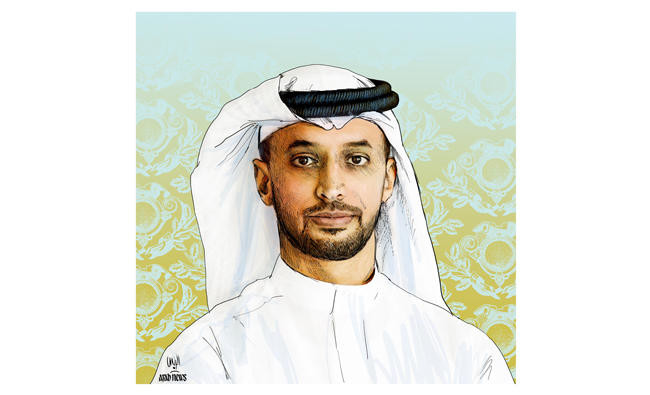
DUBAI: Ahmed bin Sulayem was very clear on the difference between the Dubai and Saudi economic development models.
“In Dubai it was a case of ‘if you build it, they will come.’ In Saudi Arabia the people are already there, they do not need to come. But now they have to build it,” he said.
That is a pretty good analysis, echoing the more complex arguments of economic strategists that the UAE had to import consumer demand for its transformation in the 1990s and 2000s, whereas the Saudi demographic means demand is already there in a population of 32 million.
It came from a man who has played his fair share in the economic and commercial transformation of Dubai and the UAE.
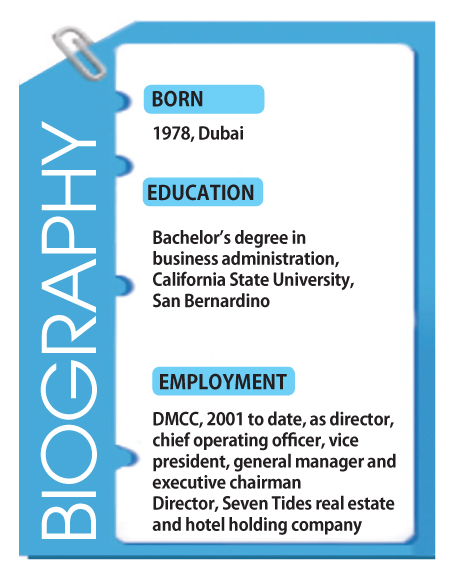
The Dubai Multi Commodities Centre (DMCC), of which he was a founding director in 2002 and executive chairman since 2007, is one of the emirate’s great success stories, with 30 percent annual growth since it was launched.
It is a commercial and financial trading hub, home to nearly 14,000 member firms in a thriving urban community at the heart of “new Dubai,” the southward sprawl of the city toward the UAE capital Abu Dhabi.
We were speaking on the 50th floor of Almas Tower, the DMCC’s headquarters. The tower stands out across the south Dubai skyline as one of the tallest buildings around, but will eventually be eclipsed by the tower of Burj 2020, the focal point of a new ambitious development in the free zone.
The DMCC is a model of the “free zone” strategy of economic development that is also being considered as part of the Saudi Vision 2030 strategy, and has regularly been voted among the top free zones in the world.
“What’s happening in Saudi Arabia now is very interesting. From the point of view of the government and the crown prince, they see the need for change and they’re pushing for it,” bin Sulayem said.
“I think what Dubai and Abu Dhabi have shown, through our own experience, is that this kind of transformation is sustainable. Dubai especially has sown a seed in the minds of regional leaders that change and diversification is possible and desirable.”
There is already quite significant Saudi business in the DMCC, with big jewelry and gold traders having a presence there.
A DMCC-operated diamond laboratory in Jeddah was a casualty of the global financial crisis, though the idea could be revived, bin Sulayem said.
“But the main interaction between the DMCC and Saudi Arabia is that foreign companies come here as an entry point for business in Saudi. Dubai is like a Hong Kong for Saudi’s China.”
Trade and commerce runs in the bin Sulayem family lineage. Ancestors were traditionally business advisers to the ruling Al-Maktoum family of Dubai, and his father Sultan was chairman of the Dubai World conglomerate until it unraveled in the global financial crisis. Sultan is still chairman of DP World, the global ports business.
For the son, the next big thing for the DMCC, and he hopes for Saudi Arabia too, is coffee. The free zone trades in virtually everything, from commodities such as tea and rice to gold, energy contracts and financial instruments. But it has so far held back from a full commitment to the coffee trade.
That will change next year when the DMCC Coffee Centre is unveiled. Rather like the tea center that has been operating for over a decade as a warehousing, blending and packaging hub — and which last year announced its own brand, Chai Dubai — the planned 4,500-square-meter coffee center aims to put Dubai on the map as the hub of the regional and even global coffee trade.
The logistics of the coffee trade mean that currently it can take as long as a month for the product to reach consuming centers in the Arabian Gulf from traditional producers in Ethiopia and Kenya.
“When the coffee center is open, we’re hoping to cut this to a few days by shipping via Dubai, and maybe having roasting facilities there too,” bin Sulayem said.
“Ethiopia insists it all has to be roasted in the country at the moment, but we’d like permission to do that in Dubai. There’s a big coffee culture in the Gulf, and Saudi is the biggest country. So I see a lot of opportunities there. I want to bring more South American coffee to the Gulf as well.”
South America has been one of his recent preoccupations, and a good number of the hundreds of thousands of air miles he clocks up each year has been to Cuba, Colombia, Paraguay, Brazil and Peru.
“I felt there has been a disconnect between the DMCC and Latin America. We focused on the big markets in India, China and Africa, to the extent that maybe we’re preoccupied. But there are enormous markets in Latin America that need to be looked at more closely,” he said.
We chatted about the last time we had spent time together, when I accompanied him on a visit to Caracas, in troubled Venezuela, in early 2016.
That trip was in relation to the Kimberley Process (KP), the diamond trade regulator of which he was chairman for a one-year stint.
But my abiding memory of it is of high-security motorcycle outriders and a shopping mall trip in the company of men with revolvers on their hips.
The security situation in the country has deteriorated significantly since then, with daily fatal clashes between the opposition and security forces loyal to President Nicolas Maduro.
But bin Sulayem is still in touch with Venezuelan business leaders. He hinted that other Dubai entities are planning to expand activities there, but declined to name them publicly.
The KP year was a significant landmark for him and for Dubai. The emirate, through the DMCC’s diamond-trading market, had become a leading world center of the multibillion-dollar trade, becoming the third-biggest diamond center in the world.
But in a controversial industry tainted by the “blood diamond” legacy, bin Sulayem did not always have the easiest time explaining the attractions of Dubai to the world.
In particular, the non-governmental organizations (NGOs) that make up a large and vocal part of the industry were quick to throw mud at Dubai.
Bin Sulayem confronted them head on, while also dealing with some of the core grievances of diamond producers, especially in Africa.
The year, which culminated in a special address to the UN in New York, was generally regarded as a success for the UAE and for bin Sulayem.
What did he learn from a year of globetrotting and policymaking in the diamond industry? “I think the perception of the UAE has changed in the diamond world. It will be harder to come after the UAE now (for alleged infringements of diamond trading rules) after we raised the issues of African exploitation in the UN and elsewhere,” he said.
“We set out the basis for a valuation system for rough diamonds, the first time that has ever been attempted. The producing nations were very happy with the steps we took on that. I think we changed the perception of Dubai in the diamond industry from being just a place to hold meetings and conferences, to a real center of policy influence.
“I was seen as a disruptive KP chair, and I’m glad about that. I think we raised the bar for KP leadership from here on. Some of the hostility we faced from civil society (the NGOs) was very personal, driven by a prejudice against the UAE and in their own interests, rather than the interest of the producing countries.”
The KP job is over, annual chairmanship having passed to Australia, but the diamond industry remains a central part of the DMCC product offering.
Later this year, the Dubai Diamond Conference takes place at the same time as the World Diamond Council annual meeting. Some star speakers are lined up for the events.
Before then, bin Sulayem will unveil the final design for Burj 2020, the new master development adjacent to the DMCC’s current location in Jumeirah Lake Towers (JLT).
It is a mixed-use project, like JLT, but with two super-large high-rise structures, both of which will be bigger than Almas.
“It really is something. The main tower will be a super-tall building, but I don’t want to get into a race,” he said.
“I don’t want to go bankrupt building the biggest tower in the world in competition with the Chinese. But the scale is huge.”
The other big recent initiative was a deal that holds out the prospect of a unified clearing house for several asset-trading classes in the UAE.
Last month, bin Sulayem signed an agreement with the Abu Dhabi Global Market, the new financial free zone based in the capital, to recognize the Dubai Gold and Commodities Exchange and the Dubai Commodities Clearing Corp. (both DMCC entities) as remote authorities for clearing and trading.
It came just a few days after the Abu Dhabi Securities Exchange, the capital’s stock market, signed a similar deal.
It may sound technical, but in the UAE financial system, where rival institutions jealously guard their own turf, it is a significant achievement of cooperation.
“The clearing business in the UAE is of a scale and size worthy of a national center that could in time become a regional hub for clearing, including for Saudi Arabia,” said bin Sulayem.
He is an inveterate social media user, as any Twitter or Instagram follower will attest, and I ask him about US President Donald Trump’s social media outpourings.
Bin Sulayem declines to pass a verdict for publication, but said: “We’re extremely happy it’s President Trump and not President (Hillary) Clinton. The other side (the Democrats and Barack Obama) allowed Iran to nuclearize its defense industry. Apart from that, Clinton has a record in this region.”
This was a clear reference to the role she, as a New York senator, played in 2006 during the political campaign to block his father’s company from buying some American ports.
The DMCC’s expansion under bin Sulayem’s leadership has been rapid, even hyperactive. I asked him finally when he thinks he will slow down a little.
“I’m turning 40 next year, so I expect that will slow me down a bit. But I also want to do my national service,” he said.
“I’m sure they have a special regime for people over 40. I’ve just been too busy until now, but I really feel it’s my duty to do it.”


