'Lucifer' heat wave holds Italy, eastern Europe in fiery grip

1 / 3
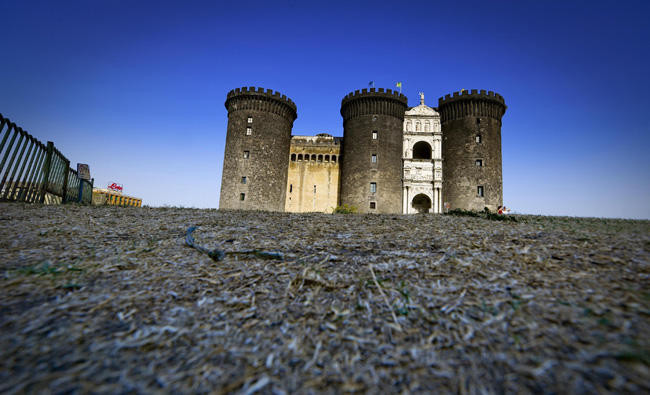
The lawn in front of the ''Maschio Angioino'' castle is completely dried out and turned hay by the heat, in Naples, Italy, on Thursday. (Ciro Fusco/ANSA via AP)
2 / 3
A man refreshes as he walks under a nebulizer at a bar, in the Navigli district of Milan, Italy, on Thursday, as temperatures rose to 35-40 degrees celsius (95-104 Fahrenheit) in central and south Italy, according to weather reports. (AP Photo/Luca Bruno)
3 / 3
A Ring-tailed Lemur eats icicles made with fruit and bamboo reeds stuffed with yogurt and frozen fruit at the Bioparco of Rome, Italy, on Friday. Rome temperatures this week hit around 100 F (38 C). (Giorgio Onorati/ANSA via AP)
Updated 04 August 2017
Follow

'Lucifer' heat wave holds Italy, eastern Europe in fiery grip

SARAJEVO/BELGRADE: Swathes of southern and eastern Europe sweltered in temperatures above 40 degrees Celsius (104°F) on Friday in a heat wave nicknamed “Lucifer” that has fanned forest fires, triggered weather warning alerts and damaged crops.
Italy and the Balkans were worst affected, though areas as far north as southern Poland also basked in abnormally hot temperatures, and European weather hub Meteoalarm issued its highest grade “red” warnings for 10 countries.
At least two people have died from the heat — one in Romania and one in Poland — and many more have been taken to hospital suffering from sunstroke and other heat-related conditions.
In Albania, 300 firefighters and soldiers struggled to contain as many as 75 forest fires and the country asked the European Union for emergency help. Firefighters were also busy in Serbia, Bosnia, Macedonia and Croatia.
With temperatures expected to stay around 40 degrees Celsius into next week, authorities advised people to increase their water intake and Red Cross volunteers across Europe visited the homeless and elderly and other people at risk.
“This prolonged period of extremely hot weather is particularly dangerous for people with existing health problems such heart conditions, high blood pressure and asthma, as well as older people and children,” said Jeya Kulasingam, health coordinator for the International Federation of the Red Cross and Red Crescent Societies in Europe.
“It is vital that people stay hydrated and drink plenty of water, keep out of the sun and avoid over-exertion.”
Wine growers in Italy have started gathering the grape harvest weeks earlier than usual due to the extreme heat.
Carlo Petrini, founder of the Slow Food movement, wrote in La Stampa newspaper that the grape harvest had never started before Aug. 15 in living memory.
“The health of the grapes is severely tested by this weather,” Petrini wrote, adding that growers ran the risk of finding the fruit “cooked by the sun and the burning heat.”
Italian authorities have issued weather risk warnings for 26 cities, including tourist hubs Venice and Rome, where many of the fountains have been turned off due to a lengthy drought.
The world-famous Uffizi art galleries in Florence had to shut temporarily on Friday when the air conditioning system broke down, their director told ANSA news agency.

Polar bears, crops suffer
In Hungary, keepers at Budapest Zoo provided huge ice blocks to cool down two polar bears, who were also fed ice-cold water melon.
Bosnian officials said the heat wave and drought had nearly halved agricultural output, which accounts for 10 percent of the country’s economic output. Neighbouring Serbia reported a similar situation and experts said drought could slash corn and soybean production by a third.
In neighboring Croatia the heat wave and peak tourist season has driven power demand and spot prices to record levels, officials said on Friday.
Temperatures along parts of Croatia’s Adriatic coast, including the major tourist hub of Dubrovnik, already stood at around 32 degrees early on Friday morning and were expected to nudge up to 42 degrees during the day, the weather service said.
The Red Cross distributed water and hand fans to people suffering from the heat in Croatia – especially tourists visiting outdoor events and motorists stuck in typical summer traffic jams.
“In two hours of my shift today I saw four people fainting on the street and complaining of heat exhaustion,” a traffic warden who identified himself as Goran told Reuters in the Serbian capital Belgrade.

In Bangladesh’s mangrove forest, villagers brave tigers to collect rare honey

Updated 58 min 55 sec ago
Follow

In Bangladesh’s mangrove forest, villagers brave tigers to collect rare honey

  • Honey is gathered from wild bee colonies deep in the Sundarbans
  • Producers made a debut at the biggest food fair in Jeddah this month

DHAKA: When the harvest begins, Mizanur Rahman gathers a few hundred men and sets out into the mangrove forest along the Bay of Bengal, where for months they climb trees to collect by hand a wild natural honey whose unique properties are only starting to attract global attention.

The honey is collected from wild bee colonies deep within the Sundarbans, the world’s largest mangrove reserve spanning parts of India and southwestern Bangladesh.

“Honey collection from this forest is mostly done in the Bangladesh part,” Rahman said. “All plants, trees, and the overall environment of this forest are natural. There is no human touch.”

Sundarban honey comes from an ecosystem where trees grow and bloom naturally, without the use of fertilizers or pesticides. Its collectors, known as mawalis, begin work in March for about three and a half months.

Rahman estimates there are about 4,000 mawalis in the local community. To enter the forest, they require special passes from the forest department.

“It’s a very risky job for the people who enter the forest,” he told Arab News. “It’s the only honey in the world where collectors risk their lives in the den of the mighty Bengal tiger to gather it. Sometimes, they also face the danger of poisonous snake bites.”

During the season, his team reaches up to 1,200 members who together manage to collect about 400 tons of honey.

“One hundred small boats start sailing together, each carrying eight to 10 people,” Rahman said. “Despite the dangers, it is a matter of pride to be part of these challenging tasks.”

Collected from a humid environment, Sundarban honey is thinner than other types. Its greenish-amber shade comes from the nectar of mangrove flowers, and the taste is less sweet than most commercial honeys, with a subtle citrus-like tanginess. The scent is mild.

Being raw and unprocessed, the honey retains more enzymes, antioxidants, and pollen.

“Some people can feel acidity similar to orange juice,” Rahman said. “It has a unique taste. If someone tastes this honey once, she or he will definitely love to taste it again and again.”

Well known locally in Bangladesh and parts of eastern India, where it has been harvested and consumed for generations, Sundarban honey is only starting to gain attention in organic and specialty food markets.

Earlier this month, it debuted at AgroFood Jeddah, Saudi Arabia’s leading international exhibition for the agriculture, food, and agritech industries.

The organic honey from the Sundarbans received an encouraging reception, according to Mohammed Saleh Uddin Bhuyan, chief category officer at Ghorer Bazar, one of the companies participating in the expo.

“We have been receiving good responses from the local buyers,” he said. “Saudi Arabia is a very promising market for us.”

Bangladeshi authorities recognize the honey’s export potential but also the fact that production still needs to be standardized to enter global markets.

Mahmudul Hasan, director of Bangladesh’s Export Promotion Bureau, told Arab News that there are plans to promote the organic practices behind the honey during future food fairs in the Gulf region.

“There is huge export potential for our mangrove honey in the Gulf countries, as Arab consumers are fond of honey. They just need to be assured of the quality in the production process,” he said.

“Our mangrove honey is undoubtedly an organic product. It has unique value, but the world is not very aware of it yet.”