Rouhani begins new term as Iran president a day after fresh sanctions

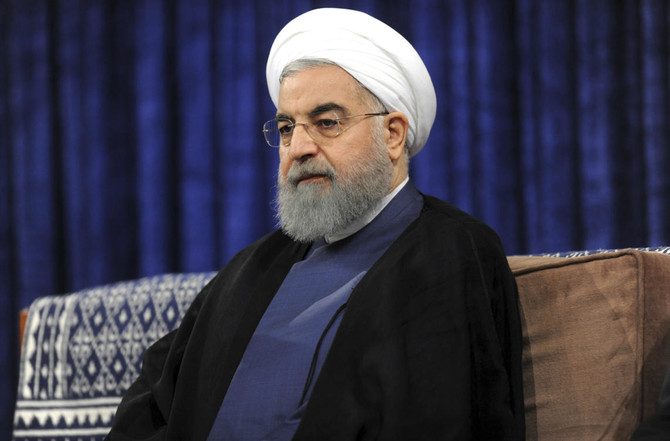
Iranian President Hassan Rouhani. (AP)
Updated 04 August 2017
Follow

Rouhani begins new term as Iran president a day after fresh sanctions

TEHRAN: Iran said Thursday that new US sanctions were a violation of its nuclear deal with world powers, piling pressure on President Hassan Rouhani as he starts his second term.
Rouhani vowed to keep up his efforts to end Iran’s isolation as he was sworn in by the Islamic republic’s supreme leader Ayatollah Ali Khamenei following his re-election in May.
But the ceremony came less than 24 hours after US President Donald Trump confirmed fresh sanctions against Iran.
Tehran says the new measures violate its 2015 deal with world powers that eased sanctions in exchange for curbs on its nuclear program, an agreement which Trump has repeatedly threatened to tear up.
“We believe that the nuclear deal has been violated and we will react appropriately,” Deputy Foreign Minister Abbas Araghchi said on state television.
“We will certainly not fall into the trap of US policy and Trump, and our reaction will be very carefully considered.”
The mounting crisis creates a difficult situation for Rouhani, a 68-year-old moderate who won a second four-year term largely thanks to his efforts to repair relations with the West.
“We will never accept isolation,” Rouhani said as he was sworn in in front of top political and military officials.
“The nuclear deal is a sign of Iran’s goodwill on the international stage.”
Khamenei took a tougher line, saying Iran must not fall for Washington’s “tricks.”
“The enemy’s hostility has made us more resistant,” the supreme leader said.
Iranian officials say they have prepared a 16-point document for how they will respond to the new sanctions, without giving details.
The new parliament will also vote on a bill boosting financial support to the Revolutionary Guards and the country’s missile program, which are targeted by the sanctions.
For Rouhani, who had hoped his second term would focus on rebuilding the stagnant economy, “it’s unfortunate timing,” said Ellie Geranmayeh, an Iran analyst with the European Council on Foreign Relations.
“What will be absolutely critical is how the Europeans position themselves,” she said.
Britain, France and Germany — who signed the deal alongside Russia, China and the United States — remain firm backers of the agreement and are eagerly seeking to rebuild trade ties with Iran despite logistical problems caused by US sanctions.
French energy giant Total defied US pressure in July by signing a multi-billion-dollar gas deal with Iran.
“What Iranians are banking on at the moment, maybe overestimating, is that Europe will safeguard and build on the deal, and make it too politically costly for Trump to tear it up, or at least show Washington that if it walks away, it will be doing so alone,” said Geranmayeh.
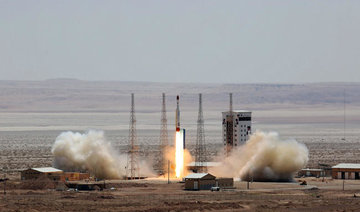
But the Europeans do oppose Iran’s recent missile tests, with the French foreign ministry stating Thursday that they “contradict” UN Resolution 2231 which oversees the nuclear deal, and “constitute a potential threat to stability and security in the region.”
They have been careful to avoid claims that Iran is “violating” any agreements, since the UN resolution only “urged” Iran to refrain from missile tests.
Everyone agrees that Iran has stuck to its central commitments regarding its nuclear program — including, reluctantly, the Trump administration.
But with Iran gaining the upper hand across the Middle East, through support for proxies in Syria, Lebanon and Iraq, US lawmakers appear determined to ratchet up tensions.
Meanwhile, Rouhani also faces challenges at home.
Since the election, he has engaged in a war of words with the Revolutionary Guards over their outsized role in the economy — although they have since sought to bury the hatchet with a public show of unity.
Meanwhile, reformist allies are angry over news that he will unveil another all-male cabinet.
Much of Rouhani’s popularity has been built on his promise of greater civil liberties, including more rights for women, but Iran has still had only one female cabinet member since the 1979 revolution — ironically under hard-liner Mahmoud Ahmadinejad.
The government line-up is due to be officially unveiled on Saturday at a high-profile inauguration ceremony in Parliament in the presence of foreign guests, including EU foreign policy chief Federica Mogherini.


Saad Hariri pledges to contest May election

Updated 15 sec ago
Follow

Saad Hariri pledges to contest May election

  • Beirut rally draws large crowds on anniversary of his father’s assassination

BEIRUT: Lebanon’s former Prime Minister Saad Hariri announced on Saturday that his movement, which represents the majority of Lebanon’s Sunni community, would take part in upcoming parliamentary elections scheduled for May.

The Future Movement had suspended its political activities in 2022.

Hariri was addressing a large gathering of Future Movement supporters as Lebanon marked the 21st anniversary of the assassination of his father and former Prime Minister Rafik Hariri, at Martyrs’ Square in front of his tomb.

He said his movement remained committed to the approach of “moderation.”

A minute’s silence was observed by the crowd in Martyrs’ Square at the exact time when, in 2005, a suicide truck carrying about 1,000 kg of explosives detonated along Beirut’s seaside road as Rafik Hariri’s motorcade passed, killing him along with 21 others, including members of his security guards and civilians, and injuring 200 people.

Four members of Hezbollah were accused of carrying out the assassination and were tried in absentia by the Special Tribunal for Lebanon.

The crowd waved Lebanese flags and banners of the Future Movement as they awaited Saad Hariri, who had returned to Beirut from the UAE, where he resides, specifically to commemorate the anniversary, as has been an annual tradition.

Hariri said that “after 21 years, the supporters of Hariri’s approach are still many,” denouncing the “rumors and intimidation” directed at him.

He added: “Moderation is not hesitation … and patience is not weakness. Rafik Hariri’s project is not a dream that will fade. He was the model of a statesman who believed, until martyrdom, that ‘no one is greater than their country.’ The proof is his enduring place in the minds, hearts and consciences of the Lebanese people.”

Hariri said he chose to withdraw from political life after “it became required that we cover up failure and compromise the state, so we said no and chose to step aside — because politics at the expense of the country’s dignity and the project of the state has no meaning.”

He said: “The Lebanese are weary, and after years of wars, divisions, alignments and armed bastions, they deserve a normal country with one constitution, one army, and one legitimate authority over weapons — because Lebanon is one and will remain one. Notions of division have collapsed in the face of reality, history and geography, and the illusions of annexation and hegemony have fallen with those who pursued them, who ultimately fled.”

Hariri said the Future Movement’s project is “One Lebanon, Lebanon first — a Lebanon that will neither slide back into sectarian strife or internal fighting, nor be allowed to do so.”

He added that the Taif Agreement is “the solution and must be implemented in full,” arguing that “political factions have treated it selectively by demanding only what suits them — leaving the agreement unfulfilled and the country’s crises unresolved.”

He said: “When we call for the full implementation of the Taif Agreement, we mean: weapons exclusively in the hands of the state, administrative decentralization, the abolition of political sectarianism, the establishment of a senate and full implementation of the truce agreement. All of this must be implemented — fully and immediately — so we can overcome our chronic problems and crises together.

“Harirism will continue to support any Arab rapprochement, and reject any Arab discord. Those who seek to sow discord between the Gulf and Arab countries will harm only themselves and their reputation.

“We want to maintain the best possible relations with all Arab countries, starting with our closest neighbor, Syria — the new Syria, the free Syria that has rid itself of the criminal and tyrannical regime that devastated it and Lebanon, and spread its poison in the Arab world.”

Hariri said he saluted “the efforts of unification, stabilization and reconstruction led by Syrian President Ahmad Al-Sharaa.”

When asked about the Future Movement’s participation in parliamentary elections following his withdrawal from politics, he said: “Tell me when parliamentary elections will be held, and I will tell you what the Future Movement will do. I promise you that, when the elections take place, they will hear our voices, and they will count our votes.”

The US Embassy in Lebanon shared a post announcing that Ambassador Michel Issa laid a wreath at the grave of Rafik Hariri.

Hariri’s legacy “to forge peace and prosperity continues to resonate years later with renewed significance,” the embassy said.