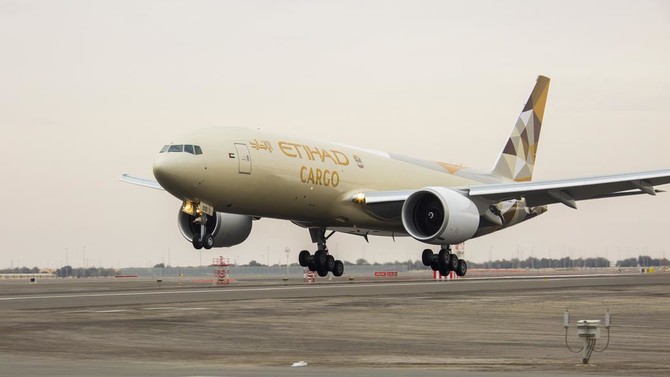
DUBAI: Middle East carriers’ share of freight volumes flow during the first half fell for the first time in 17 years, the International Air Transport Association (IATA) said on Wednesday.
The regional carriers’ shared dipped slightly to 13.9 percent, from 14 percent last year, IATA said.
Freight volumes rose 3.7 percent year-on-year, while capacity increased by 1.5 percent in the first half of 2017.
Regional freight demand, measured in freight ton kilometers, rose by 7.6 percent year-on-year in the first half, but below the 10.8 percent average annual rate over the past five years,
“The slowdown in growth is mainly due to strong competition from carriers in other regions particularly on the Asia-Europe route rather than a significant decrease in demand which has continued to trend upwards at a solid rate of around 10 percent in annualized terms since early 2017,” Iata said in its statement.
“The region’s carriers have not seen the strong pick-up in the seasonally adjusted traffic trend that has been apparent in the major regions over the past year or so,” it added.
Globally, Iata said that freight demand went up 10.4 percent in the first, half, the strongest first-half year since the air cargo industry’s recovery from the 2010 global financial crisis and nearly triple the industry’s average growth rate of 3.9 percent over the last five years.
Freight capacity, measured in available freight ton kilometers, grew by 3.6 percent in the first half of 2017, from year-ago levels.
Demand growth continues to significantly outstrip capacity growth, which is positive for yields, the Geneva based group said.
“Air cargo is flying high on the back of a stronger global economy. Demand is growing at a faster pace than at any time since the Global Financial Crisis. That’s great news after many years of stagnation. And, even more importantly, the industry is taking advantage of this momentum to accelerate much-needed process modernization and improve the value it provides to its many customers,” said Alexandre de Juniac, IATA’s Director General and CEO.


![]()
Middle East carriers’ share of international freight volumes falls — IATA
Middle East carriers’ share of international freight volumes falls — IATA

Latest updates


Recommended


© 2026 SAUDI RESEARCH & PUBLISHING COMPANY, All Rights Reserved And subject to Terms of Use Agreement.