Doha launches WTO complaint against trade boycott

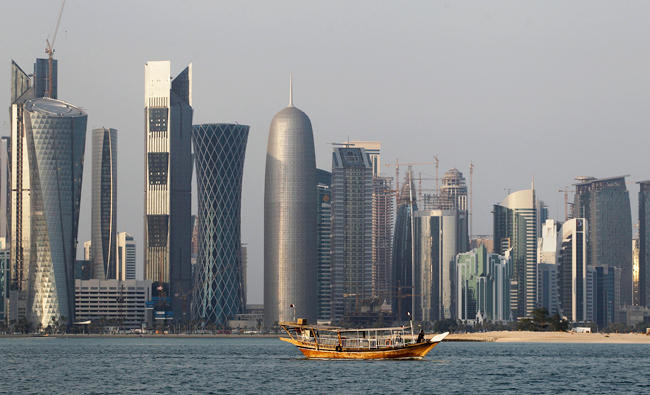
A traditional dhow floats in the Corniche Bay of Doha, Qatar, with tall buildings of the financial district in the background. Qatar has filed a complaint with the World Trade Organization against four Arab countries that have launched a trade boycott against it. (AP Photo/Saurabh Das, File)
Updated 01 August 2017
Follow

Doha launches WTO complaint against trade boycott

GENEVA: Qatar filed a wide-ranging legal complaint at the World Trade Organization (WTO) on Monday to challenge a trade boycott by Saudi Arabia, Bahrain and United Arab Emirates (UAE), the director of Qatar’s WTO office Ali Alwaleed Al-Thani told Reuters.
Qatar triggered a 60-day deadline for the Quartet to settle the complaint.
The Anti Terror Quartet cut ties with Qatar — a major global gas supplier and host to the biggest US military base in the Middle East — on June 5, accusing it of financing militant groups in Syria, and allying with Iran.
The Quartet have previously told the WTO that it would cite national security to justify its actions against Qatar. It said on Sunday it was ready for talks to tackle the dispute if Doha showed willingness to deal with their demands.
The complaints against Saudi Arabia and the UAE run to eight pages each, while the document on Bahrain is six pages.
The WTO suit does not include Egypt, the fourth country involved in the boycott. Although it has also cut travel and diplomatic ties with Qatar, Egypt did not expel Qatari citizens or ask Egyptians to leave Qatar.
The trade restrictions include bans on trade through Qatar’s ports and travel by Qatari citizens, blockages of Qatari digital services and websites, closure of maritime borders and prohibition of flights operated by Qatari aircraft.
The complaint does not put a value on the trade boycott, and Al-Thani declined to estimate how much Qatar could seek in sanctions if the litigation ever reached that stage, which can take 2-5 years or longer in the WTO system.


Gaza families struggle to recover from days of torrential rains that killed 12 people

Updated 16 December 2025
Follow

Gaza families struggle to recover from days of torrential rains that killed 12 people

  • The downpour, which dumped more than 150 milliliters (9 inches) of rain on some parts of Gaza over the past week, turned dirt lanes to mud and flooded tents in camps for displaced people

DEIR AL-BALAH, Gaza Strip: Palestinians in Gaza struggled to recover Tuesday from torrential rains that battered the enclave for days, flooding camps for the displaced, collapsing buildings already badly damaged in the two-year war and leaving at least 12 dead, including a two-week-old baby.
The downpour, which dumped more than 150 milliliters (9 inches) of rain on some parts of Gaza over the past week, turned dirt lanes to mud and flooded tents in camps for displaced people.
The Gaza Health Ministry, part of the Hamas-run government, said Tuesday the two-week-old died of hypothermia as a result of the weather. The baby was brought to the hospital a few days ago and was transferred to intensive care but died on Monday.
In Gaza City, a man died Tuesday after a home already damaged during Israeli strikes, collapsed because of the heavy rainfall, according to Shifa Hospital.
Members of the Al-Hosari family said 30 people lived in the building, but just nine were home when it collapsed. The man who was killed was a worker who had come to fix the walls, they said. Five people were injured.
The Health Ministry said the remaining 10 people were killed last week, also from buildings collapsing from the rain and heavy winds.
Emergency workers warned people not to congregate in damaged buildings due to concerns of collapse, though so much of the territory has been reduced to rubble, there are few places to escape the rain. In July, the United Nations Satellite Center estimated that almost 80 percent of the buildings in Gaza have been destroyed or damaged.
“When we hear the news that there is a storm, our whole lives change, we start thinking about where to stay, to go, where to put our mattresses and blankets, and where to keep our children safe and warm,” said Mohammed Gharableh, a father displaced from the southern city of Rafah.
“During every storm like this, water penetrates our tents, and our mattresses and blankets get soaked,” he added.
In Israel, areas near Gaza received between 60 mm to 160 mm (2 to 6 inches) of rain in the past week, according to the Israel Meteorological Service, which in some cases is more than twice the average amount of rain for this time of year.
Aid groups say despite two months of a ceasefire, not enough shelter material has been getting into Gaza to help Palestinians deal with the winter. Recently released Israeli military figures suggest it hasn’t met the ceasefire stipulation of allowing 600 trucks of aid into Gaza a day, though Israel disputes that finding.
The vast majority of Gaza’s 2 million people have been displaced, and most people live in vast tent camps stretching along the coast, or set up among the shells of damaged buildings. The buildings lack adequate flooding infrastructure and people use cesspits dug near tents as toilets.
The Israeli military body in charge of coordinating aid to Gaza, called COGAT, said close to 270,000 tents and tarps have entered Gaza over the past few months as well as winter items, shelter equipment, and sanitation supplies.
But some aid groups disputed the figures and said more supplies, especially winter items, are desperately needed.
Shelter Cluster, an international coalition of aid providers led by the Norwegian Refugee Council, last week said it has tracked just 68,000 tents that have entered Gaza via the UN, non-governmental organizations, and various countries. Many of the tents aren’t properly insulated for winter, it says.