SRINAGAR, India: Large anti-India protests and clashes spearheaded mostly by students erupted in disputed Kashmir on Tuesday after government forces killed two senior militants in a gunbattle and fatally shot a protester during an ensuing demonstration demanding an end to Indian rule.
The protests following the killings spread across the region and were led mostly by students, after which authorities ordered the closure of educational institutions.
Police Inspector-General Muneer Ahmed Khan said the two militants were killed after police and soldiers on a tip cordoned off southern Hakripora village early Tuesday.
Khan said the trapped militants fired at the troops, triggering a gunbattle, which lasted at least two hours.
Villagers said troops blasted two civilian homes with explosives during the operation.
As the gunbattle raged, residents defied the security lockdown and clashed with government forces near the site of the fighting in an attempt to help the trapped militants escape.
A young man was killed and scores of others were injured in the clashes in the village.
Large protests and clashes against Indian rule spread to several other places across Kashmir, including the Himalayan region’s main city of Srinagar, as students boycotted classes and hit the streets.
Chanting pro-rebel slogans and demanding the end of Indian rule, the students hurled rocks at government forces after being stopped outside schools and colleges.
Troops fired shotgun pellets and tear gas, leading to pitched battles, including in Srinagar’s main commercial hub, where streets were strewn with rocks and broken bricks and the stench of tear gas filled the air.
Dozens more were injured in subsequent clashes.
Authorities closed all educational institutions for a day as a “precautionary measure,” said Baseer Khan, a top civilian administrator.
Officials also blocked Internet service in the region to stop activists from using social media to rally support against Indian rule.
Police described one of the slain militants as a top commander of the Pakistan-based militant group Lashkar-e-Taiba and identified him as Abu Dujana. India blames the group for a 2008 attack that left 166 people dead in India’s commercial capital of Mumbai.
The police inspector-general described the rebel commander’s death as “good riddance to a nuisance” and said counterinsurgency operations would continue despite civilian protests.
In recent years, Kashmiris, mainly youths, have displayed open solidarity with anti-India rebels and sought to protect them by engaging troops in street clashes during military operations against the militants. The anti-India protests and clashes have persisted despite the Indian army chief warning recently that “tough action” would be taken against stone throwers during counterinsurgency operations.
Nuclear-armed rivals India and Pakistan each administer part of Kashmir, but both claim the Himalayan territory in its entirety. Rebel groups have been fighting since 1989 for the Indian-administered portion to become independent or merge with Pakistan. Nearly 70,000 people have been killed in the uprising and the ensuing Indian military crackdown.
Anti-India sentiment runs deep in Kashmir’s mostly Muslim population and most people support the rebels’ cause against Indian rule.
India accuses Pakistan of arming and training the rebels, which Pakistan denies.
Rebel groups have largely been suppressed by Indian forces in recent years and public opposition to Indian rule is now principally expressed through street protests.


Protests in Kashmir after rebels, civilian killed
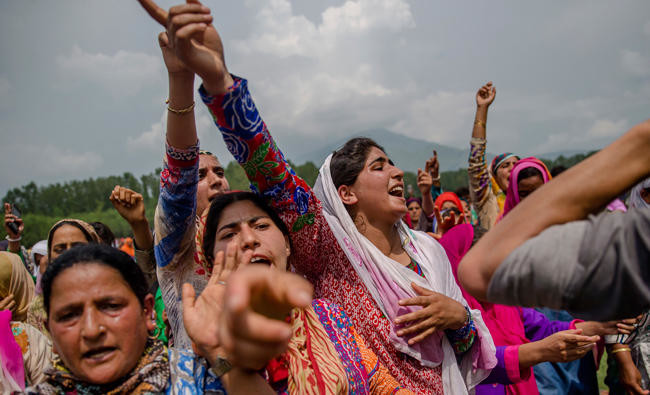
Protests in Kashmir after rebels, civilian killed

94 million need cataract surgery, but access lacking: WHO
- Of the 94 million affected, fewer than 20 percent are blind, while the rest suffer from impaired vision
GENEVA: More than 94 million people suffer from cataracts, but half of them do not have access to the surgery needed to fix it, the World Health Organization said Wednesday.
Cataracts — the clouding of the eye’s lens that causes blurred vision and can lead to blindness — are on the rise as populations get older, with age being the main risk factor.
“Cataract surgery — a simple, 15-minute procedure — is one of the most cost-effective medical procedures, providing immediate and lasting restoration of sight,” the WHO said.
It is one of the most frequently performed surgeries undertaken in high-income countries.
However, “half of the world’s population in need of cataract surgery don’t have access to it,” said Stuart Keel, the UN health agency’s technical lead for eye care.
The situation is worst in the WHO’s Africa region, where three in four people needing cataract surgery remain untreated.
In Kenya, at the current rate, 77 percent of people needing cataract surgery are likely to die with their cataract blindness or vision impairment, said Keel.
Across all regions, women consistently experience lower access to care than men.
Of the 94 million affected, fewer than 20 percent are blind, while the rest suffer from impaired vision.
- 2030 vision -
The WHO said that over the past two decades, global cataract surgery coverage had increased by 15 percent.
In 2021, WHO member states set a target of a 30-percent increase by 2030.
However, current modelling predicts that cataract surgery coverage will rise by only about 8.4 percent this decade.
To close the gap, the WHO urged countries to integrate eye examinations into primary health care and invest in the required surgical equipment.
States should also expand the eye-care workforce, training surgeons in a standardised manner and then distributing them throughout the country, notably outside major cities.
The WHO was on Wednesday launching new guidance for countries on how to provide quality cataract surgery services.
It will also issue guidance to help support workforce development.
Keel said the main issue was capacity and financing.
“We do need money invested to get rid of this backlog, which is nearly 100 million people,” he told a press conference.
While age is the primary risk factor for cataracts, others include prolonged UV-B light exposure, tobacco use, prolonged corticosteroid use and diabetes.
Keel urged people to keep up regular eye checks as they get older, with most problems able to be either prevented or diagnosed and treated.
The cost of the new lens that goes inside the eye can be under $100.
However, out-of-pocket costs can be higher when not covered by health insurance.
“Cataract surgery is one of the most powerful tools we have to restore vision and transform lives,” said Devora Kestel, head of the WHO’s noncommunicable diseases and mental health department.
“When people regain their sight, they regain independence, dignity, and opportunity.”


