BEIJING: Chinese President Xi Jinping issued a tough line on national sovereignty Tuesday amid multiple territorial disputes with his country’s neighbors, saying China will never permit the loss of “any piece” of its land to outsiders.
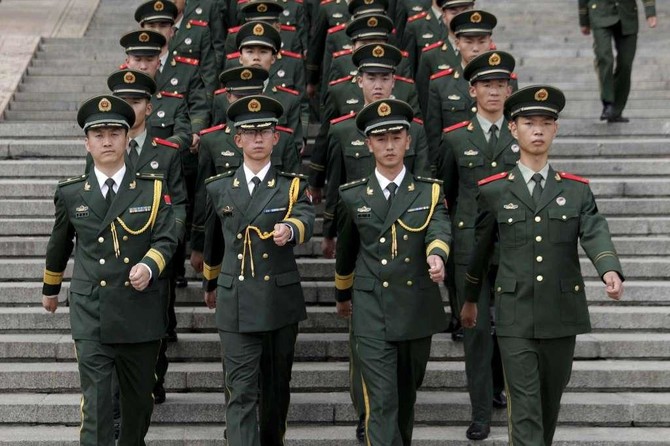
Xi’s declaration came during a nearly one-hour speech in Beijing marking the 90th anniversary of the founding of the People’s Liberation Army, which has formed a key pillar of support for the ruling Communist Party since 1927 and is the world’s largest standing military, with 2.3 million members.
“The Chinese people treasure peace and we absolutely do not engage in invasion and expansion. However, we have the confidence to conquer all forms of invasion,” Xi told government leaders and current and retired PLA members gathered at the hulking Great Hall of the People, the seat of the legislature that sits beside Tiananmen Square.
“We absolutely will not permit any person, any organization, any political party — at any time, in any form — to separate any piece of Chinese territory from China,” Xi said to applause. “No one should expect us to swallow the bitter fruit of damage to our sovereignty, security and development interests.”
Xi made no reference to any specific conflicts or disputes during his address, which focused largely on the PLA’s growth from a scrappy guerrilla force fighting Chiang Kai-shek’s Nationalists and Japanese invaders into one of the world’s most powerful, if largely untested, militaries.
However, China is currently engaged in a weeks-long border standoff with Indian forces near the countries’ disputed border high in the Himalayas, with Chinese spokesmen demanding that Indian troops withdraw to avoid a clash potentially worse than the brief but bloody war the two fought in the region in 1962.
China has also long been embroiled in a contest with Japan over East China Sea islands, as well as with five other governments over competing claims to territory in the strategically vital South China Sea. Beijing also threatens to use force to conquer Taiwan if peaceful enticements prove insufficient. China considers the self-governing democratic island Chinese territory.
In his speech, Xi also emphasized that the military’s highest loyalty is to the ruling Communist Party, underscoring the PLA’s key role as regime preserver through crises such as the bloody suppression of 1989 pro-democracy protests at Tiananmen Square. Top Chinese leaders have consistently rejected calls to make the PLA loyal to the government and people instead.
“The people’s army will resolutely safeguard the leadership of the Chinese Communist Party and our country’s socialist system, resolutely safeguard national sovereignty, security and development interests, and resolutely safeguard regional and world peace,” Xi said.
The speech followed a parade Sunday at a training ground on the edge of the Gobi Desert during which Xi donned fatigues and declared that the military has the “confidence and capability” to ensure China’s sovereignty, security and national interests.
Xi, who commands the PLA as chairman of the Central Military Commission, has frequently spoken of his “China Dream” to restore China to a leadership position in international affairs with a modern, far-reaching military force to match.
The parade at the Zhurihe base in Inner Mongolia featured troops and advanced weaponry, and was another forceful indication of Xi’s iron grip over the PLA and every other political power base within the party ahead of a pivotal congress this autumn that will award him a second five-year term as leader.
That followed similarly high-profile military reviews in Beijing in 2015 and Hong Kong in June. Last week, Xi bestowed newly created “Aug. 1” honors on servicemen in a further elevation of the armed forces’ stature.
Xi and his predecessors engineered a radical upgrading of the PLA’s capabilities through years of double-digit percentage increases in the defense budget, making China the world’s second-largest military spender after the United States, although growth has slowed alongside a cooling of the overall economy.
That has also spurred a global role for the PLA, which was formerly overwhelmingly preoccupied with securing China’s territorial integrity.
Alongside its blue-water navy, China is building its first overseas military base in the Horn of Africa nation of Djibouti, and Chinese ships held drills last month with Russia’s navy in the Baltic Sea, more than 10,000 kilometers (6,000 miles) from their home ports.

Xi says China will never permit loss of ‘any piece’ of land
Somali president to Asharq Al-Awsat: Working with Saudi-led partners to void Israel’s Somaliland recognition
- Hassan Sheikh Mohamud unveils three-pronged diplomatic and legal strategy to defend Somalia’s sovereignty and territorial unity
- Says Mogadishu coordinates with Saudi Arabia and Arab, African partners to counter what he calls a dangerous precedent
RIYADH: Somali President Hassan Sheikh Mohamud unveiled a three-pronged political and legal strategy to nullify what he described as Israeli recognition of the breakaway region of Somaliland, warning that such a move threatens Somalia’s sovereignty and regional stability.
Speaking to Asharq Al-Awsat, Mohamud said his government is acting in close coordination with partners led by Saudi Arabia to safeguard stability and shield the Horn of Africa from what he called “reckless escalation.”
Without naming specific countries, the Somali leader said some regional states may see the Israeli recognition as an opportunity to pursue “narrow, short-term interests at the expense of Somalia’s unity and regional stability.”
“I do not wish to name any particular country or countries,” he said. “But it is clear that some may view this recognition as a chance to achieve limited gains.”
He stressed that Somalia’s unity is a “red line,” adding that Mogadishu has taken firm positions to protect national sovereignty. “We warn against being misled by reckless Israeli adventurism,” he said.
Mohamud was referring to recognition announced by Israeli Prime Minister Benjamin Netanyahu of the self-declared Republic of Somaliland as an independent state.
“I affirm with the utmost clarity and firmness that any recognition of Somaliland as an independent state constitutes a blatant violation of the sovereignty and unity of the Federal Republic of Somalia,” he said.
He described the move as a grave breach of international law, the UN Charter, and African Union resolutions that uphold respect for inherited African borders.
On that basis, Somalia has adopted and will continue to pursue three parallel measures, he revealed.
The first involves immediate diplomatic action through the UN, African Union, and Organization of Islamic Cooperation to reject and legally and politically invalidate the recognition.
Mohamud said Somalia called for and secured a formal session at the UN Security Council to address what he termed a “flagrant Israeli violation” of Somalia’s sovereignty and territorial integrity.
The session, he said, marked a significant diplomatic victory for Mogadishu, particularly given Somalia’s current membership on the council.
He expressed “deep appreciation” for statements of solidarity and condemnation issued by the African Union, Arab League, OIC, Gulf Cooperation Council, Intergovernmental Authority on Development (IGAD), and the EU, among others.
The second step centers on coordinating a unified Arab, Islamic, and African position. Mohamud praised Saudi Arabia for being among the first to issue a clear statement rejecting any infringement on Somalia’s unity.
He said the Saudi position reflects the Kingdom’s longstanding commitment to state sovereignty and territorial integrity, reinforced by the Saudi cabinet’s “firm and principled” support for Somalia during what he described as a delicate moment.
The third step focuses on strengthening internal national dialogue to address political issues within the framework of a single Somali state, free from external interference or dictates.
Mohamud warned that if left unchecked, the recognition could set a “dangerous precedent and undermine regional and international peace and security.”
He said it could embolden separatist movements not only in the Horn of Africa but across Africa and the Arab world, citing developments in countries such as Sudan and Yemen as evidence of the high cost of state fragmentation.
“This concerns a vital global shipping artery and core Arab national security,” he said, referring to the Red Sea.
“Any political or security tension along Somalia’s coast will directly affect international trade and energy security.”
He added that instability would impact Red Sea littoral states, particularly Saudi Arabia, Egypt, Sudan, Eritrea, Yemen, and Jordan. “Preserving Somalia’s unity is a cornerstone of collective Red Sea security,” he said.
Mohamud argued that Israel’s objective goes beyond political recognition.
“We believe the goal extends beyond a political gesture,” he told Asharq Al-Awsat. “It includes seeking a strategic foothold in the Horn of Africa near the Red Sea, enabling influence over the Bab Al-Mandeb Strait and threatening the national security of Red Sea states.”
He described the move as a test of Somali, Arab, and African resolve on issues of sovereignty and territorial unity, emphasizing that Somalia’s opposition to secession is a principled and enduring national stance supported widely in the Arab and African worlds, “foremost by Saudi Arabia.”
He rejected any attempt to turn Somalia into a battleground for regional or international rivalries. “We will not allow Somalia to become an arena for settling conflicts that do not serve our people’s interests or our region’s security,” he declared.
Regarding Saudi-Somali relations, Mohamud described the partnership as “deep-rooted and strategic, rooted in shared history, religion, and a common destiny.” Saudi Arabia, he said, “remains a central partner in supporting Somalia’s stability, reconstruction, development, and Red Sea security.”
He voiced admiration for Saudi Arabia’s Vision 2030 and the economic and development gains achieved under the leadership of Custodian of the Two Holy Mosques King Salman bin Abdulaziz and Prince Mohammed bin Salman, Crown Prince and Prime Minister.
Asked about the recent Saudi Cabinet decision rejecting any attempt to divide Somalia, Mohamud said the federal government received it with “great appreciation and relief.”
He said the position extends the Kingdom’s historic support for Somalia’s territorial unity and sovereignty, reinforces regional stability, and sends an important message to the international community on the need to respect state sovereignty and refrain from interference in internal affairs.