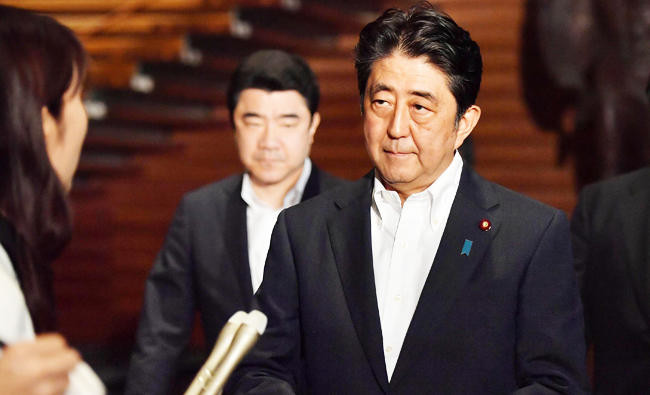
TOKYO: Japanese Prime Minister Shinzo Abe spoke with US President Donald Trump on Monday and agreed on the need for further action on North Korea just hours after the US Ambassador to the United Nations said the United States is “done talking about North Korea.”
Nikki Haley, US Ambassador to the United Nations, said in a statement that China must decide if it is willing to back imposing stronger UN sanctions on North Korea over Friday night’s long-range missile test, the second this month.
Any new UN Security Council resolution “that does not significantly increase the international pressure on North Korea is of no value,” Haley said, adding that Japan and South Korea also needed to do more.
Abe told reporters following his conversation with Trump that repeated efforts by the international community to find a peaceful solution to the North Korean issue had yet to bear fruit in the face of Pyongyang’s unilateral “escalation” of the situation.
“International society, including Russia and China, need to take this seriously and increase pressure,” Abe said, adding that the two nations would take steps toward concrete action but did not give details.
Abe and Trump did not discuss military action against North Korea, nor what would constitute the crossing of a “red line” by Pyongyang, Deputy Chief Cabinet spokesman Koichi Hagiuda told reporters.
North Korea said on Saturday it had conducted another successful test of an intercontinental ballistic missile that proved its ability to strike the US mainland, drawing a sharp warning from Trump and a rebuke from China.
Trump later wrote on Twitter that he was “very disappointed” in China and that Beijing had done “nothing” for the United States in regards to North Korea, something he would not allow to continue.
China has yet to officially respond to Trump’s tweet, but State-run Chinese tabloid the Global Times said in a Monday editorial that Trump’s “wrong tweet” was of no help to resolving the situation, and that he did not understand the issues.
“Pyongyang is determined to develop its nuclear and missile program and does not care about military threats from the US and South Korea. How could Chinese sanctions change the situation?” the paper, published by the ruling Communist Party’s official People’s Daily, added.
South Korean President Moon Jae-in, who is on vacation, planned to have a phone call with Trump soon, a senior official at the Presidential Blue House said.
“If the two heads of state talk, they will likely discuss their respective stances on North Korea, the US-(South Korea’s) alliance’s standpoint on North Korea and other things including how to impose heavy sanctions.”
The United States flew two supersonic B-1B bombers over the Korean peninsula in a show of force on Sunday in response to the missile test and the July 3 launch of the “Hwasong-14” rocket, the Pentagon said. The bombers took off from a US air base in Guam, and were joined by Japanese and South Korean fighter jets during the exercise.
“North Korea remains the most urgent threat to regional stability,” Pacific Air Forces commander General Terrence J. O’Shaughnessy said in a statement.
“If called upon, we are ready to respond with rapid, lethal, and overwhelming force at a time and place of our choosing.”

US says time for China to act on N.Korea, Japan’s Abe talks to Trump
Privacy activists call on California to remove covert license plate readers
- Groups believe gadgets feed data into a controversial US Border Patrol predictive domestic intelligence program
- An algorithm flags vehicles deemed suspicious based on where they came from, where they were going and which route they took
More than two dozen privacy and advocacy organizations are calling on California Gov. Gavin Newsom to remove a network of covert license plate readers deployed across Southern California that the groups believe feed data into a controversial US Border Patrol predictive domestic intelligence program that scans the country’s roadways for suspicious travel patterns.
“We ask that your administration investigate and release the relevant permits, revoke them, and initiate the removal of these devices,” read the letter sent Tuesday by the Electronic Frontier Foundation, Imperial Valley Equity and Justice and other nonprofits.
An Associated Press investigation published in November revealed that the US Border Patrol, an agency under US Customs and Border Protection, had hidden license plate readers in ordinary traffic safety equipment. The data collected by the Border Patrol plate readers was then fed into a predictive intelligence program monitoring millions of American drivers nationwide to identify and detain people whose travel patterns it deems suspicious.
AP obtained land use permits from Arizona showing that the Border Patrol went to great lengths to conceal its surveillance equipment in that state, camouflaging it by placing it inside orange and yellow construction barrels dotting highways.
The letter said the groups’ researchers have identified a similar network of devices in California, finding about 40 license plate readers in San Diego and Imperial counties, both of which border Mexico. More than two dozen of the plate readers identified by the groups were hidden in construction barrels.
They could not determine of the ownership of every device, but the groups said in the letter that they obtained some permits from the California Department of Transportation, showing both the Border Patrol and Drug Enforcement Administration had applied for permission to place readers along state highways. DEA shares its license plate reader data with Border Patrol, documents show.
The letter cited the AP’s reporting, which found that Border Patrol uses a network of cameras to scan and record vehicle license plate information. An algorithm flags vehicles deemed suspicious based on where they came from, where they were going and which route they took. Agents appeared to be looking for vehicles making short trips to the border region, claiming that such travel is indicative of potential drug or human smuggling.
Federal agents in turn sometimes refer drivers they deem suspicious to local law enforcement who make a traffic stop citing a reason like speeding or lane change violations. Drivers often have no idea they have been caught up in a predictive intelligence program being run by a federal agency.
The AP identified at least two cases in which California residents appeared to have been caught up in the Border Patrol’s surveillance of domestic travel patterns. In one 2024 incident described in court documents, a Border Patrol agent pulled over the driver of a Nissan Altima based in part on vehicle travel data showing that it took the driver six hours to travel the approximately 50 miles between the US-Mexican border and Oceanside, California, where the agent had been on patrol.
“This type of delay in travel after crossing the International Border from Mexico is a common tactic used by persons involved in illicit smuggling,” the agent wrote in a court document.
In another case, Border Patrol agents said in a court document in 2023 they detained a woman at an internal checkpoint because she had traveled a circuitous route between Los Angeles and Phoenix. In both cases, law enforcement accused the drivers of smuggling immigrants in the country unlawfully and were seeking to seize their property or charge them with a crime.
The intelligence program, which has existed under administrations of both parties, has drawn scrutiny from lawmakers since the AP revealed its existence last year.
A spokesperson for the California Department of Transportation said state law prioritizes public safety and privacy.
The office of Newsom, a Democrat, did not immediately respond to requests for comment.
Courts have generally upheld license plate reader collection on public roads but have curtailed warrantless government access to other kinds of persistent tracking data that might reveal sensitive details about people’s movements, such as GPS devices or cellphone location data. Some scholars and civil libertarians argues that large-scale collection systems like plate readers might be unconstitutional under the Fourth Amendment.
“Increasingly, courts have recognized that the use of surveillance technologies can violate the Fourth Amendment’s protections against unreasonable searches and seizures. Although this area of law is still developing, the use of LPRs and predictive algorithms to track and flag individuals’ movements represents the type of sweeping surveillance that should raise constitutional concerns,” the organizations wrote.
CBP did not immediately respond to a request for comment, but previously said the agency uses plate readers to help identify threats and disrupt criminal networks and their use of the technology is “governed by a stringent, multi-layered policy framework, as well as federal law and constitutional protections, to ensure the technology is applied responsibly and for clearly defined security purposes.”
The DEA said in a statement that the agency does not publicly discuss its investigative tools and techniques.
“We ask that your administration investigate and release the relevant permits, revoke them, and initiate the removal of these devices,” read the letter sent Tuesday by the Electronic Frontier Foundation, Imperial Valley Equity and Justice and other nonprofits.
An Associated Press investigation published in November revealed that the US Border Patrol, an agency under US Customs and Border Protection, had hidden license plate readers in ordinary traffic safety equipment. The data collected by the Border Patrol plate readers was then fed into a predictive intelligence program monitoring millions of American drivers nationwide to identify and detain people whose travel patterns it deems suspicious.
AP obtained land use permits from Arizona showing that the Border Patrol went to great lengths to conceal its surveillance equipment in that state, camouflaging it by placing it inside orange and yellow construction barrels dotting highways.
The letter said the groups’ researchers have identified a similar network of devices in California, finding about 40 license plate readers in San Diego and Imperial counties, both of which border Mexico. More than two dozen of the plate readers identified by the groups were hidden in construction barrels.
They could not determine of the ownership of every device, but the groups said in the letter that they obtained some permits from the California Department of Transportation, showing both the Border Patrol and Drug Enforcement Administration had applied for permission to place readers along state highways. DEA shares its license plate reader data with Border Patrol, documents show.
The letter cited the AP’s reporting, which found that Border Patrol uses a network of cameras to scan and record vehicle license plate information. An algorithm flags vehicles deemed suspicious based on where they came from, where they were going and which route they took. Agents appeared to be looking for vehicles making short trips to the border region, claiming that such travel is indicative of potential drug or human smuggling.
Federal agents in turn sometimes refer drivers they deem suspicious to local law enforcement who make a traffic stop citing a reason like speeding or lane change violations. Drivers often have no idea they have been caught up in a predictive intelligence program being run by a federal agency.
The AP identified at least two cases in which California residents appeared to have been caught up in the Border Patrol’s surveillance of domestic travel patterns. In one 2024 incident described in court documents, a Border Patrol agent pulled over the driver of a Nissan Altima based in part on vehicle travel data showing that it took the driver six hours to travel the approximately 50 miles between the US-Mexican border and Oceanside, California, where the agent had been on patrol.
“This type of delay in travel after crossing the International Border from Mexico is a common tactic used by persons involved in illicit smuggling,” the agent wrote in a court document.
In another case, Border Patrol agents said in a court document in 2023 they detained a woman at an internal checkpoint because she had traveled a circuitous route between Los Angeles and Phoenix. In both cases, law enforcement accused the drivers of smuggling immigrants in the country unlawfully and were seeking to seize their property or charge them with a crime.
The intelligence program, which has existed under administrations of both parties, has drawn scrutiny from lawmakers since the AP revealed its existence last year.
A spokesperson for the California Department of Transportation said state law prioritizes public safety and privacy.
The office of Newsom, a Democrat, did not immediately respond to requests for comment.
Courts have generally upheld license plate reader collection on public roads but have curtailed warrantless government access to other kinds of persistent tracking data that might reveal sensitive details about people’s movements, such as GPS devices or cellphone location data. Some scholars and civil libertarians argues that large-scale collection systems like plate readers might be unconstitutional under the Fourth Amendment.
“Increasingly, courts have recognized that the use of surveillance technologies can violate the Fourth Amendment’s protections against unreasonable searches and seizures. Although this area of law is still developing, the use of LPRs and predictive algorithms to track and flag individuals’ movements represents the type of sweeping surveillance that should raise constitutional concerns,” the organizations wrote.
CBP did not immediately respond to a request for comment, but previously said the agency uses plate readers to help identify threats and disrupt criminal networks and their use of the technology is “governed by a stringent, multi-layered policy framework, as well as federal law and constitutional protections, to ensure the technology is applied responsibly and for clearly defined security purposes.”
The DEA said in a statement that the agency does not publicly discuss its investigative tools and techniques.
© 2026 SAUDI RESEARCH & PUBLISHING COMPANY, All Rights Reserved And subject to Terms of Use Agreement.