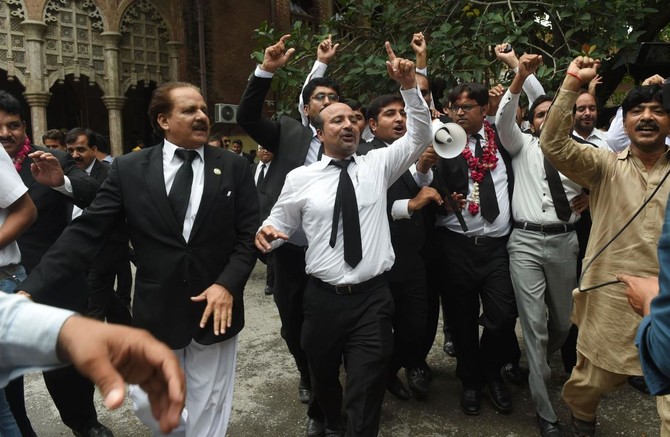
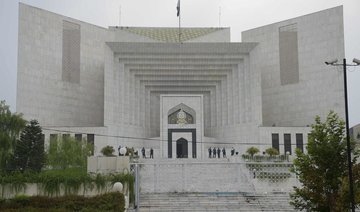
ISLAMABAD: Pakistan Prime Minister Nawaz Sharif has been ousted from power by the Supreme Court, an unceremonious end to his third term in power ahead of general elections next year.
No Pakistani prime minister has ever completed a full five-year term.
Most have seen their tenures cut short by the powerful military or by the Supreme Court. Others have been ousted by their own party, forced to resign — or been assassinated.
Although Sharif has been disqualified as prime minister, he remains the head of the Pakistan Muslim League-Nawaz (PML-N), the largest party in the National Assembly.
As such, Sharif will oversee the nomination of his successor who will then be rubber stamped in a parliamentary vote, where his party and coalition partners command a 209-seat majority in the 342-seat house.
The opposition is also expected to field a candidate for the premiership, though the nominee has almost no chance of getting sufficient votes.
The vote will likely happen in a matter of days — if not hours — of Sharif’s disqualification.
Yes, in 2012 then-prime minister Yousaf Raza Gilani was disqualified over contempt of court charges for refusing to reopen a corruption case against the sitting president Asif Ali Zardari.
After Gilani was ousted by the Supreme Court, President Zardari, the then-head of the ruling Pakistan People’s Party, led the negotiations to find a consensus candidate for the premiership.
Following three days of intense horse-trading within the fractious coalition government, PPP-loyalist Raja Pervaiz Ashraf — a controversial choice also marred by corruption allegations — was eventually elected prime minister by the National Assembly.
In theory, yes — but it is highly unlikely.
Sharif’s legal team could file a review petition but only on very limited grounds, such as a mistake in the judgment.
“The Supreme Court is the interpreter and final arbiter of what the constitution means, so if the Supreme Court says that’s how it’s supposed to be done then for all practical purposes that is what it is,” said constitutional lawyer Yasser Latif Hamdani.
An early election is unlikely because according to the constitution it can only be called by the president on the advice of the prime minister, meaning a successor to Sharif would have to be chosen first.
Elections are currently due in 2018.
The military has been in charge of Pakistan for half of its 70-year history, but few expect the army to make an explicit bid for power again.
The military already exerts control over foreign policy and defense, leading to accusations from some that it is carrying out a “creeping coup”.
“The military doesn’t need to take over because it already enjoys so many trappings of power from behind the scenes,” said Michael Kugelman, deputy director of the Asia Program at the Washington, DC-based Wilson Center.
In addition, Kugelman points out, public opinion in Pakistan does not favor a return to martial law.
“There is also simply not as much of an appetite in Pakistan for military rule as there was in previous years. That’s important for the military because the military is very concerned about its image and public opinion toward the army,” Kugelman said.

What happens now after Pakistan’s PM has been disqualified?
Asia rings in 2026 with Australia hosting defiant celebration after mass shooting
- Australia holds defiant celebrations after its worst mass shooting in nearly 30 years
- Hong Kong holds a subdued event after a deadly fire in tower blocks
MELBOURNE, Australia: Drummers pounded in the New Year and a stampede of computer-generated horses was shown over a section of the Great Wall as China and the rest of East Asia marked the start of 2026.
Temple bells rang across Japan, and some climbed mountains to see the year’s first sunrise. Hong Kong held subdued celebrations following a recent fire that killed 161 people at an apartment complex.
Sydney saluted the new year with joy and defiance, as the famous Harbor Bridge crackled with fireworks less than three weeks after Australia’s worst mass shooting in almost 30 years.
South Pacific countries were the first to bid farewell to 2025. New Zealand’s capital, Auckland, held a fireworks display 18 hours before the ball drop in New York’s Times Square.
Defiance in Australia
A heavy police presence monitored the thousands watching the fireworks show in Sydney. Many officers openly carried rapid-fire rifles, a first for the event, after two gunmen targeted a Hannukah celebration at Bondi Beach on Dec. 14, killing 15 and wounding 40.
An hour before midnight, the victims of the massacre were commemorated with a minute of silence, and the crowd was invited to show solidarity with Australia’s Jewish community.
New South Wales Premier Chris Minns had urged Sydney residents not to stay away from the festivities due to fear, saying extremists would interpret smaller crowds as a victory: “We have to show defiance in the face of this terrible crime.”
Indonesia and Hong Kong hold subdued events
Cities around Indonesia scaled back festivities in solidarity with communities devastated by floods and landslides in parts of Sumatra island a month ago, claiming more than 1,100 lives. Concerts and fireworks on the tourist island of Bali were replaced with a cultural event featuring traditional dances.
Hong Kong rang in 2026 without the usual fireworks spectacle over Victoria Harbor after the massive fire in November. Facades of landmarks instead were turned into countdown clocks that presented a light show at midnight.
In Japan, where fireworks aren’t a traditional part of festivities, temple bells rang across the country. Others ate noodles in a traditional wish for long life because of the noodle’s shape. In South Korea’s capital, Seoul, a bell tolled at the Bosingak Pavilion.
Displaced Gazans hope for end to war
Palestinians in Gaza said they hope the new year brings a definitive end to the war between Israel and Hamas that has battered the enclave for two years, as negotiators push for progress into the ceasefire’s challenging second phase.
“We hope that it will be a good year for our people in Palestine,” said Faraj Rasheed, noting that thousands continue to live in harsh conditions in tent camps.
Others described 2025 as a year of loss. “The war humiliated us,” said Mirvat Abed Al-Aal, displaced from the southern city of Rafah.
Berliners celebrate in snowfall
Tourists and Berliners marked the end of 2025 by taking selfies and making snowmen in front of the German capital’s cathedral and the iconic Brandenburg Gate. The Berlin TV Tower was nearly invisible thanks to the falling flakes and fog.
Quieter celebrations in Greece and Cyprus
Greece and Cyprus were turning down the volume, replacing traditional fireworks with low-noise pyrotechnics, light shows and drone displays in capital cities. Officials said the change is intended to make celebrations more welcoming for children and pets, particularly animals sensitive to loud noise.
Additional security in New York City
Police in New York City will have additional anti-terrorism measures at the Times Square ball drop, with “mobile screening teams.” It is not in response to a specific threat, according to NYPD Commissioner Jessica Tisch.
After the ball drops it will rise again, sparkling in red, white and blue, to mark the country’s upcoming 250th birthday.
Zohran Mamdani will take office as mayor at the start of 2026. Two swearing-in ceremonies are planned, starting with a private ceremonial event around midnight in an old subway station.