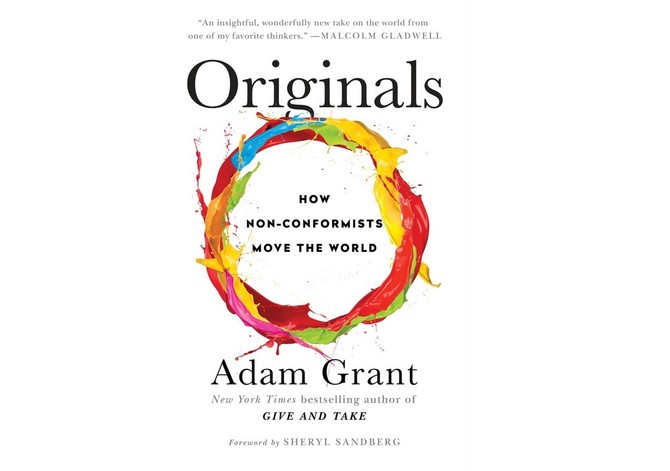
If you think that only a few people are creative, you are wrong. If you also think that some people are born to be leaders and the rest are followers, you are wrong again. If you still think that some people can have an impact but the majority cannot, keep reading. In “Originals: How Non-Conformists Move the World,” you will find out how to boost your creativity and you will also learn how to identify original ideas and predict which ones will be successful.
Adam Grant, who is recognized as one of the world’s 25 most influential management thinkers, admits that when he declined to invest in the Warby Parker company, it was the worst decision he ever made.
But what the founders of Warby Parker were trying to do seemed impossible. Back in 2008, four students wanted to make eyeglasses more affordable. They had noticed that items purchased online were much cheaper, so why not sell eyeglasses on the Internet?
People have always paid a hefty price for eyeglasses as they are considered a medical purchase. Dave Gilboa, one of Warby Parker’s co-founders, wanted to know why eyeglasses were so expensive. He soon discovered that 80 percent of the eyewear industry was dominated by a European company called Luxottica, according to the book. Luxottica, taking advantage of its monopoly status, was charging up to 20 times the standard cost of a pair of eyeglasses, according to the book. Gilboa realized that things could be done differently.
Despite being told that their idea was impossible to realize, the founders quit their jobs to start a company. They wanted to offer eyeglasses that cost $500 in a shop for $95 online and for every purchase, a pair would be donated in the developing world. After GQ Magazine called them “the Netflix of eyewear,” they reached their target for a year within a month. They were selling so many eyeglasses that at one point, they had 20,000 customers on a waiting list. Over a period of five years, the company made $100 million in annual revenues and donated more than a million pairs of eyeglasses. Warby Parker is now worth more than $1 billion.
“Originality itself starts with creativity, generating a concept that is both novel and useful. But it doesn’t stop there. Originals are people who take the initiative to make their visions a reality. The Warby Parker founders had the originality to dream up an unconventional way to sell glasses online, but became originals by taking action to make them easily accessible and affordable,” Grant wrote in the book.
Another characteristic of being original is rejecting the accepted norm and looking for a better option. Economist Michael Housman was working on a project to figure out why certain customer service agents stayed longer in their jobs than others. He discovered that employees who used Firefox or Chrome Internet browsers stayed longer than those who used Internet Explorer and Safari. He conducted a survey that showed that two thirds of the customer service agents interviewed used the default browser on their computer and never thought of trying a better one. The customer agents who accepted the built-in browsers — in this case Internet Explorer or Safari — followed standard operating procedures for dealing with customer complaints, saw their jobs as fixed, became unhappy, missed days of work and eventually quit.
The employees who decided to change their Internet browsers to Firefox or Chrome took a different approach to their jobs. They, for the most part, looked for new ways of dealing with customers, took the initiative, enjoyed working and stayed in their jobs.
The author also debunks the myth that originality requires you to take big risks. The movers and shakers of this world are also gripped by fear and doubt and would rather avoid taking big risks.
The book tells readers that of the entrepreneurs who established highly successful companies in the US, many did not quit their jobs or education. Google founders Larry Page and Sergey Brin figured out how to improve Internet searches in 1996 but they continued their graduate studies.
“We almost didn’t start Google because we were too worried about dropping out of our PhD program,” Page said.
Pierre Omidyar built eBay as a hobby and kept on working until his online job brought him more money than his job as a programmer.
For his part, Bill Gates also did not take major risks. After selling a software program in his sophomore year, he waited a whole year before leaving his studies. Even then, he did not drop out but took a leave of absence approved by the university.
“Having a sense of security in one realm gives us the freedom to be original in another. By covering our bases financially, we escape the pressure to publish half-baked books, sell shoddy art or launch untested businesses,” Grant wrote.
“Originals: How Non-Conformists Move the World” explains how you can stand up for a new idea without risking your reputation and your career. This captivating book is full of surprising advice that will not only change the way you see the world but will also change the way you live your life.


![]()
Book Review: How to be a bold entrepreneur without risking your career
Book Review: How to be a bold entrepreneur without risking your career


Latest updates





© 2026 SAUDI RESEARCH & PUBLISHING COMPANY, All Rights Reserved And subject to Terms of Use Agreement.