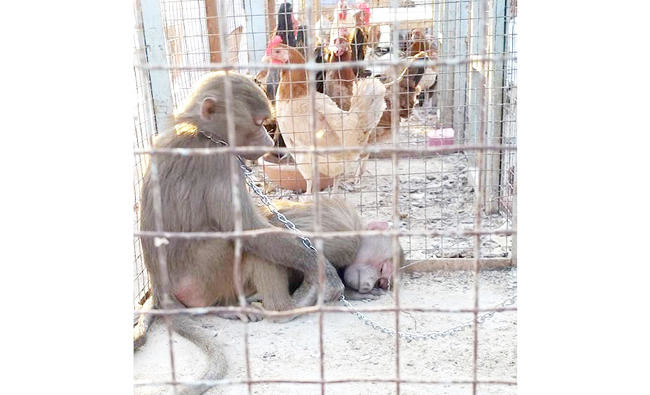
JEDDAH: For some people in Saudi Arabia, an animal is a very profitable item, and the less they spend on it, the more they profit. This translates into a miserable existence for the animals, which are often kept in cramped filthy cages too small for them to stand or turn around in. They receive no veterinary care, very little to eat and drink, and spend weeks, if not months, in chains.
And when their soul eventually departs their body, they are tossed in the trash with the rest of the garbage — and the only sorrow caused by their passing is their owner’s regret at the few hundred riyals lost.
Female baboons are separated from their babies by hunters in the mountains of Taif; dogs are stolen from their owners in Obhur and female German Shepherd dogs are kept in a specially-made cage which forces their rear ends into a position that allows her to be easily mounted and impregnated by a male dog.
All this and much more cruelty takes place before these creatures even reach the animal markets.
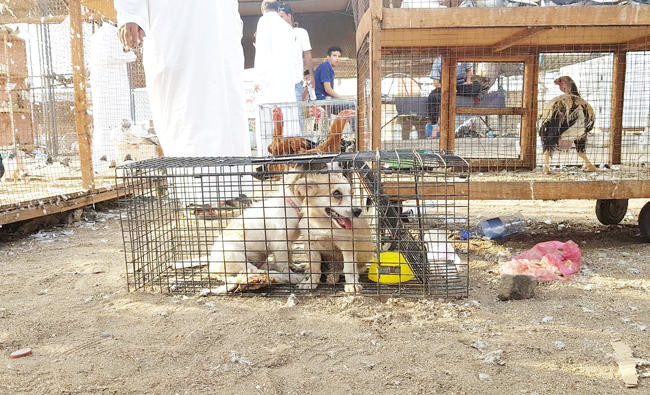
The Pigeon Souk of Jeddah is where these animals are all sold despite Ministry of Environment, Water and Agriculture and Jeddah Municipality bans being in place. It is a dirty and dusty place where the corpses of birds and other animals are strewn around, and where a dry and dusty water bowl sits next to a pair of thirsty puppies sharing a bird cage.
“The condition and treatment of the animals being sold at the animal souk is miserable and inhumane to say the least,” said Sonja Svensek, founder of Pets in Need, a Jeddah-based online platform that connects thousands of like-minded people in order to help animals in need.
“Animals are kept in small dirty cages, some without food or water. Some are chained, and the majority are in questionable health. For any animal lover, it is heartbreaking to witness the state of the animals being kept and treated there.”
Arab News visited the souk, located in Jeddah’s Khomra District, and found kittens, cats and dogs openly available for sale despite a Municipality ban on trading in anything but birds at the Pigeon Souk.
One man was selling a mother cat and her kittens. “You can have them all for SR1,100,” he told Arab News. “Or SR200 for each kitten, or SR700 for the mother.” When asked why the mother was three times the price, he said that she could make babies and those could be sold.
A few meters away, in the farthest corner of the marketplace from the parking area, were two small dogs, less than a year old, looking frightened. The man selling them said they were from France. One had a pink collar and their claws were trimmed as if recently manicured.
It seemed likely the dogs had been stolen.
“Chances were that if your dog went missing or was stolen, it would end up at that market”, Svensek said. “Out of every 10 cases of missing dogs, about six are eventually found on sale there. We see this from the posts of desperate pet owners who have lost their pet, only to find it at the souk days, or sometimes weeks, later.”
A similar problem exists at the animal souk in Riyadh, according to Dr. Lana Dunn, a volunteer at Open Paws of Riyadh, a group of Saudis and expatriates who work to reduce the number of homeless pets, control stray cat populations and help animals in need of rescue.
The issue, Dunn said, is that the Municipality controls the pet stores, animal souks and stray animal populations, but is not in charge of the condition of the animals on sale. The Municipality says that is the responsibility of the animal welfare department of the Ministry of Environment, Water and Agriculture. But the Ministry says it has no authority over areas that the Municipality is in charge of. And that is how animal welfare falls through the cracks.
“The Riyadh animal souk is a health hazard to people as well as to the animals. It’s an embarrassment to the country in the eyes of visitors, and it’s also a bad example considering Islam’s obligations to care for God’s creatures,” Dunn said. “I have nothing good to say about it. I’m dumbfounded that it is allowed to go on.”
Arab News called and messaged Jeddah Municipality and the Ministry of Environment, Water and Agriculture for comment, but did not receive a timely response.


![]()
![]()
![]()
Despicable treatment of animals in KSA: Who is to blame?

Despicable treatment of animals in KSA: Who is to blame?


Latest updates


© 2026 SAUDI RESEARCH & PUBLISHING COMPANY, All Rights Reserved And subject to Terms of Use Agreement.