Hands off the animals: Tunis croc killing zoo reopens

1 / 2
A lion and a lioness are seen at the Belvedere Zoo, which was closed for renovation works following an attack on a crocodile a month earlier, in the capital Tunis on April 13, 2017. (AFP / FETHI BELAID)
2 / 2
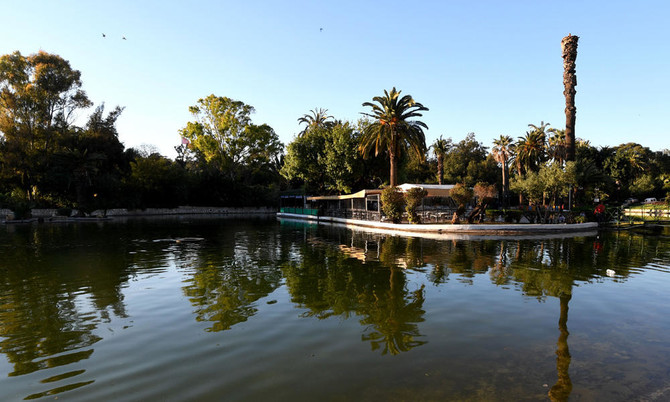
A general view shows a lake at the Belvedere Zoo, which was closed for renovation works following an attack on a crocodile a month earlier, in the capital Tunis on April 13, 2017. (AFP / FETHI BELAID)
Updated 15 April 2017
Follow

Hands off the animals: Tunis croc killing zoo reopens

TUNIS, Tunisia: A Tunisian zoo that closed after a crocodile was stoned to death has reopened, with extra guards and new signs instructing visitors not to throw things at the animals.
The Belvedere Zoo in central Tunis shut its gates in March after a public outcry over the animal’s death.
Images shared on social media showed the dead crocodile’s head beside what appeared to be a bloodied paving slab and another large rock.
The reptile’s death was the latest in a string of scandals at the 50-year-old zoo, which has long been in need of renovation.
Pictures of the site filled with litter caused an outcry on social media last year.
Staff have other complaints.
“Some people, when they see a lion sleeping, want to throw a pebble at it to get it up. We ask them to stop,” said Taoufik Yaacoubi, a guard at the zoo for 20 years. “It’s not normal.”
Zoo visitors often left rubbish on the ground or threw it into ponds, with some hurling bottles of water into the enclosures.
Director Mahmoud Latiri said that before the makeover, “people thought they were in a circus.”
He echoed widespread complaints that delinquent behavior had risen in Tunisia since a revolution toppled longtime dictator Zine El Abidine Ben Ali in 2011.
“People thought everything was allowed, that that was what freedom meant,” Latiri said.
Environment Minister Riadh Mouakher said videos from the zoo even showed children sitting on the backs of rhinoceroses.
Following the crocodile’s death, Mouakher decided to deploy extra guards at the zoo, which he said was “in a rather dilapidated state.”
“It was more a playground than a zoo,” he said.
But since the zoo reopened over the weekend following an extensive makeover, he said he had seen an “improvement in behavior.”
The authorities have cleaned pools, restored pathways, planted thousands of shrubs and flowers, and installed rubbish bins every five meters.
Plastic bags, which are dangerous to animals that eat them, are now banned. New signs instruct visitors not to disturb, feed or throw things at the animals.
“We have a better zoo,” Mouakher said.
His ministry is hoping to spend a further $6.5 million (six million euros) on developing the Belvedere Park surrounding the zoo.
School holidays have bumped visitor numbers up to 8,000 a day. This week, families strolled along the pathways in the sunshine.
Riadh, accompanied by his wife and daughter, said he could see a definite improvement since the makeover.
“Now it is cleaner. You can see that they are looking after it,” he said. Now when you pay, you understand why.”


Filipinos master disaster readiness, one roll of the dice at a time

Updated 29 December 2025
Follow

Filipinos master disaster readiness, one roll of the dice at a time

  • In a library in the Philippines, a dice rattles on the surface of a board before coming to a stop, putting one of its players straight into the path of a powerful typhoon

MANILA: In a library in the Philippines, a dice rattles on the surface of a board before coming to a stop, putting one of its players straight into the path of a powerful typhoon.
The teenagers huddled around the table leap into action, shouting instructions and acting out the correct strategies for just one of the potential catastrophes laid out in the board game called Master of Disaster.
With fewer than half of Filipinos estimated to have undertaken disaster drills or to own a first-aid kit, the game aims to boost lagging preparedness in a country ranked the most disaster-prone on earth for four years running.
“(It) features disasters we’ve been experiencing in real life for the past few months and years,” 17-year-old Ansherina Agasen told AFP, noting that flooding routinely upends life in her hometown of Valenzuela, north of Manila.
Sitting in the arc of intense seismic activity called the “Pacific Ring of Fire,” the Philippines endures daily earthquakes and is hit by an average of 20 typhoons each year.
In November, back-to-back typhoons drove flooding that killed nearly 300 people in the archipelago nation, while a 6.9-magnitude quake in late September toppled buildings and killed 79 people around the city of Cebu.
“We realized that a lot of loss of lives and destruction of property could have been avoided if people knew about basic concepts related to disaster preparedness,” Francis Macatulad, one of the game’s developers, told AFP of its inception.
The Asia Society for Social Improvement and Sustainable Transformation (ASSIST), where Macatulad heads business development, first dreamt up the game in 2013, after Super Typhoon Haiyan ravaged the central Philippines and left thousands dead.
Launched six years later, Master of Disaster has been updated this year to address more events exacerbated by human-driven climate change, such as landslides, drought and heatwaves.
More than 10,000 editions of the game, aimed at players as young as nine years old, have been distributed across the archipelago nation.
“The youth are very essential in creating this disaster resiliency mindset,” Macatulad said.
‘Keeps on getting worse’ 
While the Philippines has introduced disaster readiness training into its K-12 curriculum, Master of Disaster is providing a jolt of innovation, Bianca Canlas of the Department of Science and Technology (DOST) told AFP.
“It’s important that it’s tactile, something that can be touched and can be seen by the eyes of the youth so they can have engagement with each other,” she said of the game.
Players roll a dice to move their pawns across the board, with each landing spot corresponding to cards containing questions or instructions to act out disaster-specific responses.
When a player is unable to fulfil a task, another can “save” them and receive a “hero token” — tallied at the end to determine a winner.
At least 27,500 deaths and economic losses of $35 billion have been attributed to extreme weather events in the past two decades, according to the 2026 Climate Risk Index.
“It just keeps on getting worse,” Canlas said, noting the lives lost in recent months.
The government is now determining if it will throw its weight behind the distribution of the game, with the sessions in Valenzuela City serving as a pilot to assess whether players find it engaging and informative.
While conceding the evidence was so far anecdotal, ASSIST’s Macatulad said he believed the game was bringing a “significant” improvement in its players’ disaster preparedness knowledge.
“Disaster is not picky. It affects from north to south. So we would like to expand this further,” Macatulad said, adding that poor communities “most vulnerable to the effects of climate change” were the priority.
“Disasters can happen to anyone,” Agasen, the teen, told AFP as the game broke up.
“As a young person, I can share the knowledge I’ve gained... with my classmates at school, with people at home, and those I’ll meet in the future.”