60 ANC MPs ready to dump Zuma, says leader

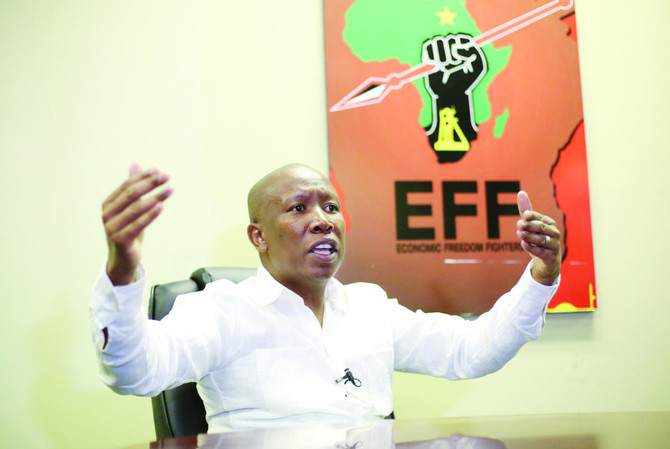
Julius Malema. (Reuters)
Updated 22 July 2017
Follow

60 ANC MPs ready to dump Zuma, says leader

JOHANNESBURG: More than 60 African National Congress (ANC) members in South Africa’s Parliament will back a no-confidence vote against President Jacob Zuma if the ballot is secret, the leader of the far-left Economic Freedom Fighters party (EFF), Julius Malema, said.
Toppling Zuma requires 50 of the 249 ANC members of Parliament (MPs) to support the no-confidence motion and some have said publicly they want him removed, including former Finance Minister Pravin Gordhan, whose sacking in March triggered damaging debt ratings downgrades. South Africa’s National Assembly has 400 members.
Malema, a firebrand politician known for his colorful language, said in an interview late on Thursday, he had received personal commitments that ANC MPs would dump Zuma.
Malema, a former head of the ANC’s Youth League before his expulsion from the party, could plausibly still have plenty of contacts in the organization.
“I personally spoke to more than 60 MPs of the ANC who have committed that if we give them a secret ballot they will deliver,” Malema told Reuters in his office.
“They’ve asked that this thing must be secret. They are not happy themselves,” said Malema, seated in front of an EFF sign featuring a clenched black fist holding a spear, super-imposed over an African map. Zuma faces the no-confidence motion on Aug. 8, the ninth time the opposition will have tried to unseat him by peeling off dissidents from the ruling party, whose majority has so far protected him.
But unlike previous attempts, this time the vote may not be open. The Constitutional Court has cleared the way for the Speaker to allow a secret ballot, though it remains unclear she will.
The ANC’s official line is that the party will close ranks and back Zuma. Party officials did not immediately respond to requests for comment on Malema’s remarks.
ANC MP Makhosi Khoza chose Nelson Mandela’s birthday on Tuesday to denounce Zuma, making clear she would break party ranks. “If you see one person doing that under such a hostile environment you must know that she must have powerful backing. She has a lot of backing,” Malema said.
One ANC MP has told Reuters they would vote for Zuma’s removal and the South African Communist Party, whose 17 MPs back the ANC in Parliament, said in April Zuma should resign.
Tens of thousands of people took part in marches in April calling for Zuma, 75, to step down over a string of graft scandals and missteps as the economy is in recession and unemployment rising.
Malema, whose party supports expropriating white-owned land and the nationalization of mines and banks, said economic misrule under Zuma was deepening apartheid’s racial disparities.
“The problem is that as the gap widens the blacks become more poor and the whites become richer. As a result then we are two nations in one country, the rich people who are white and the poor people who are black,” he said.
Malema said his party was still urging the landless to occupy unutilized land despite charges he faces for inciting property grabs.
“It’s an EFF resolution and that resolution has not been suspended by any court of law. We are calling upon our people to occupy the land,” he said.
Malema formed the EFF, known for its trademark red berets and rowdy behavior in parliament, four years ago, and the party plans to hold a birthday bash next week in the port city of Durban in the heart of Zuma’s Zulu political power base.
Durban’s streets that day will run red with cattle blood.
“We are slaughtering 10 cattle because in our African culture it is not a celebration until there is slaughter. There must be some slaughter to thank the ancestors,” Malema said.


Youth voters take center stage in Bangladesh election after student-led regime change

Updated 38 min 40 sec ago
Follow

Youth voters take center stage in Bangladesh election after student-led regime change

  • About 45% of Bangladeshis eligible to vote in Thursday’s election are aged 18-33
  • Election follows 18 months of reforms after the end of Sheikh Hasina’s 15-year rule

DHAKA: When he goes to the polls on Thursday, Atikur Rahman Toha will vote for the first time, believing that this election can bring democratic change to Bangladesh.

A philosophy student at Dhaka University, Toha was already eligible to vote in the 2024 poll but, like many others, he opted out.

“I didn’t feel motivated to even go to vote,” he said. “That was a truly one-sided election. The election system was fully corrupted. That’s why I felt demotivated. But this time I am truly excited to exercise my voting rights for the first time.”

The January 2024 vote was widely criticized by both domestic and international observers and marred by a crackdown on the opposition and allegations of voter fraud.

But the victory of the Awami League of ex-Prime Minister Sheikh Hasina was short-lived, as a few months later the government was ousted by a student-led uprising, which ended the 15-year rule of Bangladesh’s longest-serving leader.

The interim administration, led by Nobel laureate Muhammad Yunus, took control in August 2024 and prepared a series of reforms to restructure the country’s political and institutional framework and organize the upcoming vote.

About 127.7 million Bangladeshis are eligible to cast their ballots, according to Election Commission data, with nearly a third of them, or 40.4 million, aged 18-29. Another 16.9 million are 30-33, making it a youth–dominated poll, with the voters hopeful the outcome will help continue the momentum of the 2024 student-led uprising.

“We haven’t yet fully transitioned into a democratic process. And there is no fully stable situation in the country,” Toha said. “After the election we truly hope that the situation will change.”

For Rawnak Jahan Rakamoni, also a Dhaka University student, who is graduating in information science, voting this time meant that her voice would count.

“We are feeling that we are heard, we will be heard, our opinion will matter,” she said.

“I think it is a very important moment for our country, because after many years of controversial elections, people are finally getting a chance to exercise their voting rights and people are hoping that this election will be more meaningful and credible. This should be a fair election.”

But despite the much wider representation than before, the upcoming vote will not be entirely inclusive in the absence of the Awami League, which still retains a significant foothold.

The Election Commission last year barred Hasina’s party from contesting the next national elections, after the government banned Awami League’s activities citing national security threats and a war crimes investigation against the party’s top leadership.

The UN Human Rights Office has estimated that between July 15 and Aug. 5, 2024 the former government and its security and intelligence apparatus, together with “violent elements” linked to the Awami League, “engaged systematically in serious human rights violations and abuses in a coordinated effort to suppress the protest movement.”

It estimated that at least 1,400 people were killed during the protests, with the majority shot dead from military rifles.

Rezwan Ahmed Rifat, a law student, wanted the new government to “ensure justice for the victims of the July (uprising), enforced disappearances, and other forms of torture” carried out by the previous regime.

The two main parties out of the 51 contesting Thursday’s vote are the Bangladesh Nationalist Party and Jamaat-e-Islami. Jamaat, which in 2013 was banned from political participation by Hasina’s government, heads an 11-party alliance, including the National Citizen Party formed by student leaders from the 2024 movement.

“I see this election as a turning point of our country’s democratic journey … It’s not just a normal election,” said Falguni Ahmed, a psychology student who will head to the polls convinced that no matter who wins, it will result in the “democratic accountability” of the next government.

Ahmed added: “People are not voting only for their leaders; they are also voting for the restoration of democratic credibility. That’s why this election is very different.”