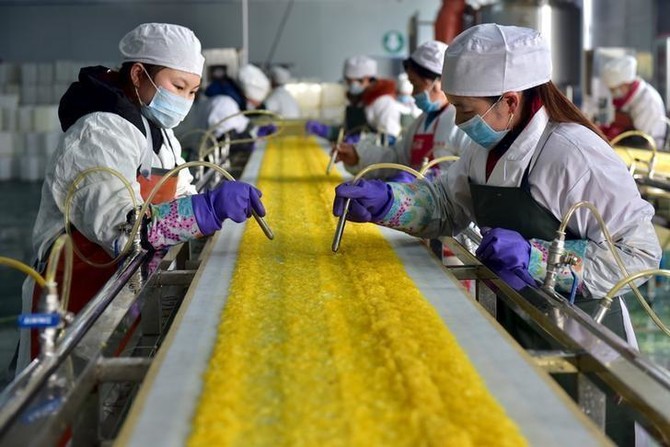
China GDP grows 6.9 percent in the second quarter

Growth in China’s economy this year has beaten expectations as exports recover and property construction remains strong. (Reuters)
Updated 17 July 2017
Follow

China GDP grows 6.9 percent in the second quarter

BEIJING: The Chinese economy grew faster than expected in the second quarter, boosted by stronger industrial output and personal consumption as well as steady investments.
The country’s GDP grew 6.9 percent in the second quarter from a year earlier, the National Bureau of Statistics said on Monday, which was also the same rate as the previous quarter. Analysts have expected the Chinese economy to expand 6.8 percent in the second quarter.
Growth in China’s economy this year has beaten expectations as exports recover and property construction remains strong, though many analysts expect the world’s second-largest economy to lose steam later in the year as policy measures to rein in red-hot housing prices and a rapid build-up in debt take a greater toll on growth.
“Overall, the economy continued to show steady progress in the first half...but international instability and uncertainties are still relatively large, and the domestic long-term buildup of structural imbalances remains,” the statistics bureau said in a statement.
The government is aiming for growth of around 6.5 percent in 2017, slightly lower than last year’s actual 6.7 percent, which was the weakest pace in 26 years.
China’s factory output grew 7.6 percent in June from a year earlier, the fastest pace in three months, while fixed-asset investment expanded 8.6 percent in the first six months of the year, both beating forecasts.
Retail sales meanwhile rose 11.0 percent in June from a year earlier, the fastest pace since December 2015 and beating analysts’ expectations for a 10.6 percent rise.
An acceleration in global demand for Chinese products could be a boon for the country’s leaders as they seek to contain a dangerous build-up in debt that has ballooned to 277 percent of GDP.
“(The new data) is encouraging for global growth as well because China is the second largest economy on the planet,” said Craig James, chief economist at Commonwealth Securities in Sydney.
“Based on this data, there is no need for easing and no need really for tightening either because inflationary pressures are very much contained. So I think the People’s Bank of China just continues to be watchful.”


Saudi ports container handling rises 2% to 738k TEUs in January: Mawani 

Updated 7 sec ago
Follow

Saudi ports container handling rises 2% to 738k TEUs in January: Mawani 

RIYADH: Saudi Arabia’s ports handled 738,111 twenty-foot equivalent units in January, a 2.01 percent increase from a year earlier, driven by a sharp rise in transshipment volumes despite weaker inbound and outbound trade. 

Ports overseen by the Saudi Ports Authority, known as Mawani, reported that transshipment containers surged 22.44 percent year on year to 184,019 TEUs, helping offset softer cargo flows.  

This comes as Saudi Arabia accelerates efforts to position itself as a global logistics hub under its National Transport and Logistics Strategy, investing heavily in port infrastructure and supply-chain integration to capture a larger share of regional trade flows. 

Mawani emphasized in a statement that the increased container handling “delivers multiple economic benefits, including enhanced trade activity, stimulation of maritime-related industries, tourism growth, and strengthened supply chains.” 

While overall container volumes grew, the figures revealed a mixed performance across different segments. Inbound container volumes declined 3.23 percent to 284,375 TEUs, while outbound containers fell 3.47 percent to 269,717 TEUs compared to January 2025. 

Passenger traffic through Saudi ports jumped 42.27 percent to 143,566 travelers in January, while vehicle volumes rose 3.31 percent to 109,097 units.  

Livestock imports showed particularly strong momentum, with ports receiving 886,908 heads of cattle — a 49.86 percent increase compared to 591,824 heads during the same period in 2025. 

Liquid bulk cargo registered a marginal increase of 0.28 percent, reaching 14.1 million tonnes. However, total handled tonnage — including general cargo, dry bulk, and liquid bulk — declined 3.04 percent to 19.2 million tonnes. General cargo stood at 839,987 tonnes, while dry bulk reached 4.26 million tonnes. 

Vessel traffic experienced a slight decrease of 1.75 percent, with 1,121 ships calling at Saudi ports compared to 1,141 ships in January 2025. 

The positive January figures follow a strong 2025 performance, during which Mawani-supervised ports achieved a 10.58 percent annual increase in container throughput, handling 8.32 million TEUs compared to 7.52 million TEUs in 2024. Transshipment containers for full-year 2025 rose 11.78 percent to 1.93 million TEUs. 

The total number of outgoing containers rose by 11.72 percent in 2025 to reach 3.1 million TEUs, compared to 2.8 million TEUs, while the total number of incoming containers increased by 8.82 percent to reach 3.2 million TEUs in 2025, compared to 2.9 million TEUs a year earlier.