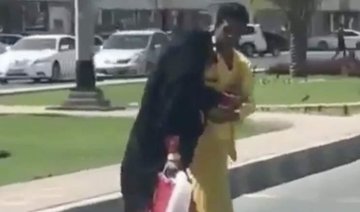
JEDDAH: One would think that no one really wants to be a garbage man, as the job entails handling things that most people do not wish to see, touch or smell.
In Saudi Arabia the job pays a mere SR400 ($107) per month, and involves spending up to 11 hours per day, six days per week in the stifling heat in places where feral cats and street rats abound.
But there is one benefit to being a garbage man: Due to a sense of pity and the charitable nature of Saudi Arabia’s citizens and residents, cash handouts are frequent.
A number of street cleaners told Arab News they are given SR700-SR2,500 each month in cash handouts from passing motorists.
This has not gone unnoticed by some who are in Saudi Arabia illegally and without a source of income.
Badr Al-Ahmari, a representative of Seder Group’s Environmental Services Division in charge of cleanliness in some districts of Riyadh and Jeddah, said there is a problem with individuals obtaining uniforms and pretending to be street cleaners in order to get money.
“In the case of one worker at the Grand Mosque in Makkah, he was found to be making SR300 an hour in tips,” Al-Ahmari said.
Arab News was able to obtain blue overalls, a reflective safety vest, orange gloves, a broom and a garbage bag for only SR114 from various safety-equipment businesses.
Donning a street cleaner’s uniform, this reporter cleaned the streets of Al-Rawdah district in Jeddah for two hours, receiving SR10.
This is hardly the SR300 Al-Ahmari spoke of, but for those who do not have money to eat, SR10 makes a huge difference.
During the course of this investigation, Arab News watched seven street cleaners for a number of hours.
They never wandered more than 200 meters away from a traffic light, repeatedly walking back and forth between cars as the traffic light changed color. They were obviously more interested in receiving handouts than cleaning the streets.
Arab News approached the seven street cleaners for an interview. One abandoned his garbage can and broom and ran away.
The second walked away. When cornered, he said: “I’m sorry, I won’t do it again. You’ll never see me here again.”
The third walked away briskly but was caught up to. As he pulled out his iqama from his wallet, SR5 and SR10 notes fell out and were blown away by the wind. As Arab News tried to collect the money to give it back to him, he ran away.
The other four street cleaners were employees of municipality-contracted companies who said they had cleaned their part of the neighborhood and were exhausted from walking in the heat for the past few hours.
They claimed to be resting at the traffic light awaiting the end of their shift for the company bus to pick them up.
One of them, Abdulrahman from Bangladesh, who cleans Tahlia Street and was the only one of the seven making an effort to keep the street clean, said his salary is SR500 per month.
He added that he collects aluminum cans and sells them for SR3 per kg, as well as cardboard boxes for SR40 per kg.
He said he depends on this and handouts from the public in order to send money to his wife and two children in his country.
Mohammed, a legitimate street cleaner, said: “Those who want to give us a tip shouldn’t give them to those who stand at traffic lights. The real street cleaners are those who clean the inner streets of your neighborhood and who shy away from places where there are a lot of people. If you want to give money, give it to the cleaners there who you actually see cleaning.”