

US should declare the Muslim Brotherhood a terrorist organization, says John Bolton

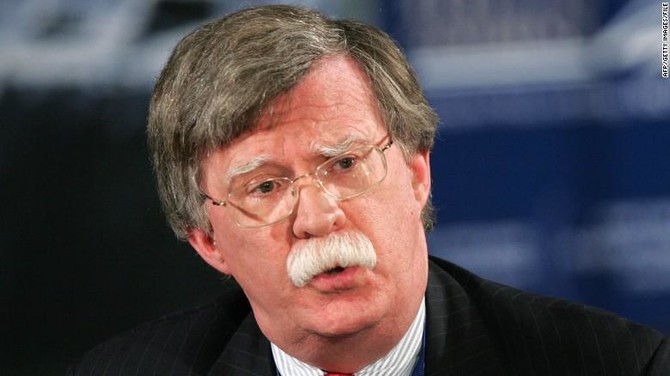
John Bolton, former US ambassador to the United Nations. (AFP)
Updated 13 July 2017
Follow

US should declare the Muslim Brotherhood a terrorist organization, says John Bolton

JEDDAH: In order for Qatar to stop supporting the Muslim Brotherhood, the US must declare it a terrorist organization, said former US Ambassador to the UN John Bolton.
“The Saudis have picked on Qatar in particular because of its support for the Muslim Brotherhood, but I think also they’re worried about Qatar’s tilt toward Iran,” he told Breitbart News on Wednesday.
Saudi Arabia wants a “united Sunni Arab community” in the Middle East, Bolton said, adding: “Qatar’s response is, ‘Well, what are you picking on us for? Because of the Muslim Brotherhood? The United States hasn’t declared the Muslim Brotherhood a terrorist organization and neither have we, so why are we any different from you?’”
He said the US should “do what it should’ve done anyway. Let’s declare the Brotherhood a terrorist organization. Having done that, we turn back to Qatar and say, ‘Now you follow suit’.”
Bolton urged the US to make full use of the outcomes of the Riyadh Summit upon President Donald Trump’s visit to Saudi Arabia in May, which concluded with the inauguration of a pan-Arab, pan-Muslim center against terrorism.
“Give all these governments the cover they need to cut off the sources of terrorist financing,” Bolton said, including the Qatari royal family.
Although Saudi Arabia declared the Brotherhood a terrorist group in 2014, he believes it is a “complicated organization; not every part of it is devoted to the support of terrorism. Some of them do humanitarian work and so on. A declaration that the entire Brotherhood is a foreign terrorist organization would actually buttress the cause of the jihadis.”
Excluding some affiliates and components of the Brotherhood from the designation would be a better option, he said, adding: “Just declare part of it a terrorist organization. We’ll deal with the rest of it later.”

Iran and the IRGC
Meanwhile, Bolton said the US should also add Iran’s Revolutionary Guard Corps (IRGC) to the list of terrorist groups, because “that’s fundamentally what it is.”
Tehran’s objective is “to link up from Iran, through the Baghdad government in Iraq, to the Assad regime’s regular forces in Syria and the Hezbollah terrorists who are there in Lebanon,” Bolton warned.
He said Tehran is trying to create “an arc of control that lays the foundation for the next struggle in the Middle East, against the Sunni coalition led by the Saudis.”
He added that the Obama administration was “entirely comfortable” with that, as the situation was consistent with its view that Iran is a “normal kind of nation; we’ll just talk them out of their nuclear weapons and then everything will be fine.” Bolton said Tehran has a different take on this issue.
To prevent it from creating that arc of control, Bolton proposed the creation of a new state that is secular yet demographically Sunni, partially paid for by Saudi Arabia.
“This is part of the bigger picture of how we deal with Iran, which is continuing to pursue nuclear weapons along with its friends in North Korea, and continuing to support terrorism around the world,” he said.
“That struggle with Iran is something that was just absent from the radar screen in the Obama administration, but it’s going to come to the fore again once ISIS (Daesh) is defeated.”
On Sunday, Iraq declared victory against Daesh in Mosul after a grueling months-long campaign, dealing the biggest defeat yet to the terrorist group.
Bolton said having an active strategy is a must. “It’s not enough to kind of wake up every day and say, ‘Well, gee, what problem do we have now?’ You have to have a strategy.”
He said combating terrorism and tackling the threat of “the world’s principal state sponsor of terrorism, which is Iran,” is a critical strategy that should be developed urgently. This requires advancing US objectives and Arab unity, he added.



Japan, UNOPS sign $4.6m project to restore customs capacity at major Yemeni ports

Updated 9 sec ago
Follow

Japan, UNOPS sign $4.6m project to restore customs capacity at major Yemeni ports

  • The notes for the project were signed and exchanged in Riyadh on Thursday

RIYADH: Japan and the United Nations Office for Project Services have signed an agreement for a new grant aid project aimed at improving customs functions at key ports in Yemen.

The notes for the project were signed and exchanged in Riyadh on Thursday by Yoichi Nakashima, Japan’s ambassador to Yemen, and Muhammad Usman Akram, representative and director of the UNOPS Operational Hub in Amman. The grant amounts to 732 million yen (approximately $4.6 million).

The initiative, titled “The Project for the Improvement of Customs Functions at Major Ports,” seeks to address mounting operational challenges facing Yemen’s customs authorities after years of conflict.

Officials said damage to cargo inspection infrastructure, particularly X-ray screening systems, has significantly reduced inspection capacity at customs facilities. As a result, only about 20 percent of cargo entering through affected ports can be scanned, while the remaining shipments are subject to manual inspection.

This imbalance has contributed to prolonged clearance times and increased risks, including the potential smuggling of weapons, narcotics and other prohibited goods, according to statements delivered at the ceremony.

The project will focus on three major entry points: Aden Sea Port in Aden Governorate, Al-Shihn Land Port in Al-Mahra, and Al-Wadiah Land Port in Hadramout.

Under the agreement, Japan will fund the rehabilitation of X-ray inspection systems and the provision of modern detection equipment. The program also includes capacity development measures, including specialized training for Yemeni customs officials.

Speaking at the event, Nakashima said the project was designed to strengthen the operational capabilities of the Yemeni Customs Authority over an 18-month period. Improving inspection efficiency would help accelerate procedures while reducing reliance on manual checks.

Strengthening customs systems was expected to facilitate smoother trade flows and improve the handling of humanitarian shipments, which remain critical amid Yemen’s ongoing humanitarian crisis, he added.

UNOPS representative Akram described the agreement as a significant step forward in supporting Yemen’s customs authorities through Japanese funding.

“Today marks a significant step forward in strengthening the Yemeni Customs Authority through vital and much appreciated funding from our longstanding partner, the Government of Japan,” he said during the ceremony.

He added the project aimed to address key operational challenges facing the Yemen Customs Authority and enhance efficiency by strengthening institutional capacity in cargo inspection and clearance procedures.

According to Akram, the initiative is expected to reduce the time and costs associated with importing goods into Yemen, including humanitarian assistance.

To achieve these objectives, UNOPS will draw on its procurement expertise to acquire cargo inspection devices and critical spare parts required to restore existing vehicle and container scanners, alongside other necessary equipment.

Akram added that the program will also include capacity-building and training components to support effective operationalization of the upgraded systems.

He said Yemen had a historical role as a major trading crossroads linking the Red Sea and the Gulf of Aden, describing the measures under the project as an important step toward revitalizing and modernizing the country’s customs infrastructure.

The improvements, he said, were expected to facilitate trade, strengthen revenue collection and support the Yemeni government’s broader reconstruction and development priorities.

Akram also expressed appreciation to the Government of Japan for its continued partnership, as well as to Yemeni authorities for their cooperation in facilitating operational and logistical processes related to UNOPS projects.

“UNOPS remains committed to supporting the efforts of the Government of Yemen towards reconstruction and sustainable development with the valuable support of the international community,” he said.

Yemen’s Deputy Finance Minister Hani Wahab welcomed the agreement, describing the project as a major step in improving customs infrastructure and operational efficiency.

Speaking during the ceremony, he said the initiative would contribute to modernizing automated inspection systems, providing spare parts for equipment and supporting personnel training. He added improved customs capacity would help facilitate trade, strengthen revenue collection and combat the trafficking of illegal goods.

Nakashima also highlighted Japan’s broader development engagement with Yemen, saying the country had provided technical support in customs management through training programs implemented by JICA in recent years.

With the latest grant, total Japanese assistance to Yemen since 2015 has reached approximately $497 million. Japan said it would continue working with UN agencies and international partners to support peace and institutional resilience in Yemen.

This article also appears on Arab News Japan