

Anti-Terror Quartet issue a joint statement on US-Qatar MoU

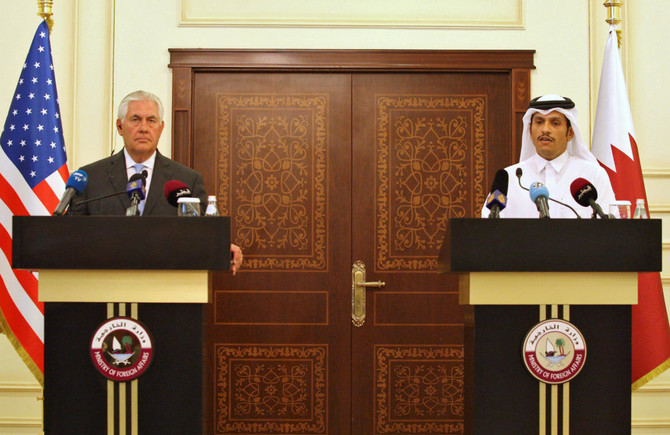
Qatar’s foreign minister Sheikh Mohammed bin Abdulrahman Al-Thani (R) and US Secretary of State Rex Tillerson attend a joint news conference in Doha, Qatar, July 11, 2017. (Reuters)
Updated 11 July 2017
Follow

Anti-Terror Quartet issue a joint statement on US-Qatar MoU

JEDDAH: The Anti-Terror Quartet (ATQ) — Saudi Arabia, Egypt, UAE and Bahrain — issued a joint statement in which they valued the US efforts in the fight against terror financing.

The statement reads:

The four countries value the efforts of the United States of America in the fight against terrorism and its financing and the full and solid partnership embodied in the Arab-Islamic-American Summit, which has established a firm international position to confront extremism and terrorism regardless of its source and origin.
The signing of a Memorandum of Understanding on Combating the Financing of Terrorism between the United States and the Qatari authorities is the result of the repeated pressures and demands over the past years by the four countries and their partners to stop its support for terrorism with the assertion that this step is not enough and that the four countries will closely monitor the seriousness of the authorities in its fight against all forms of terrorist financing, its support and embrace.
The four countries emphasize that the measures they have taken have been because of the continuation of various activities of the Qatari authorities in supporting and financing terrorism, harboring extremists, spreading hatred and extremism and interfering in the internal affairs of other countries. These activities must be fully and definitively stopped in implementation of the legitimate and just demands.
The Qatari authorities have consistently revoked all the agreements and commitments, the most recent of which was the Riyadh Agreement (2013), which led to the withdrawal of ambassadors and their return only after the Qatari authorities signed the supplementary agreement (2014) and their continued intervention, incitement, conspiracy, harboring of terrorists, financing terrorist acts and spreading hatred and extremism, with which it cannot be trusted in any commitment it makes according to its existing policy without the establishment of strict controls to verify the seriousness of its return to the normal and right track.
The four countries also reiterate the continuation of their current procedures until the Qatari authorities are committed to the implementation of the just and full demands that will ensure that terrorism is addressed and stability and security are established in the region.


— With input from SPA

Fledgling radio station aims to be ‘voice of the people’ in Gaza

Updated 5 sec ago
Follow

Fledgling radio station aims to be ‘voice of the people’ in Gaza

  • The electricity crisis is one of the most serious and difficult problems in the Gaza Strip, says Shereen Khalifa Broadcaster

DEIR EL-BALAH: From a small studio in the central city of Deir El-Balah, Sylvia Hassan’s voice echoes across the Gaza Strip, broadcast on one of the Palestinian territory’s first radio stations to hit the airwaves after two years of war.

Hassan, a radio host on fledgling station “Here Gaza,” delivers her broadcast from a well-lit room, as members of the technical team check levels and mix backing tracks on a sound deck. “This radio station was a dream we worked to achieve for many long months and sometimes without sleep,” Hassan said.

“It was a challenge for us, and a story of resilience.”

Hassan said the station would focus on social issues and the humanitarian situation in Gaza, which remains grave in the territory despite a US-brokered ceasefire between Israel and Hamas since October.

“The radio station’s goal is to be the voice of the people in the Gaza Strip and to express their problems and suffering, especially after the war,” said Shereen Khalifa, part of the broadcasting team.

“There are many issues that people need to voice.” Most of Gaza’s population of more than 2 million people were displaced at least once during the gruelling war.

Many still live in tents with little or no sanitation.

The war also decimated Gaza’s telecommunications and electricity infrastructure, compounding the challenges in reviving the territory’s local media landscape. “The electricity problem is one of the most serious and difficult problems in the Gaza Strip,” said Khalifa.

“We have solar power, but sometimes it doesn’t work well, so we have to rely on an external generator,” she added.

The station’s launch is funded by the EU and overseen by Filastiniyat, an organization that supports Palestinian women journalists, and the media center at the An-Najah National University in Nablus, in the occupied West Bank.

The station plans to broadcast for two hours per day from Gaza and for longer from Nablus. It is available on FM and online.

Khalifa said that stable internet access had been one of the biggest obstacles in setting up the station, but that it was now broadcasting uninterrupted audio.

The Gaza Strip, a tiny territory surrounded by Israel, Egypt, and the Mediterranean Sea, has been under Israeli blockade even before the attack on Oct. 7, 2023, which sparked the war. Despite the ceasefire, Israel continues to strictly control the entry of all goods and people to the territory.

“Under the siege, it is natural that modern equipment necessary for radio broadcasting cannot enter, so we have made the most of what is available,” she said.