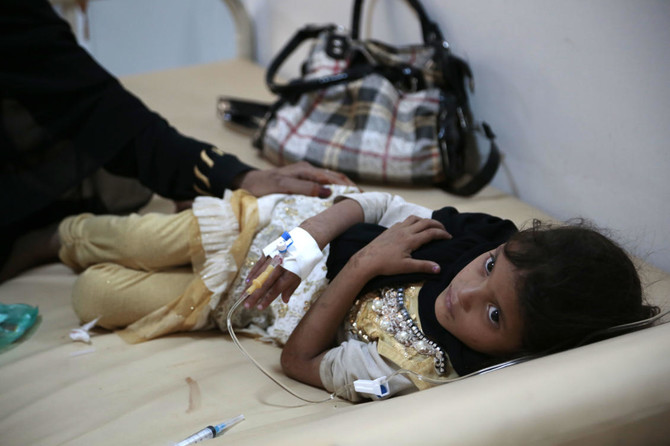
GENEVA: A 10-week cholera epidemic has now infected more than 300,000 people in Yemen and claimed more than 1,600 lives, the International Committee of the Red Cross (ICRC) said on Monday, a health disaster on top of war, economic collapse and near-famine in the impoverished country.
“Disturbing. We’re at 300k+ suspected cases with ~7k new cases/day,” Robert Mardini, ICRC regional director, said in a tweet.
The World Health Organization (WHO) has said there were 297,438 suspected cases and 1,706 deaths by July 7, but it did not publish a daily update on Sunday when the 300,000 mark looked set to be reached. A WHO spokesman said the figures were still being analyzed by Yemen’s Health Ministry.
Although the daily growth rate in the overall number of cases has halved to just over 2 percent in recent weeks and the spread of the disease has slowed in the worst-hit regions, outbreaks in other areas have grown rapidly.
The most intense impact has been in areas in the west of the country which have been fiercely contested in the two-year war between a Saudi-led coalition and armed Iran-aligned Houthi rebels.
The war has been a breeding ground for the disease, which spreads by faeces getting into food or water and thrives in places with poor sanitation.
In the past week, a first few cases have appeared in Sayun city and Mukalla port in Hadramawt region in the east.
Yemen’s economic collapse means 30,000 health workers have not been paid for more than 10 months, so the UN has stepped in with “incentive” payments to get them involved in an emergency campaign to fight the disease.
The WHO has said its response, based on a network of rehydration points and the remnants of Yemen’s shattered health system, has succeeded in catching the disease early and keeping the death rate from the disease low, at 0.6 percent of cases.
The spread of the disease is also being limited by “herd immunity” — the natural protection afforded by a large proportion of the population contracting and then surviving the disease.
It is not yet clear how people could be affected in total. Early in the outbreak, the WHO said there could be 300,000 cases within six months, but on June 27 it said the epidemic may have reached the halfway mark at 218,800 cases.
However, since then, the daily number of new cases has risen from about 6,500 on average to about 7,200, according to a Reuters analysis of WHO data.

Yemen cholera cases pass 300,000 mark, ICRC says
Lebanon approves financial gap draft law despite opposition from Hezbollah and Lebanese Forces
- Legislation aims to address the fate of billions of dollars in deposits that have been inaccessible to Lebanese citizens during the country’s financial meltdown
BEIRUT: Lebanon’s Cabinet on Friday approved a controversial draft law to regulate financial recovery and return frozen bank deposits to citizens. The move is seen as a key step in long-delayed economic reforms demanded by the International Monetary Fund.
The decision, which passed with 13 ministers voting in favor and nine against, came after marathon discussions over the so-called “financial gap” or deposit recovery bill, stalled for years since the banking crisis erupted in 2019. The ministers of culture and foreign affairs were absent from the session.
The legislation aims to address the fate of billions of dollars in deposits that have been inaccessible to Lebanese citizens during the country’s financial meltdown.
The vote was opposed by three ministers from the Lebanese Forces Party, three ministers from Hezbollah and the Amal Movement, as well as the minister of youth and sports, Nora Bayrakdarian, the minister of communications, Charles Al-Hajj, and the minister of justice, Adel Nassar.
Finance Minister Yassin Jaber broke ranks with his Hezbollah and Amal allies, voting in favor of the bill. He described his decision as being in line with “Lebanon’s supreme financial interest and its obligations to the IMF and the international community.”
The draft law triggered fierce backlash from depositors who reject any suggestion they shoulder responsibility for the financial collapse. It has also drawn strong criticism from the Association of Banks and parliamentary blocs, fueling fears the law will face intense political wrangling in Parliament ahead of elections scheduled in six months.
Prime Minister Nawaf Salam confirmed the Cabinet had approved the bill and referred it to Parliament for debate and amendments before final ratification. Addressing public concerns, he emphasized that the law includes provisions for forensic auditing and accountability.
“Depositors with accounts under $100,000 will be repaid in full with interest and without any deductions,” Salam said. “Large depositors will also receive their first $100,000 in full, and the remainder will be issued as negotiable bonds backed by the assets of the Central Bank, valued at around $50 billion.”
He said further that bondholders will receive an initial 2 percent payout after the first tranche of repayments is completed.
The law also includes a clause requiring criminal accountability. “Anyone who smuggled funds abroad or benefited from unjustified profits will be fined 30 percent,” Salam said.
He emphasized that Lebanon’s gold reserves will remain untouched. “A clear provision reaffirms the 1986 law barring the sale or mortgaging of gold without parliamentary approval,” he said, dismissing speculation about using the reserves to cover financial losses.
Salam admitted that the law was not perfect but called it “a fair step toward restoring rights.”
“The banking sector’s credibility has been severely damaged. This law aims to revive it by valuing assets, recapitalizing banks, and ending Lebanon’s dangerous reliance on a cash economy,” he said. “Each day of delay further erodes people’s rights.”
While the Association of Banks did not release an immediate response after the vote, it previously argued during discussions that the law would destroy remaining deposits. Bank representatives said lenders would struggle to secure more than $20 billion to cover the initial repayment tier and accused the state of absolving itself of responsibility while effectively granting amnesty for decades of financial mismanagement and corruption.
The law’s fate now rests with Parliament, where political competition ahead of the 2025 elections could complicate or delay its passage.
Lebanon’s banking sector has been at the heart of the country’s economic collapse, with informal capital controls locking depositors out of their savings and trust in state institutions plunging. International donors, including the IMF, have made reforms to the sector a key condition for any financial assistance.