Mosul loss huge, but not deadly blow to ‘caliphate’

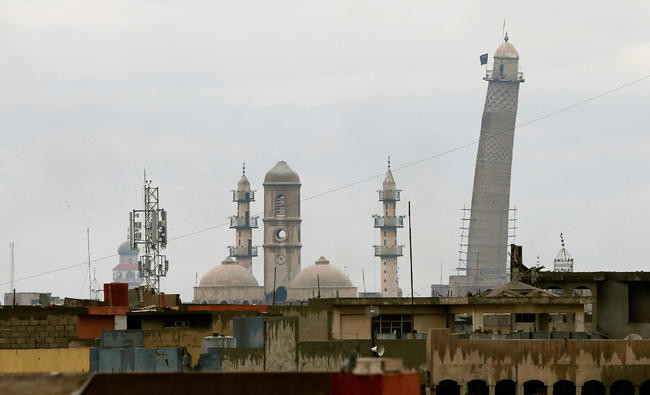
FILE PHOTO: A black jihadist flag hangs from Mosul's Al-Habda minaret at the Grand Mosque, where Islamic State leader Abu Bakr al-Baghdadi declared his caliphate back in 2014, as Iraqi forces battle to drive out Islamic state militants from the western part of Mosul, Iraq, March 16, 2017. REUTERS/Youssef Boudlal/File Photo
Updated 10 July 2017
Follow

Mosul loss huge, but not deadly blow to ‘caliphate’

BAGHDAD: Mosul was the largest city in the “caliphate” proclaimed by Daesh and its loss is a huge blow to the terrorists’ statehood experiment — but not a fatal one.
The northern Iraqi city was where Daesh leader Abu Bakr Al-Baghdadi made his only known public appearance in July 2014, announcing himself to the world as “caliph” during a Friday sermon at a mosque in the Old City.
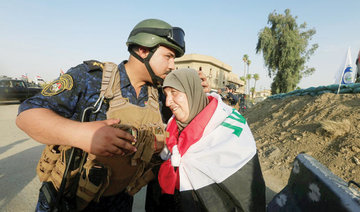
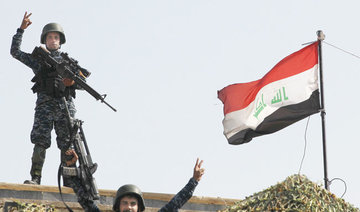
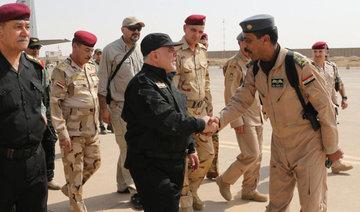
It took tens of thousands of Iraqi forces backed by Western warplanes and special forces nearly nine months to defeat Daesh, who leave behind them a heavily damaged city and exhausted security forces.
With Mosul, a city that had a population of around 2 million three years ago, the “caliphate” loses one of the main hubs of its administration and Daesh one of the most potent symbols of its might.
“It is a major blow to IS (Daesh’s) prestige,” said David Witty, an analyst and retired US special forces colonel.
The recapture of Mosul is the latest in a long string of setbacks for Daesh. At its peak, Daesh controlled a territory roughly the size of South Korea or Jordan and with a population of more than 10 million. It has now lost more than half of the land and three quarters of the population.
And a major offensive on its other de facto capital, the Syrian city of Raqqa, is gathering momentum. The group has not conquered new areas around the core of its “caliphate” since 2015, has lost thousands of fighters and is less attractive to foreign terrorists than it once was.
The fall of Mosul further reduces the so-called caliphate’s territorial contiguity, leaving more pockets of Daesh-held land completely isolated.
Yet analysts warn it is too early to declare final victory.
“We should not view the recapture of Mosul as the death knell for Daesh,” said Patrick Martin, Iraq analyst at the Institute for the Study of War, adding the group “still holds significant urban terrain,” notably in Syria.
Even in Iraq, where the terrorists lost more ground and only retain 7 percent of the territory they once had, declaring the caliphate dead “implies that Daesh can no longer control terrain and govern,” he said.
Yet “if security forces do not take steps to ensure that gains against Daesh are sustained for the long-term, then Daesh could theoretically resurge and recapture urban terrain,” Martin said.
As it attempts to save the remnants of the caliphate, the group is likely to intensify a transformation it has already begun by focusing more of its resources on guerrilla attacks and bombings.
“In the near-term in Iraq, IS (Daesh) will switch to terrorism and insurgency instead of trying to openly control major areas,” Witty said.
Martin said there was already a pattern of major Daesh attacks following military setbacks.
The deadliest ever bomb attack in Baghdad, in which more than 320 people were killed last year, came after Daesh lost its emblematic bastion of Fallujah.
The group also staged a major commando attack on the Kurdish-controlled city of Kirkuk days after the launch of the assault on Mosul, which was Iraq’s biggest military operation in years.
With its dreams of statehood on hold, Daesh is expected to revert to those types of attack and do everything it can to deny the Iraqi government any claim it has been eliminated.
“It is very easy to see this coming, and Iraq will likely be plagued by insecurity for years to come,” Witty said.
The reach of Daesh ideology remains one of the greatest threats in the world after three years that saw foreign affiliates mushroom far beyond the core of the “caliphate” and thousands of foreign fighters join the battlefield, with some returning home.


Washington presses Syria to shift from Chinese telecom systems

Updated 26 February 2026
Follow

Washington presses Syria to shift from Chinese telecom systems

  • Syria is exploring the possibility of procuring Chinese technology
  • It was unclear whether the United States ⁠pledged financial or logistical support to Syria to do so

DAMASCUS: The United States has warned Syria against relying on Chinese technology in its telecommunications sector, arguing it conflicts with US interests and threatens US national security, according to three sources familiar with the matter.
The message was conveyed during an unreported meeting between a US State Department team and Syrian Communications Minister Abdulsalam Haykal in San Francisco on Tuesday. Washington has been coordinating closely with Damascus since 2024, when Syria’s now President Ahmed Al-Sharaa ousted longtime leader Bashar Assad, who had a strategic partnership with China.
Syria is exploring the possibility of procuring Chinese technology to support its telecommunications towers and the infrastructure of local Internet service providers, according to a Syrian businessman involved in the procurement talks.
“The US side asked for clarity on the ministry’s plans regarding Chinese telecom equipment,” said ⁠another source briefed on ⁠the talks.
But Syrian officials said infrastructure development projects were time-critical and that Damascus was seeking greater vendor diversity, the source added.
SYRIAN OFFICIALS CITE US EXPORT CONTROLS AS TELECOMS BARRIER
Syria is open to partnering with US firms but the matter was urgent and export controls and “over-compliance” remained an issue, according to person familiar with the meeting in San Francisco.
A US diplomat familiar with the discussions told Reuters that the US State Department “clearly urged Syrians to use American technology or technology from allied countries in the telecoms sector.”
It was unclear whether the United States ⁠pledged financial or logistical support to Syria to do so.
Responding to Reuters questions, a US State Department spokesperson said: “We urge countries to prioritize national security and privacy over lower-priced equipment and services in all critical infrastructure procurement. If it seems too good to be true, it probably is.”
The spokesperson added that Chinese intelligence and security services “can legally compel Chinese citizens and companies to share sensitive data or grant unauthorized access to their customers’ systems” and promises by Chinese companies to protect customers’ privacy were “entirely inconsistent with China’s own laws and well-established practices.”
China has repeatedly rejected allegations of it using technology for spying purposes.
The Syrian Ministry of telecommunications told Reuters any decisions related to equipment and infrastructure are made “in accordance with national technical and security standards, ensuring data protection and service continuity.”
The ministry said it is also prioritizing the diversification of partnerships and technology sources to ⁠serve the national interest.
Syria’s telecom ⁠infrastructure has relied heavily on Chinese technology due to US sanctions imposed on successive Assad governments over the civil war that grew from a crackdown on anti-government protests in 2011.
Huawei technology accounts for more than 50 percent of the infrastructure of Syriatel and MTN, the country’s only telecom operators, according to a senior source at one of the companies and documents reviewed by Reuters. Huawei did not immediately respond to a request for comment.
Syria is seeking to develop its private telecommunications sector, devastated by 14 years of war, by attracting foreign investment.
In early February, Saudi Arabia’s largest telecom operator, STC, announced it would invest $800 million to “strengthen telecommunications infrastructure and connect Syria regionally and internationally through a fiber-optic network extending over 4,500 kilometers.”
The ministry of telecommunications says that US restrictions “hinder the availability of many American technologies and services in the Syrian market,” emphasizing that it welcomes expanding cooperation with US companies when these restrictions are lifted.
Syria has inadequate telecommunications infrastructure, with network coverage weak outside city centers and connection speeds in many areas barely exceeding a few kilobits per second.