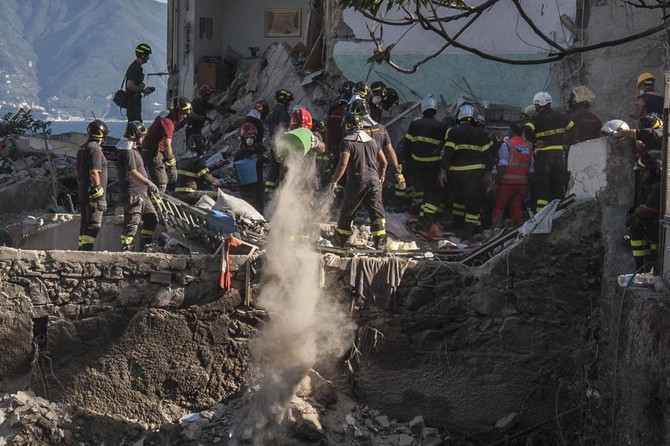
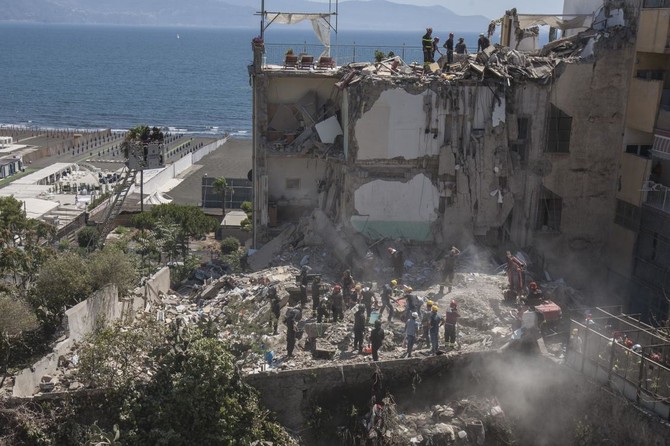
MILAN: Italian firefighters say eight bodies have been pulled from the rubble of a five-story apartment building that partially collapsed in a seaside town south of Naples.
The work of digging through the debris for victims ended Saturday morning, more than 24 hours after the residential building along a railway line suddenly collapsed. About 80 firefighters worked through the night with diggers, drills and by hand to locate the victims.
The cause remained under investigation, but authorities say it may be linked to renovation work on the building, located along the Naples-Salerno railway line in the town of Torre Annunziata.
Witnesses said there was no explosion before the collapse but that a train had just passed by. The Italian railway said vibrations from the train have no impact on adjacent buildings.

8 bodies pulled from the rubble in Italy building collapse
Italian PM pledges to deepen cooperation with African states
- The plan, launched in 2024, aims to promote investment-led cooperation rather than traditional aid
ADDIS ABABA: Italy pledged to deepen cooperation with African countries at its second Italy-Africa summit, the first held on African soil, to review projects launched in critical sectors such as energy and infrastructure during Italy’s first phase of the Mattei Plan for Africa.
The plan, launched in 2024, aims to promote investment-led cooperation rather than traditional aid.
Italy’s Prime Minister Giorgia Meloni addressed dozens of African heads of state and governments in Ethiopia’s capital, Addis Ababa, and reiterated that a successful partnership would depend on Italy’s “ability to draw from African wisdom” and ensure lessons are learned.
“We want to build things together,” she told African heads of state. “We want to be more consistent with the needs of the countries involved.”
Ethiopian Prime Minister Abiy Ahmed said Italy had provided Africa with a gateway to Europe through these partnerships.
“This is a moment to move from dialogue to action,” he said.
“By combining Africa’s energetic and creative population with Europe’s experience, technology, and capital, we can build solutions that deliver prosperity to our continents and beyond.”
After the Italy-Africa summit concluded, African leaders remained in Addis Ababa for the annual African Union Summit.
Kenyan writer and political analyst Nanjala Nyabola said tangible results from such summits depend on preparations made by countries.
African governments often focus on “optics instead of actually making summits a meaningful engagement,” she said.
Instead of waiting for a list of demands, countries should “present the conclusions of an extended period of mapping the national needs” and engage in dialogue to determine how those needs can be met.
Since it was launched two years ago, the Mattei Plan has directly involved 14 African nations and has launched or advanced around 100 projects in crucial sectors, including energy and climate transition, agriculture and food security, physical and digital infrastructure, healthcare, water, culture and education, training, and the development of artificial intelligence, according to the Italian government.