

Pakistan orders Shell pay at least $2.4m after tanker fire

Pakistan orders Shell subsidiary to pay at least $2 million for deadly tanker explosion.(AFP)
Updated 07 July 2017
Follow

Pakistan orders Shell pay at least $2.4m after tanker fire

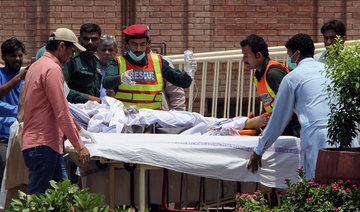
ISLAMABAD: Pakistan on Friday ordered Shell Pakistan to pay at least $2.4 million in compensation after more than 200 people were killed when one of its tankers overturned and exploded in a devastating inferno last month.
The tanker contracted by Royal Dutch Shell’s local subsidiary crashed on a main highway in central Punjab province while carrying some 50,000 liters of fuel from Karachi to Lahore on June 25.
It exploded minutes later, sending a fireball through crowds from a nearby village who had gathered to scavenge for the spilled fuel, despite warnings by the driver and police to stay away.
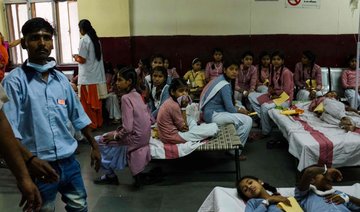
Health officials and police Friday put the death toll, which has continued to rise since the accident, at 218 people and said 38 victims were still in hospital, some in critical condition.
“OGRA (the Oil and Gas Regulatory Authority) has found Shell Pakistan responsible for the oil tanker incident and imposed a fine of 10 million rupees ($100,000) on it,” authority spokesman Imran Ghaznavi told AFP.
“Shell Pakistan has also been ordered to pay 1 million rupees compensation to the families of each deceased and 500,000 rupees for each of the injured,” he added.
That would require Shell pay at least $2.48 million to the families of the dead so far. It was not immediately clear how many wounded would receive compensation, or if the death toll might continue to increase.
Ghaznavi said OGRA had sent a list of 21 questions to Shell Pakistan about the accident, but had not yet received an answer.
OGRA’s investigation found that Shell never checked if the private tanker it had hired complied with safety standards, according to a report seen by AFP.

UN sanctions on militant group welcomed

Pakistan’s Foreign Ministry has praised the UN for imposing sanctions on a splinter group of the Pakistani Taliban, which is linked to deadly attacks in the country.
In a statement Friday, the ministry welcomed the move in which the UN Security Council on Thursday added the Jamaat-ul-Ahrar group to a list of organizations and individuals subject to freezing of assets, a travel ban and an arms embargo. The ministry said the UN took this step at Islamabad’s request.
Pakistan often claims that Jamaat-ul-Ahrar operates from neighboring Afghanistan. It imposed a ban on the group last year and launched a crackdown to trace and arrest its leadership.

US Justice Department official eyes cases against Cuba leaders as Trump floats ‘friendly takeover’

Updated 47 min 14 sec ago
Follow

US Justice Department official eyes cases against Cuba leaders as Trump floats ‘friendly takeover’

  • “Working group” formed to build cases against people connected to the Cuban government
  • Trump’s has increasingly displayed aggressive stance against Cuba’s communist leadership

MIAMI: The top Justice Department prosecutor in Miami is considering criminal investigations of Cuban government officials, according to people familiar with the matter. The inquiry comes as President Donald Trump has raised the possibility of a “friendly takeover” of the communist-run island.
Jason Reding Quiñones, the US attorney for the Southern District of Florida, has created a “working group” that includes federal prosecutors and officials from the Drug Enforcement Administration and other agencies to try to build cases against people connected to the Cuban government and its Communist Party, according to one of the people. They spoke on the condition of anonymity because they were not authorized to publicly discuss the effort.
It was not immediately clear which Cuban officials the office is targeting or what criminal charges prosecutors may be looking to bring.
The Justice Department said in a statement Friday that “federal prosecutors from across the country work every day to pursue justice, which includes efforts to combat transnational crime.”
The effort is taking place against the backdrop of Trump’s increasingly aggressive stance against Cuba’s communist leadership.
Emboldened by the US capture of Cuba’s close ally, Venezuelan President Nicolás Maduro, Trump last month said his administration was in high-level talks with officials in Havana to pursue “a friendly takeover” of the country. He repeated those claims this week, saying his attention would turn back to Cuba once the war with Iran winds down.
“They want to make a deal so bad,” Trump said of Cuba’s leadership.
While Cuba has faded from Washington’s radar as a major national security threat in recent decades, it remains a priority in the US Attorney’s office in Miami, whose political, economic and cultural life is dominated by Cuban-American exiles.
The FBI field office has a dedicated Cuba group that in 2024 was instrumental in the arrest of former US Ambassador Victor Manuel Rocha on charges of serving as a secret agent of Cuba stretching back to the 1970s.
In recent weeks, several Miami Republicans, in addition to Florida Sen. Rick Scott, have called on the Trump administration to reopen its criminal investigation into the 1996 shootdown of four planes operated by anti-communist exiles.
In a letter to Trump on Feb. 13, lawmakers including Reps. Maria Elvira Salazar and Carlos Gimenez highlighted decades-old news reports indicating that former President Raúl Castro — the head of Cuba’s military at the time — gave the order to shoot down the unarmed Cessna aircraft.
“We believe unequivocally that Raúl Castro is responsible for this heinous crime,” lawmakers wrote. “It is time for him to be brought to justice.”
While no indictment against Castro has been announced, Florida’s attorney general said this week that he would open a state-level investigation into the crime.
The Trump administration has also accused Cuba of not cooperating with American counterterrorism efforts, adding it alongside North Korea and Iran to a select few nations the US considers state sponsors of terrorism.
The designation stems from Cuba’s harboring of US fugitives and its refusal to extradite several Colombian rebel leaders while they were engaged in peace talks with the South American nation.