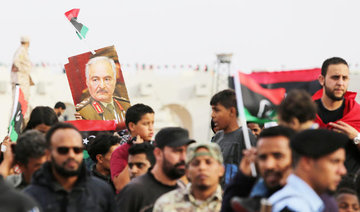
JEDDAH: A new era is dawning on the people of Benghazi, Libya’s second-largest city, after the military leader in the country’s east, Khalifa Haftar, said his National Libyan Army had fully liberated Benghazi from terrorism.
Libyan political analyst Mohammed Akila Al-Imami told Arab News: “One of the factors that helped Haftar liberate the city is the international isolation of Qatar, which forced its followers in Libya to stop their militant activity.”
He added: “The tough situation that has surrounded Benghazi for the past three years culminated on Thursday in liberating the pockets that were fortified in the areas extending from the port of Benghazi to the Zirea area that’s adjacent to the Sabri area.”
The area “extends over 20 km from northwest Benghazi toward the east, and over 5 km from the north toward the southwest,” Al-Imami said.
“This residential area was the last resort for extremists who chose to bear arms against their citizens and were linked to Al-Qaeda… They dug tunnels under the houses they occupied and placed snipers on the roofs.”
The eastern Parliament in Tobruk appointed Haftar as leader of the Libyan army after he refused to recognize the Government of National Accord in Tripoli, headed by Fayez Al-Sarraj.
Al-Imami said Haftar’s army enjoys increasing public support, and has been able to attract many volunteers and officers who graduated from the military academy.
The liberation of Benghazi has come at a high cost, with an estimated death toll of 5,200, he said, adding that the city’s people hope for a unified Libya.

Qatar isolation ‘helped Haftar liberate Benghazi’
Controversial Israeli minister enters area around Al-Aqsa Mosque on first Friday of Ramadan
- Far-right National Security Minister Itamar Ben-Gvir is seen making provocative remarks directed at Palestinians in presence of Israeli police
- It comes amid heightened Israeli security and restrictions on Palestinians entering the mosque, despite which an estimated 80,000 people attend first Friday prayers of the holy month
JERUSALEM: Israel’s far-right national security minister, Itamar Ben-Gvir, entered the area around Al-Aqsa Mosque on Friday, coinciding with the first Friday prayers of Ramadan.
Footage shared on social media showed him arriving through the Moroccan Gate, accompanied by the Israeli police commissioner, Daniel Levy, and the Jerusalem District police commander, Avshalom Peled.
Ben-Gvir was seen making provocative remarks directed at Palestinians in the presence of Israeli police officers, the Palestinian Wafa news agency reported.
The Moroccan Gate, located near Al-Buraq Wall, is one of the main entrances to Al-Aqsa and has been under Israeli control since 1967. It is regularly used by Israeli forces and settlers to access the mosque compound.
Jerusalem Governorate said the minister’s actions came amid heightened Israeli security measures and tighter restrictions on Palestinian in occupied Jerusalem during Ramadan.
Despite this, an estimated 80,000 worshippers attended the first Friday prayers of Ramadan at Al-Aqsa Mosque, according to figures provided by the Islamic Waqf Department in Jerusalem.
From early in the morning, Israeli forces imposed strict controls on Palestinians traveling from the West Bank to Jerusalem. Dozens of elderly worshippers were reportedly turned back at the Qalandia and Bethlehem checkpoints after being told they lacked the necessary permits.
Security forces also briefly detained four paramedics and disrupted the work of journalists and medical teams at Qalandia, witnesses said.
Additional security measures were also enforced at entrances to Jerusalem’s Old City and the gates of Al-Aqsa, with young men subjected to identity checks and a number of worshippers denied access.