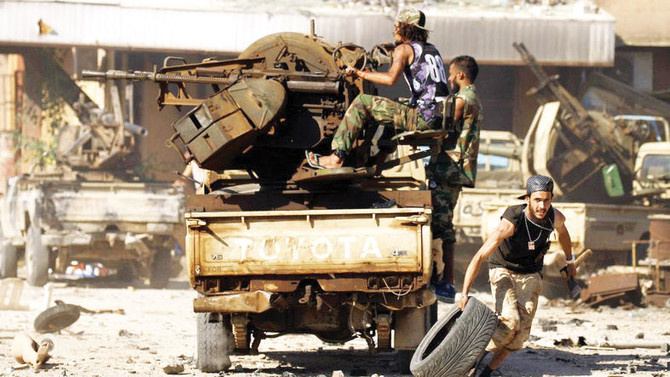
BENGHAZI: Forces loyal to east Libya strongman Khalifa Haftar said Wednesday they have cornered the last jihadists in a neighborhood of second city Benghazi and vowed that victory is “imminent.”
The self-styled Libyan National Army said fighting in Soug Al-Hout neighborhood was over and its soldiers had advanced into the central district of Al-Sabri where they were surrounding the last jihadists.
LNA General Abdessalam Al-Hassi told AFP the jihadists were cornered in a small part of Al-Sabri and coming under attack from air strikes as well as ground forces on three fronts.
Haftar’s forces have retaken most of Benghazi since the eastern coastal city was overrun by jihadists in 2014.
Last week a medical source in the city said 44 LNA soldiers had been killed in June alone in Al-Sabri and Soug Al-Hout.
Hassi said the “total liberation of Benghazi from jihadists is imminent.”
A spokesman for the LNA special forces, Col. Miloud Al-Zwei, said Haftar’s forces were getting ready “to launch an assault on Al-Joumhouriya hospital and Al-Jarid market” in Al-Sabri.
Benghazi, cradle of the 2011 uprising that toppled and killed Libya’s veteran dictator Muammar Qaddafi, was overrun by several jihadist groups.
These include the Revolutionary Shoura Council of Benghazi, an alliance of Islamist militias among them suspected members of the Daesh and the Al-Qaeda-linked Ansar Al-Sharia.

Libya forces corner jihadists in Benghazi district
US makes plans to reopen embassy in Syria after 14 years
- The administration has been considering re-opening the embassy since last year
- Trump told reporters on Friday that Al-Sharaa was “doing a phenomenal job” as president
WASHINGTON: The Trump administration has informed Congress that it intends to proceed with planning for a potential re-opening of the US Embassy in Damascus, Syria, which was shuttered in 2012 during the country’s civil war.
A notice to congressional committees earlier this month, which was obtained by The Associated Press, informed lawmakers of the State Department’s “intent to implement a phased approach to potentially resume embassy operations in Syria.”
The Feb. 10 notification said that spending on the plans would begin in 15 days, or next week, although there was no timeline offered for when they would be complete or when US personnel might return to Damascus on a full-time basis.
The administration has been considering re-opening the embassy since last year, shortly after longtime strongman Bashar Assad was ousted in December 2024, and it has been a priority for President Donald Trump’s ambassador to Turkiye and special envoy for Syria, Tom Barrack.
Barrack has pushed for a deep rapprochement with Syria and its new leadership under former rebel Ahmad Al-Sharaa and has successfully advocated for the lifting of US sanctions and a reintegration of Syria into the regional and international communities.
Trump told reporters on Friday that Al-Sharaa was “doing a phenomenal job” as president. “He’s a rough guy. He’s not a choir boy. A choir boy couldn’t do it,” Trump said. “But Syria’s coming together.”
Last May, Barrack visited Damascus and raised the US flag at the embassy compound, although the embassy was not yet re-opened.
The same day the congressional notification was sent, Barrack lauded Syria’s decision to participate in the coalition that is combating the Daesh militant group, even as the US military has withdrawn from a small, but important, base in the southeast and there remain significant issues between the government and the Kurdish minority.
“Regional solutions, shared responsibility. Syria’s participation in the D-Daesh Coalition meeting in Riyadh marks a new chapter in collective security,” Barrack said.
The embassy re-opening plans are classified and the State Department declined to comment on details beyond confirming that the congressional notification was sent.
However, the department has taken a similar “phased” approach in its plans to re-open the US Embassy in Caracas, Venezuela, following the US military operation that ousted former President Nicolás Maduro in January, with the deployment of temporary staffers who would live in and work out of interim facilities.