Malaysia joins Indonesia in call for Starbucks boycott

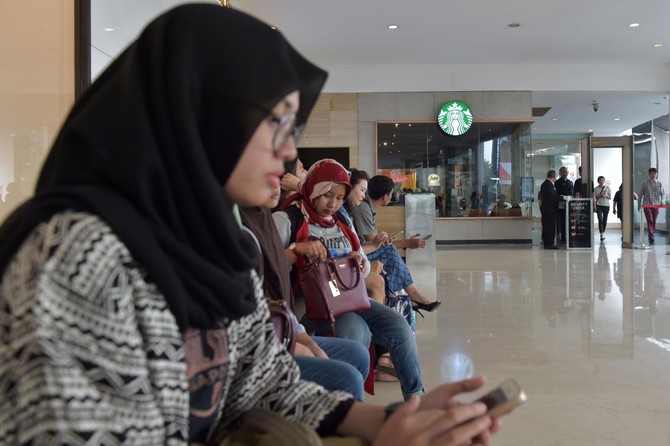
This photo taken on July 4, 2017 shows Indonesian Muslim women sitting outside a Starbucks cafe at a shopping mall in Jakarta. Muslims in Indonesia and Malaysia were urged to boycott Starbucks on July 4 by major Islamic groups accusing the coffee chain of being pro-gay rights, as concerns grow over rising religious conservatism in both nations. (AFP)
Updated 06 July 2017
Follow

Malaysia joins Indonesia in call for Starbucks boycott

JAKARTA: Muslim groups in Malaysia and Indonesia have called for a boycott of Starbucks because of the coffee chain’s support for LGBT rights.
Malaysian group Perkasa, which supports a hard-line form of Islam and nationalism, this week called on its more than 500,000 members to stay away from Starbucks coffee shops. This week and last, leaders of Indonesia’s second largest mainstream Muslim group, Muhammadiyah, with an estimated 29 million members, denounced the chain.
The groups were apparently reacting to comments made several years ago by former CEO Howard Schultz in support of gay rights that drew renewed attention amid an increasingly anti-LGBT climate in both of the predominantly Muslim countries.
Perkasa said in a statement that the Malaysian government should revoke the trading license given to Starbucks and other companies such as Microsoft and Apple that support LGBT rights and same-sex marriage.
Amini Amir Abdullah, who heads Perkasa’s Islamic affairs bureau, said Muslims should stay away from Starbucks because its pro-gay rights policy is against Islam and Malaysia’s constitution.
Sodomy is illegal in Malaysia and punishable by up to 20 years in prison. Homosexuality is not illegal in Indonesia, the world’s most populous Muslim nation, but a case before the Constitutional Court is seeking to criminalize gay sex and sex outside of marriage.
A boycott Starbucks hashtag was briefly popular on Twitter in Indonesia and shares of the company that operates Starbucks in the country fell sharply this week. But its stores in the capital Jakarta appeared as popular as ever.
Gavin Bowring, a Malaysia analyst at risk consulting company Eurasia Group, said the boycott was unlikely to amount to much but reflected “a growing tendency toward conservatism and strict adherence to Islamic principles.”


Gaza student evacuated to UK with her family after government climbdown

Updated 9 sec ago
Follow

Gaza student evacuated to UK with her family after government climbdown

  • Manar Al-Houbi was initially denied permission to bring her husband and children after changes to UK rules on foreign scholarship recipients
  • Several students still stranded in Gaza as relocation deadline looms, after refusing to abandon family members

LONDON: A student from Gaza granted permission to live and study in the UK has been evacuated from the Palestinian territory, with her family, by the British government.

Manar Al-Houbi won a full scholarship to study for a doctorate at the University of Glasgow. It also allowed her to bring her husband and children with her, and they applied for the required visas. But shortly before her studies were due to start, UK authorities told her the rules for international students and their dependents had changed and her family could no longer accompany her.

Shortly after her story was reported in October, however, the government backed down as said it would consider evacuation of international students’ dependents on a “case-by-case basis.”

Al-Houbi and her family are now in Jordan, on their way to the UK, The Guardian newspaper reported on Friday. The British scheme for the evacuation of students from Gaza is due to expire on Dec. 31. People who have attempted to use it have described it as being riddled with issues, as a result of which some students with scholarships have been left stranded in the Palestinian territory.

Several told the Guardian they had decided not to travel to the UK because they had felt pressured into leaving loved ones behind, including children.

Wahhaj Mohammed, 32, said he was told by the Foreign, Commonwealth and Development Office to travel to the UK alone, and his wife and children would be allowed to join him later. Two months after he arrived in Glasgow, his family are still in Gaza with no time frame for them to follow him.

“The uncertainty affects every aspect of my life here,” he told The Guardian. “It’s difficult to settle, to feel present or to engage academically when the people you love most remain living under constant threat.”

The Guardian said UK officials were “hopeful” his family would be evacuated in 2026 but could offer no guarantee about when this might happen.

Another student, Amany Shaher, said she refused to leave her family behind in Gaza and as a result was denied permission to travel to the UK this week. She does not know whether she will be permitted to defer her scholarship to study at the University of Bristol.

The 34-year-old, who has three children, said: “How can I even consider leaving my children behind in Gaza? Nowhere else in the world would a mother be expected to part so easily from her children. It’s dehumanizing. We have a right to stick together as a family and not be forced to separate — that should not be too much to ask.

“None of us know if the UK’s student evacuation scheme will be extended or not. We haven’t been given any clear guidance or timelines and have no idea what 2026 will bring.”

Mohammed Aldalou also refused to leave behind his family, including his 5-year-old autistic and non-verbal son, to take up a scholarship for postgraduate studies at the London School of Economics.

He said the Foreign Office had suggested to him he travel separately from them, as they did with Mohammed.

“They should ask themselves what they would do if they were in my shoes,” he said. “It’s heartbreaking that after everything we’ve been through, we’re being asked to make this impossible decision.”

Sources told The Guardian it was unlikely the Foreign Office would extend the scheme to allow students to travel from Gaza to the UK later, but that a meeting took place last week with the Department for Education to discuss whether students could begin their studies online.