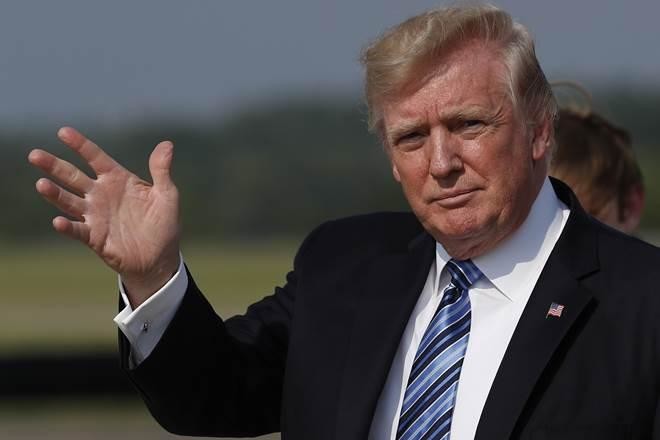
BERLIN: US President Donald Trump meets other world leaders at Germany’s G20 summit from Friday, with North Korea’s first successful test of an intercontinental ballistic missile casting a long shadow over the gathering at the heavily-fortified venue.
The rising global threat posed by Pyongyang is likely to see conflicts over climate and trade take a back seat as regional neighbors China, Japan and South Korea gather with Trump and Russian strongman Vladimir Putin in Hamburg.
“Testing an ICBM represents a new escalation of the threat to the United States, our allies and partners, the region, and the world,” US Secretary of State Rex Tillerson said, confirming North Korea now possessed a weapon capable of reaching US territory.
Russia and China condemned Tuesday’s test and the European Union may consider additional sanctions.
All eyes will be on Trump, who had vowed North Korea’s goal of possessing an ICBM “won’t happen” and has repeatedly pressed China to rein in its truculent neighbor.
In the most anticipated moment of the G20, Trump will meet Putin, the ex-KGB agent accused of having aided, with hackers and fake news, the surprise rise of the property tycoon into the White House.
The moment they shake hands is sure to see “an Olympian level of macho posturing between these two leaders, who both understand the importance of symbolism and the perception of being tough,” said Derek Chollet of the German Marshall Fund of the United States.
Trump ruffled other leaders at a G7 meeting in Italy in May and has steered the economic and military superpower on an isolationist “America First” course.
His counterparts are bracing for fresh surprises after Trump stunned the world by pulling out of the 2015 Paris climate pact, questioned long-standing NATO allegiances and dismissed free trade principles.
Trouble is also brewing at the conference table at a time when the West and Europe are deeply divided, the post-Cold War order is fraying and China and Russia are asserting themselves on the global stage.
“There is a danger that the summit will lead to polarization between the US and other countries” on climate change and other issues, warned Oxford Analytics economist Adam Slater.
Trade wars loom as Trump has demanded Germany and China reduce their huge surpluses and threatened other countries with punitive measures in battles over steel, natural gas and hormone-treated beef.
The year’s gathering of the Group of 20 big industrialized and emerging economies, the biggest diplomatic event outside the UN, will also provide a stage for other world leaders muscling for power and regional influence.
Chinese President Xi Jinping will meet regional rival Japan’s Prime Minister Shinzo Abe, at a time when both are worried about North Korea.
Also looming over the summit will be the bloody conflict in Syria and the frozen one in Ukraine — both involving Russia — as well as the struggle for Mideast dominance between Saudi Arabia and Iran.
Then there is Turkey’s President Recep Tayyip Erdogan, whose crackdown on alleged coup plotters, civil society and Kurds after a 2016 putsch attempt has poisoned relations with Germany.
Trump, before the summit, will meet leaders from ex-communist eastern European nations, including Hungary’s authoritarian Viktor Orban — threatening to deepen a new east-west split in the EU, which is facing Brexit and still recovering from divisions over the debt crisis.
The US president will on Thursday meet the summit host, German Chancellor Angela Merkel, the longest-serving leader and, aside from Britain’s Theresa May, the only woman in the club.
Merkel, hailed by some as the “new leader of the free world,” advocates an internationalist approach to global issues — but her G20 motto, “Shaping an Interconnected World,” contrasts sharply with Trump’s go-it-alone approach.
The chancellor — a green energy champion who has allowed more than a million mostly Muslim refugees into Germany since 2015 — said last week that “the differences are obvious and it would be dishonest to try to cover that up. That I won’t do.”
In Hamburg, she must walk a fine line between trying to build a 19-1 front against Trump on key issues and preventing even further damage to transatlantic ties, while seeking common ground for at least a watered-down G20 final communique.
Some 20,000 police will guard the leaders against anti-capitalist protesters who have greeted them with the combative slogan “G20 — Welcome to Hell.”
Up to 100,000 protesters are expected, a diverse group of environmentalists, peace and anti-poverty activists, united in the belief that the global elite is failing to solve the pressing global problems.
“We think that they all deserve our protest and our resistance from the streets,” said one left-wing activist, Georg Ismael, 25.
“We are demonstrating against the G20 because we don’t think that they represent the interests of humanity.

Trump, world leaders head to G20 summit under North Korea shadow
Australia Day protesters demand Indigenous rights
SYDNEY: Thousands of people rallied in cities across Australia demanding justice and rights for Indigenous peoples on Monday, a national holiday marking the 1788 arrival of a British fleet in Sydney Harbor.
Crowds took to the streets in Sydney, Melbourne, Canberra, Perth and other cities on Australia Day, many with banners proclaiming: “Always was, always will be Aboriginal land.”
In Sydney, police allowed the protests to go ahead despite new curbs introduced after gunmen opened fire on a Jewish Hanukkah festival on Bondi Beach on December 14, killing 15 people.
Millions of Australians celebrate the annual holiday with beers and backyard barbecues or a day by the sea, and this year a broad heatwave was forecast to push the temperature in South Australian capital Adelaide to 45C.
Shark sightings forced people out of the water at several beaches in and around Sydney, however, after a string of shark attacks in the region this month — including one that led to the death of a 12-year-old boy.
Many activists describe the January 26, 1788, British landing as “Invasion Day,” a moment that ushered in a period of oppression, lost lands, massacres and Indigenous children being removed from their families.
Aboriginal and Torres Strait Islander peoples make up about four percent of the population.
They still have a life expectancy eight years shorter than other Australians, higher rates of incarceration and deaths in custody, steeper youth unemployment and poorer education.
- Anti-immigration protests -
“Let’s celebrate on another day, because everyone loves this country and everyone wants to celebrate. But we don’t celebrate on a mourning day,” Indigenous man Kody Bardy, 44, told AFP in Sydney.
Another Indigenous protester in Sydney, 23-year-old Reeyah Dinah Lotoanie, called for people to recognize that a genocide happened in Australia.
“Ships still came to Sydney and decided to kill so many of our people,” she said.
Separately, thousands of people joined anti-immigration “March for Australia” protests in several cities, with police in Melbourne mobilizing to keep the two demonstrations apart.
In Sydney, “March for Australia” protesters chanted, “Send them back.” Some carried banners reading: “Stop importing terrorists” or “One flag, one country, one people.”
“There’s nowhere for people to live now, the hospitals are full, the roads are full, you’ve got people living on the streets,” said one demonstrator, 66-year-old Rick Conners.
Several also held aloft placards calling for the release of high-profile neo-Nazi Joel Davis, who is in custody after being arrested in November on allegations of threatening a federal lawmaker.
“There will be no tolerance for violence or hate speech on Sydney streets,” New South Wales Premier Chris Minns told reporters.
“We live in a beautiful, multicultural community with people from around the world, but we will not tolerate a situation where on Australia’s national day, it’s being pulled down by divisive language, hate speech or racism,” he said.
“Police are ready and willing to engage with people that breach those rules.”
Crowds took to the streets in Sydney, Melbourne, Canberra, Perth and other cities on Australia Day, many with banners proclaiming: “Always was, always will be Aboriginal land.”
In Sydney, police allowed the protests to go ahead despite new curbs introduced after gunmen opened fire on a Jewish Hanukkah festival on Bondi Beach on December 14, killing 15 people.
Millions of Australians celebrate the annual holiday with beers and backyard barbecues or a day by the sea, and this year a broad heatwave was forecast to push the temperature in South Australian capital Adelaide to 45C.
Shark sightings forced people out of the water at several beaches in and around Sydney, however, after a string of shark attacks in the region this month — including one that led to the death of a 12-year-old boy.
Many activists describe the January 26, 1788, British landing as “Invasion Day,” a moment that ushered in a period of oppression, lost lands, massacres and Indigenous children being removed from their families.
Aboriginal and Torres Strait Islander peoples make up about four percent of the population.
They still have a life expectancy eight years shorter than other Australians, higher rates of incarceration and deaths in custody, steeper youth unemployment and poorer education.
- Anti-immigration protests -
“Let’s celebrate on another day, because everyone loves this country and everyone wants to celebrate. But we don’t celebrate on a mourning day,” Indigenous man Kody Bardy, 44, told AFP in Sydney.
Another Indigenous protester in Sydney, 23-year-old Reeyah Dinah Lotoanie, called for people to recognize that a genocide happened in Australia.
“Ships still came to Sydney and decided to kill so many of our people,” she said.
Separately, thousands of people joined anti-immigration “March for Australia” protests in several cities, with police in Melbourne mobilizing to keep the two demonstrations apart.
In Sydney, “March for Australia” protesters chanted, “Send them back.” Some carried banners reading: “Stop importing terrorists” or “One flag, one country, one people.”
“There’s nowhere for people to live now, the hospitals are full, the roads are full, you’ve got people living on the streets,” said one demonstrator, 66-year-old Rick Conners.
Several also held aloft placards calling for the release of high-profile neo-Nazi Joel Davis, who is in custody after being arrested in November on allegations of threatening a federal lawmaker.
“There will be no tolerance for violence or hate speech on Sydney streets,” New South Wales Premier Chris Minns told reporters.
“We live in a beautiful, multicultural community with people from around the world, but we will not tolerate a situation where on Australia’s national day, it’s being pulled down by divisive language, hate speech or racism,” he said.
“Police are ready and willing to engage with people that breach those rules.”
© 2026 SAUDI RESEARCH & PUBLISHING COMPANY, All Rights Reserved And subject to Terms of Use Agreement.