Schaeuble hoping growth will end stimulus

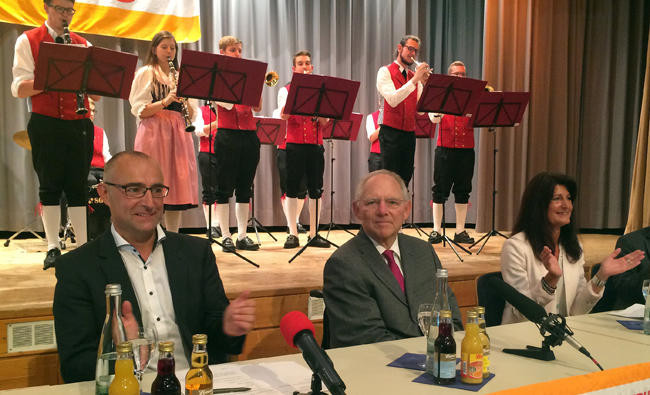
German Finance Minister Wolfgang Schaeuble attends a Christian Democratic Union CDU party meeting in the Black Forest town of Sasbachwalden, Germany on July 3, 2017. Schaeuble says Euro zone growth is stronger than expected and this will enable the European Central Bank (ECB) to slowly normalize its monetary policy and end a “crazy situation” of negative interest rates. (REUTERS/Michael Nienaber)
Updated 04 July 2017
Follow

Schaeuble hoping growth will end stimulus

SASBACHWALDEN, Germany: Euro zone growth is stronger than expected and this will enable the European Central Bank (ECB) to slowly normalize its monetary policy and end a “crazy situation” of negative interest rates, German Finance Minister Wolfgang Schaeuble said on Monday.
Senior German government officials have stepped up the pressure on the ECB to scale back its monetary stimulus of bond purchases and sub-zero rates as Germany heads toward federal elections and voters complain about meager savings returns.
Critics of the ECB’s decision to buy sovereign bonds on the secondary market also argue that the program has reduced pressure on euro zone governments to implement reforms.
Speaking to voters in his constituency in the southern state of Baden-Wuerttemberg less than three months before the Sept. 24 election, Schaeuble said the euro zone was recovering surprisingly well and the threat of deflation had vanished.
Schaeuble said that inflation in the euro zone was slowly picking up and that it was moving toward the ECB’s price stability target of just under 2 percent.
This development would help ECB policymakers find a case for normalization of their ultra-loose monetary policy, he added. “We must quickly come back to a situation in which interest rates are what they used to be,” Schaeuble said.
He also pointed out that euro zone governments still had some work to do when it comes to reforms and that France and Germany next week would press ahead with proposals to strengthen bilateral cooperation and European integration.
The veteran finance minister, 74, is the longest serving lawmaker in the Bundestag lower house of Parliament and he will run for another four years as a parliamentarian in September.
“I am ready to continue,” Schaeuble told the crowd of some 400 voters in the tiny Black Forest town of Sasbachwalden near Offenburg. “But for this, we first need a clear majority.”


Saudi Arabia, Japan trade rises 38% between 2016 and 2024, minister says

Updated 11 January 2026
Follow

Saudi Arabia, Japan trade rises 38% between 2016 and 2024, minister says

RIYADH: Trade between Saudi Arabia and Japan has increased by 38 percent between 2016 and 2024 to reach SR138 billion ($36 billion), the Kingdom’s investment minister revealed.

Speaking at the Saudi-Japanese Ministerial Investment Forum 2026, Khalid Al-Falih explained that this makes the Asian country the Kingdom’s third-largest trading partner, according to Asharq Bloomberg.

This falls in line with the fact that Saudi Arabia has been a very important country for Japan from the viewpoint of its energy security, having been a stable supplier of crude oil for many years.

It also aligns well with how Japan is fully committed to supporting Vision 2030 by sharing its knowledge and advanced technologies.

“This trade is dominated by the Kingdom's exports of energy products, specifically oil, gas, and their derivatives. We certainly look forward to the Saudi private sector increasing trade with Japan, particularly in high-tech Japanese products,” Al-Falih said.

He added: “As for investment, Japanese investment in the Kingdom is good and strong, but we look forward to raising the level of Japanese investments in the Kingdom. Today, the Kingdom offers promising opportunities for Japanese companies in several fields, including the traditional sector that links the two economies: energy.”

The minister went on to note that additional sectors that both countries can also collaborate in include green and blue hydrogen, investments in advanced industries, health, food security, innovation, entrepreneurship, among others.

During his speech, Al-Falih shed light on how the Kingdom’s pavilion at Expo 2025 in Osaka achieved remarkable success, with the exhibition receiving more than 3 million visitors, reflecting the Japanese public’s interest in Saudi Arabia.

“The pavilion also organized approximately 700 new business events, several each day, including 88 major investment events led by the Ministry of Investment. Today, as we prepare for the upcoming Expo 2030, we look forward to building upon Japan’s achievements,” he said.

The minister added: “During our visit to Japan, we agreed to establish a partnership to transfer the remarkable Japanese experience from Expo Osaka 2025 to Expo Riyadh 2030. I am certain that the Japanese pavilion at Expo Riyadh will rival the Saudi pavilion at Expo Osaka in terms of organization, innovation, and visitor turnout.”

Al-Falih also shed light on how Saudi-Japanese relations celebrated their 70th anniversary last year, and today marks the 71st year of these relations as well as how they have flourished over the decades, moving from one strategic level to an even higher one.