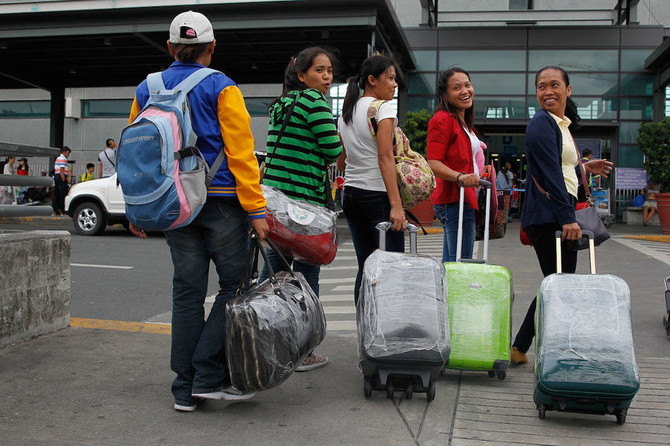
The Philippine labor department by the end of July will start to issue identification cards for overseas Filipino workers and do away with the overseas employment certificates being required before they are deployed abroad.
“We will start implementing I-DOLE (Department of Labor and Employment) cards to all bona fide OFWs at no cost. This will be the substitute for the OECs,” labor secretary Silvestre Bello III said in a live commentary with Presidential Communications Office assistant secretary Margaux Uson over Facebook.
The initiative, one of the major priorities under president Rodrigo Duterte’s administration, will be launched on July 12.
Filipinos working abroad have long complained about the difficulty of obtaining OECs whenever they have to go back home or return to their workplaces since they have to hurdle long queues just to get one.
Aside from providing the basic information and replacing the OEC, the ID will also serve as the migrant workers’ Social Security System (SSS), Pag-ibig Fund and PhilHealth membership IDs.
The labor secretary, in a separate briefing at Malacañan Palace, also said that they are exploring a system that would allow the I-DOLE cards to also be designated passport of OFWs.
“We are talking to the DFA (Department of Foreign Affairs) and the DOJ (Department of Justice) through its agency, the Bureau of Immigration, so that the IDOLE may be used as a passport,” he said.
There are approximately 10 million OFWs in 170 countries, with 1 million in Saudi Arabia alone, followed by Japan, Hong Kong, the United Arab Emirates and Taiwan.
Last year, OFW remittances reached a record $26.9 billion, up 5 percent from $25.61 billion in 2015 with almost 80 percent of the amount send from countries like Saudi Arabia, the UAE, Kuwait, Qatar, Singapore, Germany, Hong Kong, Japan, the UK and the US.
All bonafide OFWs will be given an IDOL (Identification ID of Labor) or an OFW ID Card which will served as replacement of OEC - Bello
— DOLE Philippines (@laborgovph) July 4, 2017