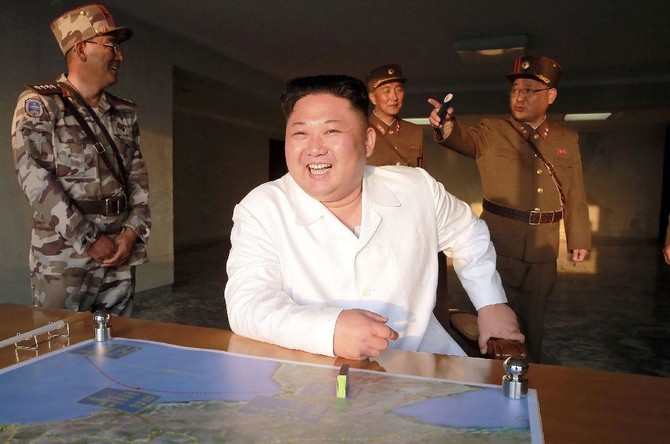
SEOL: North Korea launched a ballistic missile Tuesday as the US prepared to mark its Independence Day, triggering a Twitter outburst from President Donald Trump who urged China to “end this nonsense once and for all.”
Analysts said the rocket could bring Alaska within range of the North’s devices.
The launch was the latest in a series of provocations that have ratcheted up tensions over the nuclear-armed North’s weapons ambitions, and came days after Seoul’s new leader Moon Jae-In and Trump focused on the Pyongyang threat in their first summit.
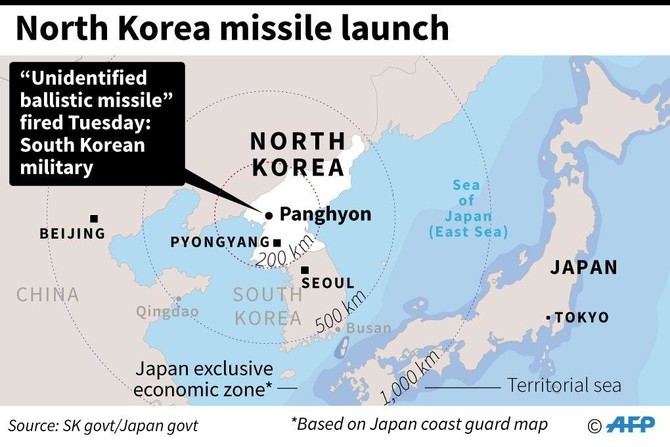
The “unidentified ballistic missile” was fired from a site in North Phyongan province, the South’s Joint Chiefs of Staff said in a statement, and came down in the East Sea, the Korean name for the Sea of Japan.
It flew for “more than 930 kilometers,” they added.
The device may have come down in Japan’s exclusive economic zone, a spokeswoman for Tokyo’s defense ministry told AFP — waters extending 200 nautical miles from its coast.
Japanese Chief Cabinet Secretary Yoshihide Suga said the missile flew “for about 40 minutes” — an unusually long flight time, with Prime Minister Shinzo Abe telling reporters: “This launch clearly shows that the threat has grown.”
The US, Japan and South Korea will hold a summit on the sidelines of this week’s G20 meeting on the issue, he added. “Also I will encourage President Xi Jinping and President Putin to take more constructive measures.”
The United Nations has imposed multiple sets of sanctions on Pyongyang over its weapons programs, which retorts that it needs nuclear arms to defend itself against the threat of invasion.
It has a goal of developing a missile capable of delivering a warhead to the US mainland — something that Trump has vowed “won’t happen.”
There are doubts whether the North can miniaturise a nuclear weapon sufficiently to fit it onto a missile nose cone, or master the technology needed for it to survive re-entry into the Earth’s atmosphere.
But analysts say the isolated, impoverished country has made great progress in its military capabilities in the years since young leader Kim Jong-Un inherited power.
In response to the latest launch, Trump asked on Twitter: “Does this guy have anything better to do with his life?“
US Pacific Command confirmed the test and said it was a land-based, intermediate range missile that flew for 37 minutes and did not pose a threat to North America.
But David Wright, of the Union of Concerned Scientists, said the available figures implied a significant increase in the range of Pyongyang’s missiles.
The missile would have had to have flown on a “very highly lofted trajectory” and reached a maximum altitude of more than 2,800 kilometers, he said.
“If the reports are correct, that same missile could reach a maximum range of roughly 6,700 km on a standard trajectory,” he wrote on the organization’s allthingsnuclear blog.
“That range would not be enough to reach the lower 48 states or the large islands of Hawaii, but would allow it to reach all of Alaska.”
The North has carried out multiple launches since Moon — who backs engagement with the North but also stresses the need for sanctions — was elected in May, and he summoned the South’s National Security Council in response to the latest firing.
Shea Cotton, a researcher at the James Martin Center for Nonproliferation Studies in the US, suggested the launch was deliberately timed to coincide with the anniversary of the US declaration of independence.
“It’s already 4th of July in North Korea,” he said on Twitter. “I somewhat suspect they’re shooting off some fireworks today specifically because of that.”
Washington, South Korea’s security guarantor, has more than 28,000 troops in the country to defend it from its Communist neighbor, and fears of conflict reached a peak earlier this year as the Trump administration suggested military action was an option under consideration.
There has also been anger in the United States after Otto Warmbier, an American student detained in North Korea on a tourist trip around 18 months ago, was returned home in a coma in June, dying days later.
Trump has been pinning his hopes on China — North Korea’s main diplomatic ally — to bring pressure to bear on Pyongyang.
Last week he declared that Beijing’s efforts had failed, but returned to the idea on Twitter following the launch: “Perhaps China will put a heavy move on North Korea and end this nonsense once and for all!“
But a former foreign policy adviser to Hillary Clinton warned that his comments risked undermining the credibility of both the US deterrent, and its assurances to its allies in Seoul and Tokyo.
She added: “Picking a twitter fight with a nuclear-armed dictator is not wise — this is not reality TV anymore.”

N.Korea fires ballistic missile that ‘could reach Alaska’
Russia thinks it can outsmart the US during Ukraine peace talks, a European intelligence chief says
LONDON: Russian officials have no desire to halt Russia’s almost 4-year-old invasion of neighboring Ukraine and think they can “outsmart” the United States during talks with Washington about how to end the war, a senior European intelligence official told The Associated Press.
Kaupo Rosin, the head of Estonia’s foreign intelligence service, said Moscow is playing for time in the talks with Washington and “there is absolutely no discussion about how to really cooperate with the US in a meaningful way.”
Rosin, who spoke at an online briefing with reporters ahead of the publication of Estonia’s annual security report on Tuesday, said the findings were based on intelligence his country gathered from “Russian internal discussions.” He did not elaborate on how the information was obtained.
Russian officials have publicly insisted they want a negotiated deal, but they show little willingness to compromise and remain adamant their demands must be met.
US-brokered talks between envoys from Russia and Ukraine in recent weeks have been described by officials from both sides as constructive and positive, but there has been no sign of any progress on key issues in the discussions.
Russian President Vladimir Putin, “in his head, still thinks that he can actually militarily win (in Ukraine) at some point,” Rosin said.
A White House official responded to the Estonian intelligence chief’s comments and said the president’s negotiators had made “tremendous progress” on the talks to end the war in Ukraine. Although prisoner exchanges have happened sporadically since May, they pointed in particular to a recent agreement in Abu Dhabi among the US, Ukraine and Russia to release more than 300 prisoners.
That agreement was evidence that efforts to end the war are advancing, said the official, who was granted anonymity because they did not have permission to speak publicly.
In an indication that US President Donald Trump wants to accelerate the momentum of peace efforts, Ukrainian President Volodymyr Zelensky said last week that Washington has given Ukraine and Russia a June deadline to reach a settlement. Trump over the past year has set several deadlines that have come and gone without apparent consequences.
Fiona Hill, a Russia expert and adviser to Trump in his first term, said Trump and his officials are spinning a story that depicts the US president as a peacemaker and, for that reason, they are not interested in changing their assessment that Putin wants to end the war.
Both leaders, she told the AP, “need their version of events to play out” and are hanging on to their version of the truth — Putin as the victor in Ukraine and Trump as the dealmaker.
It’s unclear why US officials believe Putin wants peace
Although Trump has repeatedly suggested that Putin wants peace, he has sometimes appeared frustrated with the Russian leader’s lukewarm approach to talks.
From an intelligence perspective, Rosin said he doesn’t know why US officials believe the Russian leader wants to end the war.
Hill, who served as a national intelligence officer under previous US administrations, said it’s unclear what intelligence information Trump gets on Russia — or if he reads it.
He relies heavily on his lead negotiators, special envoy Steve Witkoff and son-in-law Jared Kushner, who Hill said may struggle to believe that the damage to the Russian economy caused by the war is a price Putin is willing to pay for Ukraine.
Referring to reports that Witkoff has attended meetings with Putin without a US State Department translator, she questioned if Trump’s envoys understood what was being said in meetings and suggested officials may be “selectively” looking for what they want to hear.
Being told what they want to hear
Putin is fixated on controlling all of Ukraine and the idea “is so deep in his head” that it takes priority over anything else, including economics, Rosin said, suggesting that the conflict will continue in some form for several years.
He said Putin’s position may change only if the situation in Russia, or on the front line, becomes “catastrophic,” threatening his power. For now, the Russian leader still believes he can take Ukraine and “outsmart everybody,” Rosin said.
One reason Putin thinks he can win militarily in Ukraine is because he is “definitely” getting some incorrect information from his officials, the Estonian intelligence chief said.
Not all Russian officials, however, believe they are winning the war in Ukraine, Rosin said.
“The lower you go in the food chain,” the more people understand “how bad it is actually on the ground,” he said, whereas higher up, officials are more optimistic because they are given more positive reports. Rosin cited examples of officials being told Russian forces had captured Ukrainian settlements when that was not true.
The reports that arrive at Putin’s desk may be “much more optimistic” than the situation on the ground because Putin only wants to see success, Rosin said.
Hill said both Trump and Putin are probably being told what they want to hear by people who want to please them.
Kaupo Rosin, the head of Estonia’s foreign intelligence service, said Moscow is playing for time in the talks with Washington and “there is absolutely no discussion about how to really cooperate with the US in a meaningful way.”
Rosin, who spoke at an online briefing with reporters ahead of the publication of Estonia’s annual security report on Tuesday, said the findings were based on intelligence his country gathered from “Russian internal discussions.” He did not elaborate on how the information was obtained.
Russian officials have publicly insisted they want a negotiated deal, but they show little willingness to compromise and remain adamant their demands must be met.
US-brokered talks between envoys from Russia and Ukraine in recent weeks have been described by officials from both sides as constructive and positive, but there has been no sign of any progress on key issues in the discussions.
Russian President Vladimir Putin, “in his head, still thinks that he can actually militarily win (in Ukraine) at some point,” Rosin said.
A White House official responded to the Estonian intelligence chief’s comments and said the president’s negotiators had made “tremendous progress” on the talks to end the war in Ukraine. Although prisoner exchanges have happened sporadically since May, they pointed in particular to a recent agreement in Abu Dhabi among the US, Ukraine and Russia to release more than 300 prisoners.
That agreement was evidence that efforts to end the war are advancing, said the official, who was granted anonymity because they did not have permission to speak publicly.
In an indication that US President Donald Trump wants to accelerate the momentum of peace efforts, Ukrainian President Volodymyr Zelensky said last week that Washington has given Ukraine and Russia a June deadline to reach a settlement. Trump over the past year has set several deadlines that have come and gone without apparent consequences.
Fiona Hill, a Russia expert and adviser to Trump in his first term, said Trump and his officials are spinning a story that depicts the US president as a peacemaker and, for that reason, they are not interested in changing their assessment that Putin wants to end the war.
Both leaders, she told the AP, “need their version of events to play out” and are hanging on to their version of the truth — Putin as the victor in Ukraine and Trump as the dealmaker.
It’s unclear why US officials believe Putin wants peace
Although Trump has repeatedly suggested that Putin wants peace, he has sometimes appeared frustrated with the Russian leader’s lukewarm approach to talks.
From an intelligence perspective, Rosin said he doesn’t know why US officials believe the Russian leader wants to end the war.
Hill, who served as a national intelligence officer under previous US administrations, said it’s unclear what intelligence information Trump gets on Russia — or if he reads it.
He relies heavily on his lead negotiators, special envoy Steve Witkoff and son-in-law Jared Kushner, who Hill said may struggle to believe that the damage to the Russian economy caused by the war is a price Putin is willing to pay for Ukraine.
Referring to reports that Witkoff has attended meetings with Putin without a US State Department translator, she questioned if Trump’s envoys understood what was being said in meetings and suggested officials may be “selectively” looking for what they want to hear.
Being told what they want to hear
Putin is fixated on controlling all of Ukraine and the idea “is so deep in his head” that it takes priority over anything else, including economics, Rosin said, suggesting that the conflict will continue in some form for several years.
He said Putin’s position may change only if the situation in Russia, or on the front line, becomes “catastrophic,” threatening his power. For now, the Russian leader still believes he can take Ukraine and “outsmart everybody,” Rosin said.
One reason Putin thinks he can win militarily in Ukraine is because he is “definitely” getting some incorrect information from his officials, the Estonian intelligence chief said.
Not all Russian officials, however, believe they are winning the war in Ukraine, Rosin said.
“The lower you go in the food chain,” the more people understand “how bad it is actually on the ground,” he said, whereas higher up, officials are more optimistic because they are given more positive reports. Rosin cited examples of officials being told Russian forces had captured Ukrainian settlements when that was not true.
The reports that arrive at Putin’s desk may be “much more optimistic” than the situation on the ground because Putin only wants to see success, Rosin said.
Hill said both Trump and Putin are probably being told what they want to hear by people who want to please them.
© 2026 SAUDI RESEARCH & PUBLISHING COMPANY, All Rights Reserved And subject to Terms of Use Agreement.