WASHINGTON: Saudi Foreign Minister Adel Al-Jubeir said measures taken against Qatar were painful considering its status as a brotherly and neighboring country, but were warranted due to its support for terrorist and extremist organizations, as well as its interference in the internal affairs of other countries.
In an interview with journalists at the Saudi Embassy in Washington, he said such interference was rejected not only by countries boycotting Qatar, but by all countries. He expressed hope that wisdom will prevail in Doha to put an end to such interventionism.
“We presented our list of demands to Qatar and clarified our position and took our decision, and the list of demands is non-negotiable and must be fully enforced,” said Al-Jubeir.
During his visit to the US, he participated in meetings with 30 members of the Senate and House of Representatives in Congress, and with heads of committees from the House of Representatives.
Meanwhile, Saudi Ambassador to the UN Abdullah Al-Mouallimi said Qatar insisted on destabilizing Saudi and regional security, and supporting terrorism that threatens the whole world.
Doha is participating with Tehran in creating regional chaos, and Saudi Arabia, the UAE, Bahrain and Egypt have taken a sovereign decision to boycott Qatar in order to maintain security and press it to stop supporting terrorism, he added.
Qatar has chosen to be an ally of Iran, and for 20 years has supported terrorist groups with knowledge of their plots against countries in the region, Al-Mouallimi said. This has made Qatar a primary haven for terrorists, who are allowed to conspire against other countries, he added.
Doha was given several opportunities to stop supporting terrorism and interfering in the internal affairs of other countries, most recently in 2013 and 2014, but it did not comply, he said.

Al-Jubeir: Measures against Qatar painful but necessary
Crown prince sponsors launch of world-class Arabic calligraphy center in Madinah
- The Prince Mohammed bin Salman Global Center for Arabic Calligraphy was inaugurated by Prince Salman bin Sultan bin Abdulaziz
RIYADH: A new center for Arabic calligraphy under the patronage of Crown Prince Mohammed bin Salman officially opened in Madinah on Monday.
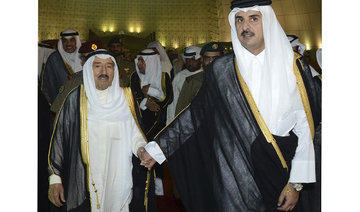
The Prince Mohammed bin Salman Global Center for Arabic Calligraphy was inaugurated by Prince Salman bin Sultan bin Abdulaziz, governor of Madinah region.
He was joined by Culture Minister Prince Badr bin Abdullah bin Farhan, touring the new facility’s exhibition spaces and receiving briefings on cultural programming and the center’s achievements.
They also viewed collections highlighting Arabic calligraphy’s artistic and historical importance.
Speaking at the opening, Prince Badr said: “From this land of enlightenment and scholarship, we proudly launch a global platform dedicated to Arabic calligraphy as an invaluable cultural asset.”
He went on to credit the crown prince’s “generous and boundless support” for the cultural sector.
The minister said that the center demonstrated to the world the legacy of Arabic calligraphy while underscoring Saudi Arabia’s commitment to safeguarding its cultural identity and heritage.
According to Prince Badr, the facility represents an ambitious vision to elevate Arabic calligraphy as both a universal communication tool and an integral element of Arab heritage, art, architecture and design.
The center further aims to enhance the Kingdom’s cultural identity and strengthen its international presence, targeting calligraphers, emerging talents, visual artists, Islamic arts researchers, educational and cultural institutions, as well as art and heritage enthusiasts worldwide.
It will deliver specialized programs including research and archival services, calligraphy instruction, academic grants, a permanent museum, touring exhibitions, an international calligraphy association and a business incubator supporting calligraphy enterprises.
Additional offerings feature artist residency programs, expert-led workshops, and standardized curriculum development, complemented by international educational partnerships aimed at heritage conservation and expanding global appreciation for this time-honored art form.
The center’s establishment in Madinah carries particular significance, given the city’s historical role as the cradle of Arabic calligraphy and its association with transcribing the Qur’an and preserving Islamic knowledge.