

New York mosque receives letter threatening a ‘massacre on a scale never seen’

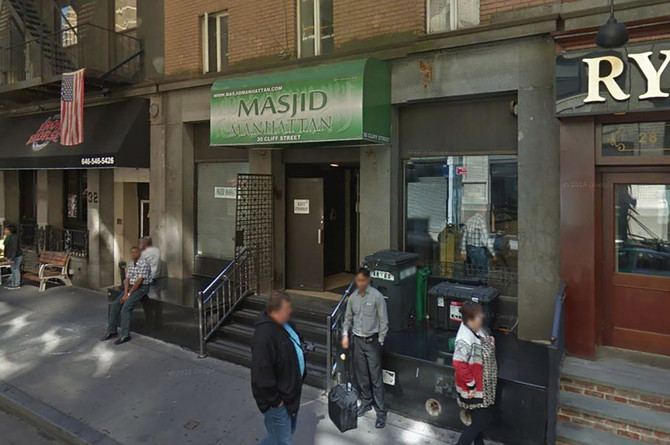
An official at Masjid Manhattan Mosque told police the letter had been mailed from London. (Photo courtesy: Google Maps)
Updated 23 June 2017
Follow

New York mosque receives letter threatening a ‘massacre on a scale never seen’

DUBAI: A mosque in New York received a letter threatening a massacre “on a scale never seen,” the New York Post reported Thursday.
An official at Masjid Manhattan Mosque told police the letter had been mailed from London and had been received on Wednesday afternoon.
According to the newspaper’s police source, the letter read: “We will be coming to your Mosque in August to carry out a massacre… It will be on a scale never seen.”
The threat is being investigated by the New York Police Department’s Hate Crimes Task Force.
Local elected officials released a joint statement Thursday, reading, “Threatening a massacre at a house of worship is fundamentally an attack on the values and core principles of our nation, our city, and our borough.”
“A political climate that fosters hatred and fear continues to have very real consequences in our neighborhoods,” state senator Daniel Squadron, congressman Jerrod Nadler, Manhattan Borough President Gale Brewer, assemblywoman Yuh-Line Niou and councilwoman Margaret Chin said in the statement.

“We stand united with the Muslim community and all New Yorkers in denouncing this threat, and the hateful rhetoric that creates this climate.”
The news comes after a 47-year-old man drove a van into worshippers exiting London’s Finsbury Park Mosque this week, injuring 10 people.

Myanmar, Afghan hopeful scholars mourn UK study visa ban

Updated 4 sec ago
Follow

Myanmar, Afghan hopeful scholars mourn UK study visa ban

  • Myanmar, Afghanistan, Sudan and Cameroon citizens will be barred from obtaining university visas
  • Britain’s travel block is “really painful” for Afghan women hoping to escape to an education abroad, said one female

YANGON, Myanmar: Aspiring students are lamenting Britain’s ban on education visas for their war-weary countries — dashing dreams of bettering themselves and their home nations.
Myanmar, Afghanistan, Sudan and Cameroon citizens will be barred from obtaining university visas, London announced this week, saying asylum applications by visiting students had “rocketed” nearly 500 percent from 2021 to 2025.
“It’s like the country is punishing the weak, the most vulnerable people,” said one woman from Myanmar.
She was preparing for a scholarship interview for a master’s in climate change finance when her plans were upended by Downing Street’s decree on Wednesday.
“I could not focus the whole morning,” the 28-year-old told AFP from Yangon, speaking on condition of anonymity for security reasons in a country riven by civil war since a 2021 military coup.
“I can’t picture my future.”
Like in much of the developed world, immigration has become a divisive issue in Britain.
Efforts to beat back arrivals mirror the sweeping travel bans issued by US President Donald Trump which have shut out citizens of Myanmar, Sudan and Afghanistan.
Since the chaotic military withdrawal of Britain, the United States and other NATO nations in 2021, Afghanistan has been ruled by a resurgent Taliban government which has banned women over age 12 from attending school.
Britain’s travel block is “really painful” for Afghan women hoping to escape to an education abroad, said one female child social worker in Ghazni province, who asked to remain anonymous for security reasons.
She has now canceled her plans to study for a master’s in both the US and the UK.
“Now I am trying to be hopeful, but I think it would also be a mistake,” said the 27-year-old.
In the summer of 2024, Arefa Mohammadi fled to neighboring Pakistan, living in limbo as she applied to universities.
She got an offer to study public health in England but now cannot accept it.
“It was truly shocking for me,” said the 24-year-old.
“This situation put me in a place where I haven’t any goals, because all my goals and all my futures are unpredictable.”

- ‘Cruel and short-sighted’ -
In Kabul, a 39-year-old man faces similar heartbreak.
He was accepted to study specialist subjects related to water management at three universities in England and Scotland.
“When I was a child I witnessed several challenges like flash floods, water scarcity, environmental neglect, inefficient irrigation systems,” he said, asking to remain anonymous for security reasons. “To address these challenges I made my application.”
“I hoped to acquire modern knowledge. It’s impossible to acquire in Afghanistan,” he added.
Some 33 million people in the country face severe water shortages, aid agencies say, a result of compounding multi-year droughts, climate change and infrastructure battered by decades of war.
Britain’s Labour government made the decision to curb visas as the right-wing Reform UK party surges in opinion polls with its hard-line stance against immigration.
The UK Home Office said almost 135,000 asylum seekers had entered the country through legal routes since 2021.
Activist organization Burma Campaign UK called the visa ban “exceptionally cruel and shortsighted.”
“The opportunity to come to the UK to study is life-changing for the individual student but also an investment in the future of Myanmar,” said program director Zoya Phan in a statement.
One exiled Myanmar journalist has been living over the border in Thailand after escaping the military rule which has clamped down on press freedoms.
“When the military coup happened I was just 22, so I had a lot of dreams,” she said. “But over the past five years there have been a lot of struggles — I couldn’t complete my dreams.”
Every year since the junta takeover she applied for further education to buoy her spirits.
But she received an email Thursday morning canceling her place to study for a master’s at a London university.
“Everything is gone,” she said. “My UK dream is all disappeared.”