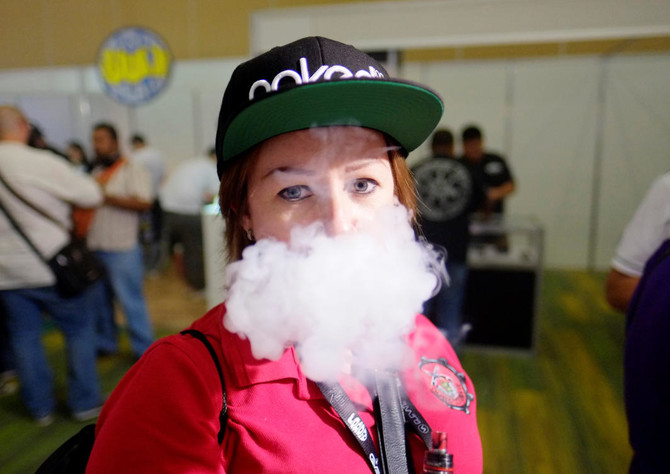
San Francisco to ban sales of vaping flavored liquid

San Francisco approved a measure that bans the sale of flavored nicotine-laced liquid. (Reuters)
Updated 22 June 2017
Follow

San Francisco to ban sales of vaping flavored liquid

SAN FRANCISCO: San Francisco city supervisors unanimously approved a measure that bans the sale of flavored nicotine-laced liquid used in electronic cigarettes and flavored tobacco products, saying nicotine masked in cotton candy, banana cream, mint and other flavors entices kids into a lifetime of addiction.
Other cities have passed laws reducing access to flavored vaping liquids and flavored tobacco but San Francisco is the first in the country to approve a sales ban.
Sales of vaping liquids that taste like tobacco will still be allowed.
“We’re focusing on flavored products because they are widely considered to be a starter product for future smokers,” said Supervisor Malia Cohen, who sponsored the bill.
Gregory Conley, president of the American Vaping Association, a nonprofit organization that advocates for vaping products, said the ordinance is “complete nonsense” and ignores the benefits of flavored vaping products.
“There is a great deal of evidence that flavors are critical to helping adults quit smoking by helping them disconnect from the taste of tobacco,” said Conley, who quit smoking in 2010 with the help of watermelon flavored “e-liquid,” the liquid used in electronic cigarettes.
Conley pointed to a report by the Centers for Disease Control and Prevention released last week that found the number of high school and middle school students using e-cigarettes fell to 2.2 million last year, from 3 million the year before. The CDC also estimates that the number of middle and high school students using tobacco products fell to 3.9 million last year, from 4.7 million the year before.
“Unfortunately, San Francisco supervisors ignored that data and the stories about how vaping was the only thing that helped many smokers quit,” he said.
The measure approved Tuesday requires another vote by the board next week, which is expected to pass. The law would take effect in April 2018.
Cohen, who represents the historically black Bayview-Hunters Point neighborhood, said tobacco companies advertise 10 times more in black neighborhoods and market candy and fruit flavored products to young people, the LGBTQ community and other minorities.
“For too many years, the tobacco industry has selectively targeted our young adults with products that are deceptively associated with fruits and mint and candy,” said Cohen, whose grandmother smoked menthol cigarettes for years and died of emphysema.
“Menthol cools the throat so you don’t feel the smoke and the irritants and it masks the flavors. This legislation is about saying enough is enough,” she added.
Businesses that violate the law could have their city tobacco sales permits suspended.
Small business owners have said they will lose business because people can still buy the flavored “e-liquid” and tobacco products in neighboring cities or purchase them online and have them delivered to their San Francisco homes.
“Those tobacco products aren’t 100 percent of our revenue, but they are an anchor product,” Miriam Zouzounis, a board member of the Arab American Grocers Association whose father owns a small corner store, told the San Francisco Chronicle.
She added: “Even at 15 percent of our stock, it’s what brings people through the door. We can’t compete with Safeway or Walgreens for food and milk items, let alone the online retailers filling the gap for everything else.”
The San Francisco ban is the latest restriction on tobacco products approved in California. The state’s cigarette tax increased in April by $2 per pack, more than doubling the previous tax of 87 cents a pack.
Last year, Gov. Jerry Brown approved tougher tobacco regulations as part of a special legislative session on health care. The state’s legal age to buy tobacco was boosted from 18 to 21 and existing regulations governing tobacco were extended to electronic cigarettes.
Federal law bans sales of flavored cigarettes. But it does not prohibit the sale of menthol cigarettes or flavored tobacco products other than cigarettes.


US talks with hard-line Venezuelan minister Cabello began months before raid

Updated 11 sec ago
Follow

US talks with hard-line Venezuelan minister Cabello began months before raid

NEW YORK/MIAMI/WASHINGTON: Trump administration officials had been in discussions with Venezuela’s hard-line interior minister Diosdado Cabello months before the US operation to seize President Nicolas Maduro, and have been in communication with him since then, according to multiple people familiar with the matter.
The officials warned Cabello, 62, against using the security services or militant ​ruling-party supporters he oversees to target the country’s opposition, four sources said. That security apparatus, which includes the intelligence services, police and the armed forces, remains largely intact after the January 3 US raid.
Cabello is named in the same US drug-trafficking indictment that the Trump administration used as justification to arrest Maduro, but was not taken as part of the operation.
The communication with Cabello, which has also touched on sanctions the US has imposed on him and the indictment he faces, dates back to the early days of the current Trump administration and continued in the weeks just prior to the US ouster of Maduro, two sources familiar with the discussions said. The administration has also been in touch with Cabello since Maduro’s ouster, four of the people said.
The communications, which have not been previously reported, are critical to the Trump administration’s efforts to control the situation inside Venezuela. If Cabello decides to unleash the forces that he controls, it ‌could foment the kind ‌of chaos that Trump wants to avoid and threaten interim President Delcy Rodriguez’s grip on power, according ‌to ⁠a source ​briefed on ‌US concerns.
It is not clear if the Trump administration’s discussions with Cabello extended to questions about the future governance of Venezuela. Also unclear is whether Cabello has heeded the US warnings. He has publicly pledged unity with Rodriguez, whom Trump has so far praised.
While Rodriguez has been seen by the US as the linchpin for US President Donald Trump’s strategy for post-Maduro Venezuela, Cabello is widely believed to have the power to keep those plans on track or upend them.
The Venezuelan minister has been in contact with the Trump administration both directly and via intermediaries, one person familiar with the conversations said.
All of the sources were granted anonymity to speak freely about sensitive internal government communications with Cabello.
The White House and the government of Venezuela did not immediately respond to requests for comment.

CABELLO HAS BEEN MADURO LOYALIST
Cabello has long been seen ⁠as Venezuela’s second most powerful figure. A close aide of late former President Hugo Chavez, Maduro’s mentor, he went on to become a long-time Maduro loyalist, feared as his main enforcer of repression. Rodriguez and Cabello have ‌both operated at the heart of the government, legislature and ruling socialist party for years, but ‍have never been considered close allies of each other.
A former military officer, ‍Cabello has exerted influence over the country’s military and civilian counterintelligence agencies, which conduct widespread domestic espionage. He has also been closely associated with pro-government militias, notably ‍the colectivos, groups of motorcycle-riding armed civilians who have been deployed to attack protesters.
Cabello is one of a handful of Maduro loyalists Washington has relied on as temporary rulers to maintain stability while it accesses the OPEC nation’s oil reserves during an unspecified transition period.
But US officials are concerned that Cabello — given his record of repression and a history of rivalry with Rodriguez — could play the spoiler, according to a source briefed on the administration’s thinking.
Rodriguez has been working to consolidate her own power, installing loyalists in key positions ​to protect herself from internal threats while meeting US demands to boost oil production, Reuters interviews with sources in Venezuela have shown.
Elliott Abrams, who served as Trump’s special representative on Venezuela in his first term, said many Venezuelans would expect Cabello to be removed ⁠at some point if a democratic transition is to advance.
“If and when he goes, Venezuelans will know that the regime has really begun to change,” said Abrams, now at the Council on Foreign Relations think tank.

US SANCTIONS AND INDICTMENT
Cabello has long been under US sanctions for alleged drug trafficking.
In 2020, the US issued a $10 million bounty for Cabello and indicted him as a key figure in the “Cartel de los Soles,” a group the US has said is a Venezuelan drug-trafficking network led by members of the country’s government.
The US has since raised the award to $25 million. Cabello has publicly denied any links to drug trafficking.
In the hours after Maduro’s ouster, some analysts and politicians in Washington questioned why the US didn’t also grab Cabello — listed second in the Department of Justice indictment of Maduro.
“I know that just Diosdado is probably worse than Maduro and worse than Delcy,” Republican US Representative Maria Elvira Salazar said in an interview with CBS’s “Face the Nation” on January 11.
In the days following, Cabello denounced American intervention in the country, saying in a speech that “Venezuela will not surrender.”
But media reports of residents being searched at checkpoints — sometimes by uniformed members of the security forces and sometimes by people in plain clothes — have become less frequent in recent days.
And both Trump and the Venezuelan government have said many detainees who are considered ‌by the opposition and rights groups to be political prisoners will be released.
The government has said that Cabello, in his role as interior minister, is overseeing that effort. Rights groups say the liberations are proceeding extremely slowly and hundreds remain unjustly detained.