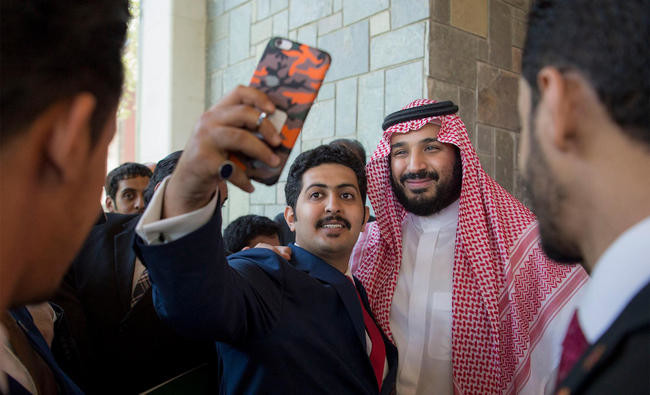
RIYADH: Prince Mohammed bin Salman on Wednesday was elevated to the position of crown prince and deputy prime minister, and will maintain his post as minister of defense.
Born on Aug. 31, 1985, Prince Mohammed bin Salman, the son of King Salman, received his education at Riyadh schools where he ranked among the top 10 students in his class. He received his bachelor’s degree in law from King Saud University (KSU), where he graduated second in his class.
Prince Mohammed gained international experience in corporate governance and international finance. He began his political career as a consultant to the Experts Commission under the Saudi Cabinet.
On Dec. 15, 2009, Prince Mohammed bin Salman was appointed special adviser to then-Prince Salman bin Abdul Aziz, who at the time was governor of Riyadh province.
He was also a special adviser to the chairman of the board for the King Abdul Aziz Foundation for Research and Archives (Darah), and then became supervisor of the crown prince’s office.
In March 2013, by royal decree, Prince Mohammed was appointed head of the crown prince’s court with the rank of minister and special adviser to then-Crown Prince Salman. On April 25, 2014, he was appointed as a state minister and member of the Cabinet.
His long history of philanthropic initiatives earned him many awards. In 2011, he established the Prince Mohammed bin Salman bin Abdulaziz Foundation (MiSK), which enables young Saudis to learn, develop and progress in the fields of business, literature, culture, science and technology, and sociology.
Following the demise of King Abdullah in 2015, King Salman ascended to the throne and appointed Prince Mohammed as deputy crown prince, second deputy premier and minister of defense. He has also served as chief of the Royal Court, and chairs the powerful Council for Economic and Development Affairs.
Last year, the crown prince moved into what he described as his most important role: Transforming the Kingdom’s economy and reducing its dependence on oil revenues.
On April 25, 2016, the Saudi government unveiled Vision 2030, including a series of developmental, economic and social programs. The same day, Al Arabiya News Channel aired an exclusive interview with Prince Mohammed. During the interview, the crown prince pledged to end the Saudi economy’s dependence on oil revenues by 2020. Prince Mohammed also discussed measures to lift subsidies on the Kingdom’s wealthy citizens and assist the country’s poor.
The measures, as part of Vision 2030, will be implemented on everyone, “including princes and government ministers,” Prince Mohammed said. “This is a promise.”
In an interview with prominent news outlet Bloomberg earlier in April 2016, Prince Mohammed discussed the Kingdom’s soon-to-be unveiled National Transformation Plan (NTP) 2020, part of Vision 2030.
At the time, he told Bloomberg that the Kingdom would dramatically expand its Public Investment Fund, a sovereign wealth fund, to reach around $2 trillion in assets. The sale of around 5 percent of Saudi Aramco’s shares would be placed into the fund, he added. “What is left now is to diversify investments,” he said. “So, within 20 years, we will be an economy or state that doesn’t depend mainly on oil.”
In a second, even longer interview with Bloomberg later that month, Prince Mohammed further expanded on his plans to transform the Kingdom’s economy. The interview also highlighted the prince’s personal life — his long hours, fluency in English, love of reading books by Sun Tzu and Winston Churchill, and his choice to have just one wife.
The crown prince has represented King Salman abroad, traveling to Beijing, Moscow and Washington, where he met President Donald Trump in March.
In an interview with Al Arabiya, former US President Barack Obama described him as “extremely knowledgeable, very smart” and “wise beyond his years.”
Last year, Prince Mohammed visited Silicon Valley to sell his vision of market-oriented reforms and a transformation of the Kingdom’s economy and society.
In recent years, Prince Mohammed has become the government’s face of reform, modernization and change. In the Kingdom, where around 60 percent of the population is under 30, the young crown prince is widely seen as an icon in the push toward socio-economic reforms.


![]()
Profile: Saudi Crown Prince Mohammed bin Salman
Profile: Saudi Crown Prince Mohammed bin Salman
Related


Latest updates


© 2026 SAUDI RESEARCH & PUBLISHING COMPANY, All Rights Reserved And subject to Terms of Use Agreement.