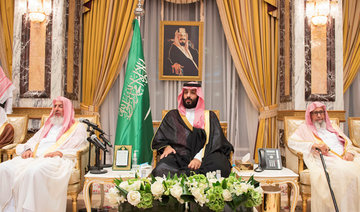
Prince Mohammed bin Naif leads Saudis into pledging allegiance to new crown prince

Crown Prince Mohammed bin Salman, left, kisses the hand of Prince Mohammed bin Naif at Al-Safa Palace in Makkah on Wednesday. (SPA)
Updated 22 June 2017
Follow

Prince Mohammed bin Naif leads Saudis into pledging allegiance to new crown prince

JEDDAH: Former Crown Prince Mohammed bin Naif led Saudis into pledging allegiance to the new Crown Prince Mohammed bin Salman on Wednesday.
Prince Mohammed bin Naif pledged allegiance to the new crown prince at Al-Safa Palace.
In a viral video that has been circulated widely on social media, Prince Mohammed bin Naif is seen pledging allegiance to Crown Prince Mohammed bin Salman.
Organization of Islamic Cooperation (OIC) Secretary General Yousef A. Al-Othaimeen expressed his congratulations to King Salman over this choice, given Prince Mohammed’s experience, wisdom and vision in the management of the affairs of the Kingdom, his dedication to the service of his religion, nation and Ummah, and his commitment to taking far-reaching steps on joint actions in the interest of the Islamic world.
Sheikh Mohammad Abdulkarim Al-Issa, secretary-general of the Makkah-based Muslim World League (MWL), described the appointment of the new crown prince as successful and promising given the national and international prestige Mohammed bin Salman enjoys.
In a statement issued Wednesday, Al-Issa said Prince Mohammed bin Salman had always served his religion first, and his country, king and nation second.
Head of the Council of Pakistanis Scholars Sheikh Al-Hafiz Mohammad Taher Mahmoud Ashrafi, backed the royal decree and said that the appointment is a wise step taken by King Salman and Saudi Arabia’s Allegiance Council, as Prince Mohammed is known for his ethics and leadership, as seen in Vision 2030.


Healthcare must be ‘proactive’ says Hevolution exec

Updated 4 sec ago
Follow

Healthcare must be ‘proactive’ says Hevolution exec

  • Princess Dr. Haya bint Khaled bin Bandar Al-Saud spoke to Arab News at a presentation of its second Global Healthspan Report

RIYADH: Healthcare needs to shift to a global model that targets preventing disease rather than treating it, a senior executive from the Saudi-funded Hevolution Foundation told Arab News.

The senior vice president of research of Hevolution, Princess Dr. Haya bint Khaled bin Bandar Al-Saud, spoke to Arab News at a presentation of its second Global Healthspan Report at the nonprofit’s headquarters in Riyadh’s KAFD on Wednesday.

“People have to be aware, healthcare has to change its way of thinking, because it’s a must,” she said. “We cannot be reactive anymore, we have to be proactive.

“And this has to start earlier in the education of health professionals, and third, someone needs to take this to the global agenda. The general public needs to know that this is a reality.” 

Launching its report, Hevolution called for urgent global action to treat healthy aging as an economic imperative, where prevention, not disease, drives prosperity.

The organization focuses on healthspan research, or extending the healthy human lifespan.

The findings of the report centered around five main areas; rising awareness and public demand, breakthrough science and new therapies, AI and data revolution, investment momentum and gaps and economic and policy imperatives.

The report detailed the momentum of a new healthspan era where science, technology and public awareness are converging, but momentum alone is not enough.

Al-Saud explained that achieving equitable and evidence-based progress would require coordinated leadership from scientists, policymakers and investors alike.

“Today, science and societal cause has to be integrated, meaning the public needs to know that everything that we are investing in is for the general population, not just on a local level but on a global level,” she said.

The report surveyed 23 countries on the awareness of healthspan, which found that two-thirds of healthcare professionals now receive patient inquiries about healthspan interventions at least once a month, with one-third reporting them weekly.

Al-Saud highlighted that the report also found that 80 per cent of citizens believed governments should fund preventive care programs, while 39 per cent expressed concern about inequality in access.

“Awareness is the most important thing. This subject touches every single one of us, every single one of us has a story that this relates to, whether a grandparent, sick parent, or us,” she said.

Under artificial intelligence the report found that 74 per cent of experts believe AI will transform healthspan R&D and healthcare delivery, yet 26–30 per cent remain opposed to AI in diagnostics, reflecting an ongoing trust and ethics gap.

The report detailed that 59 per cent of investors cite lack of awareness as the top barrier while 46 per cent point to limited experts, unclear evidence and weak regulatory frameworks.

“Between 2022 and 2024 the investments in healthspan has doubled, it’s estimated to be $7 billion invested in finding interventions in healthspan globally,” Al-Saud said.

Investment in healthspan reached $7.33 billion in 2024, up from $3.48 billion the previous year. The average deal size has grown 77 per cent since 2020, signaling maturing confidence in the sector.

“Hevolution Foundation remains the world’s largest philanthropic backer of aging biology and healthspan science, with $400 million allocated in over 230 grants, 25 partnerships, and four biotech ventures,” Al-Saud said.

According to a report from Hevolution, expanding could deliver up to $220 billion annually in productivity gains, and every $1 invested in prevention could yield $16 in returns.

“We always want to support scientists but the end-consumer is the general public,” Al-Saud said.

Hevolution has remained true to its mission since its foundation; to extend healthy human lifespan for all, mobilizing the science, innovation and investment needed to make healthier longer lives a shared global reality.

Established by royal decree in 2018 and launched in 2021, Hevolution Foundation is a non-profit organization that focuses on accelerating independent research and entrepreneurship in the emerging field of healthspan science.

Headquartered in Riyadh, Saudi Arabia, with a North American hub in Boston, the foundation says it has plans for further international expansion, and has set key goals and targets to advance its vision and mission.