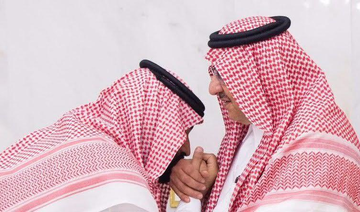
JEDDAH: Saudi Arabia’s Council of Senior Scholars has welcomed King Salman’s choice of Mohammed bin Salman as crown prince on Wednesday.
The highest religious body pledged allegiance to the newly appointed Crown Prince in a series of tweets hailing the leadership’s wise choice.
King Salman appointed his son Prince Mohammed bin Salman to be next in line for the throne, replacing his cousin Prince Mohammed bin Nayef.
Mohammed bin Salman had been appointed to his new position after being chosen by 31 out of 34 members of the Allegiance Council.

Saudi Arabia’s senior clerics welcome choice of new crown prince
Arabian hare returns to Saudi Arabia
JEDDAH: The Prince Mohammed bin Salman Royal Reserve has reintroduced the Arabian hare (Lepus capensis arabicus), the 14th native species returned to the reserve since the ReWild Arabia program began in winter 2022.
The Arabian hare occupies a foundational position in the desert food web, having been found in the central region of Saudi Arabia.
Its return signals another step in the reserve’s long-term ambition to restore functioning, self-sustaining ecosystems across a landscape increasingly shaped by climate pressures.
The reintroduction of this primary consumer supports the re-establishment of a critical layer of the trophic food web, restoring energy pathways from vegetation to predators.
It also supports the recovery of ecosystem functioning at the landscape scale.
As herbivores, they graze and disperse seeds, helping to regulate vegetation across the reserve’s ecosystems.
For desert predators, they are a principal food source, transferring energy upward from scarce desert plant biomass with a high ectotrophic efficiency, sustaining higher-level wildlife.
Twenty Arabian hares were selected to enhance genetic diversity and have been introduced through the reserve’s rewilding program.
Due to their ecological significance, the animals will initially remain in purpose-built breeding enclosures to accelerate population growth before release. The first leveret (hare young) has already been born.
Unlike many desert species that retreat underground to escape extreme heat, Arabian hares are uniquely adapted to life on the land’s surface, hence their other name, the desert hare.
They are among the few mammals able to survive extreme temperatures without burrowing.
Their cryptic coloration provides effective camouflage, reducing detection by predators.
Large ears, which can reach up to 17 centimeters in length, 30 percent of their total body length, act as efficient cooling systems and provide acute hearing, with pinnae capable of rotating independently.
Combined with near-360-degree vision, these adaptations enable early detection of predators.
When threatened, Arabian hares can run at speeds of up to 80 km per hour, zigzagging sharply to evade pursuit.
Despite these defenses, predation rates in desert environments can reach up to 90 percent, underscoring their importance as a primary prey species.
Andrew Zaloumis, the reserve’s CEO, told Arab News exclusively: “By 2050, temperatures in northwestern Saudi Arabia are projected to rise by 2–3 degrees C under medium to high emission scenarios, with annual rainfall declining by 5–10 percent.
“In a hotter and drier future, habitat restoration and rewilding are not optional; they are essential.
“By rebuilding ecosystems, we strengthen biodiversity, enhance natural resilience, increase moisture retention and create one of our most powerful defenses against climate change.”
As climate models point to rising temperatures and declining rainfall across the region, the reserve’s rewilding strategy is designed to strengthen ecological resilience by rebuilding complete food webs rather than restoring isolated species.
The primary indicator used to evaluate long-term success “is that the species is performing its key ecological function.
“This is being assessed through many sub-indicators, including reproduction, dispersal across the landscape and its role within the trophic pyramid.”
Zaloumis added that one of the first indicators of success will be the birth of leverets in the wild and the gradual return of the species across its historical range — moving beyond initial release sites and establishing free-roaming populations across the reserve.
The reserve is also looking at the population growth and stability of predator species that rely on hare, including jackals, foxes and birds of prey, as an indication that ecological connections are being restored.
By monitoring predator populations, their distribution and territories, and overlapping this data with hare distribution and dispersal, it becomes possible to build a clearer picture of ecosystem recovery.
As hares move across the landscape, they deposit organic matter through their droppings, enriching the soil and supporting plant regeneration.
In doing so, they act as effective seed dispersers, spreading native plant seeds and helping vegetation recover across wider areas of the reserve.
This process is particularly important in arid environments, where plant growth can be slow and patchy.
“Hares play an important role as ecosystem engineers within desert landscapes. As herbivores, their grazing helps regulate vegetation growth and influences the structure and composition of plant communities,” Zaloumis said.
By selectively feeding on grasses, shrubs and other low vegetation, they can prevent any one species from becoming dominant, helping maintain a more balanced and diverse plant community.
“Their feeding also contributes to nutrient cycling,” he added.
As Arabian hares typically occupy relatively small territories, often within a few square kilometers, individuals of the same species from different regions are not typically closely related.
“Introducing animals from suitable but separate populations can help increase genetic mixing once they are released and begin breeding with existing wild individuals, improving overall genetic diversity and long-term resilience of the population,” Zaloumis said.
Genetic diversity was assessed by analyzing partial mitochondrial (Cytochrome B) sequences and constructing a phylogenetic tree to understand how closely related different hare samples were and to ensure they are pure-bred Arabian hares.
Statistical testing was used to ensure the robustness of the lineage groupings and confirm relationships between individuals.
“This analysis confirmed that the relocated hares are genetically linked to populations from within the Arabian region and form part of a distinct regional lineage of Lepus capensis arabicus.
“Ensuring that the animals belong to this native lineage was an important first step in maintaining the genetic integrity of the population being restored within the reserve,” Zaloumis said.
Arabian hares are currently in a purpose-built, predator-proof breeding facility where they are under 24-hour monitoring by the reserve’s specialist animal husbandry team. This allows tracking health and breeding success ahead of release.
Following release at sites selected for their suitability, monitoring will continue through the reserve’s ranger and scientific services teams, who will track survival, distribution and habitat use through regular field observations and ongoing ecological monitoring.
Across the reserve, satellite and GPS tracking technologies are deployed where a deeper understanding of dispersal and territory establishment is needed, especially among larger, migratory species such as the griffon vulture.
A similar approach would be considered for a small number of hares when more detailed data is required.
Zaloumis said: “This reintroduction of Arabian hare is helping to establish a viable, resilient, genetically diverse population capable of strengthening ecosystem function across the landscape.”
Since the ReWild Arabia program began, 14 species have been successfully reintroduced.
The Arabian hare marks the sixth species to breed within the program. To date, the reserve has recorded over 100 sand gazelle births, 19 mountain gazelle births, the first two Nubian ibex kids, 36 Arabian oryx calves, and a Persian onager foal.