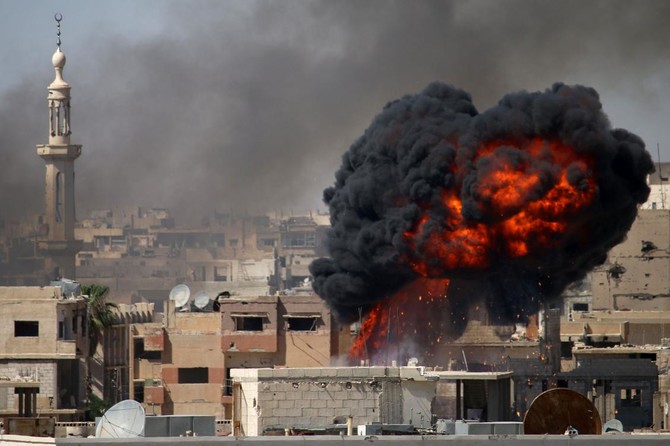
AMMAN/BEIRUT: Government air and artillery bombardments hit rebel-held areas of the Syrian city of Daraa, on the border with Jordan, on Tuesday after a two-day cease-fire expired, witnesses and the Syrian Observatory for Human Rights said.
The Syrian military could not be reached for comment on the renewed action, which took place as US and Russian officials were holding held talks on creating a “de-escalation zone” in southwestern Syria that would include Daraa.
A witness and two insurgents in Daraa said the army and its allies had resumed air and artillery bombardments in the city and the narrow strip of countryside separating it from the border.
If the army takes rebel-held parts of Daraa and the few kilometers (miles) between it and the border, it would split the insurgent areas of southeast Syria in half.
At least six raids took place in Gharz in east Daraa and in the old quarter of the city, where the army resumed efforts to break rebel lines, the rebels said.
The witness said that barrel bombs, artillery shells and rockets were used in the bombardment. Clashes took place near a military base southwest of the city near the border with Jordan, the witness added.
US and Russian officials agreed a cease-fire, which ended on Monday, during talks in Amman aimed at strengthening goodwill before more detailed negotiations on setting up the “de-escalation zone,” diplomats in Jordan said.
On Saturday the Syrian army said it would suspend combat operations in Daraa for 48 hours in order to support “reconciliation efforts.”
Rebels in the city and other residents have said this month that the army’s bombardment of Daraa has intensified and insurgents said the government had brought more troops to the city.
Syrian President Bashar Assad is backed in the six-year-old war by Russia, Iran and Shiite militias while some of the rebels seeking to oust him are supported by the United States, Turkey and Gulf monarchies.

Air strikes pound southwest Syrian city of Daraa
Trump says change of power in Iran would be ‘best thing’
- Trump’s comments were his most overt call yet for the toppling of Iran’s clerical establishment
- USS Gerald R. Ford — the world’s largest warship — would be “leaving very soon” for the Middle East
WASHINGTON: US President Donald Trump said Friday that a change of government in Iran would be the “best thing that could happen,” as he sent a second aircraft carrier to the Middle East to ratchet up military pressure on the Islamic republic.
Trump’s comments were his most overt call yet for the toppling of Iran’s clerical establishment, and came as he pushes on Washington’s arch-foe Tehran to make a deal to limit its nuclear program.
At the same time, the exiled son of the Iranian shah toppled in the 1979 Islamic revolution renewed his calls for international intervention following a bloody crackdown on protests by Tehran.
“Seems like that would be the best thing that could happen,” Trump told reporters at the Fort Bragg military base in North Carolina when a journalist asked if he wanted “regime change” in Iran.
Trump declined to say who he would want to take over in Iran from supreme leader Ayatollah Ali Khamenei, but he added that “there are people.”
He has previously backed off full-throated calls for a change of government in Iran, warning that it could cause chaos, although he has made threats toward Khamenei in the past.
Speaking earlier at the White House, Trump said that the USS Gerald R. Ford — the world’s largest warship — would be “leaving very soon” for the Middle East to up the pressure on Iran.
“In case we don’t make a deal, we’ll need it,” Trump said.
The giant vessel is currently in the Caribbean following the US overthrow of Venezuela’s Nicolas Maduro. Another carrier, the USS Abraham Lincoln, is one of 12 US ships already in the Middle East.
‘Terribly difficult’
When Iran began its crackdown on protests last month — which rights groups say killed thousands — Trump initially said that the United States was “locked and loaded” to help demonstrators.
But he has recently focused his military threats on Tehran’s nuclear program, which US forces struck last July during Israel’s unprecedented 12-day war with Iran.
The protests have subsided for now but US-based Reza Pahlavi, the son of Iran’s last shah, urged international intervention to support the Iranian people.
“We are asking for a humanitarian intervention to prevent more innocent lives being killed in the process,” he told the Munich Security Conference.
It followed a call by the opposition leader, who has not returned to his country since before the revolution, for Iranians at home and abroad to continue demonstrations this weekend.
Videos verified by AFP showed people in Iran this week chanting anti-government slogans as the clerical leadership celebrated the anniversary of the Islamic revolution.
Iran and the United States, who have had no diplomatic relations since shortly after the revolution, held talks on the nuclear issue last week in Oman. No dates have been set for new talks yet.
The West fears the program is aimed at making a bomb, which Tehran denies.
The head of the UN nuclear watchdog, Rafael Grossi, said Friday that reaching an accord with Iran on inspections of its processing facilities was possible but “terribly difficult.”
Reformists released
Trump said after talks with Israeli Prime Minister Benjamin Netanyahu earlier this week that he wanted to continue talks with Iran, defying pressure from his key ally for a tougher stance.
The Israeli prime minister himself expressed skepticism at the quality of any agreement if it didn’t also cover Iran’s ballistic missiles and support for regional proxies.
According to the US-based Human Rights Activists News Agency, 7,008 people, mostly protesters, were killed in the recent crackdown, although rights groups warn the toll is likely far higher.
More than 53,000 people have also been arrested, it added.
The Norway-based Iran Human Rights (IHR) NGO said “hundreds” of people were facing charges linked to the protests that could see them sentenced to death.
Figures working within the Iranian system have also been arrested, with three politicians detained this week from the so-called reformist wing of Iranian politics supportive of President Masoud Pezeshkian.
The three — Azar Mansouri, Javad Emam and Ebrahim Asgharzadeh — were released on bail Thursday and Friday, their lawyer Hojjat Kermani told the ISNA news agency.