LONDON: The terrorist who rammed a van into worshippers near north London’s Finsbury Park Mosque on Monday declared his intention to kill Muslims as he was cornered by irate worshippers.
Darren Osborne, a 47-year-old father of four, swerved the van he was driving into a group of mainly North and West African people shortly after midnight as they left prayers at the Muslim Welfare House near the mosque in the early hours of Monday morning,
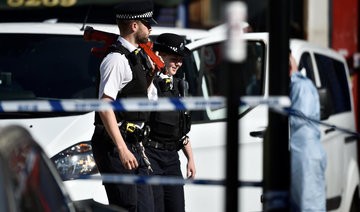
He was grabbed at the scene by locals and pinned down until police arrived.
After being seized, Osborne said he had wanted to kill “many Muslim people,” one witness told journalists.
Ten people were injured in the attack, which UK Prime Minister Theresa May described as a “sickening” terrorist attack on Muslims.
Osborne is being held on suspicion of attempted murder, a charge later extended to preparing or instigating terrorism, including murder and attempted murder.
A man, who had apparently suffered a heart attack before the incident, died at the scene, but it was not clear if his death was a result of the van attack.
“This morning, our country woke to news of another terrorist attack on the streets of our capital city, the second this month and every bit as sickening as those which have come before,” May told reporters outside No. 10 Downing Street. “This was an attack on Muslims near their place of worship,” May added, who later visited Finsbury Park Mosque for a multi-faith meeting with religious leaders.
The attack was the fourth to take place in Britain since March and the third to involve a vehicle deliberately driven at pedestrians.
The victims had just left special prayers during the Muslim holy month of Ramadan.
Usain Ali, 28, said he heard a bang and ran for his life. “When I looked back, I thought it was a car accident, but people were shouting, screaming and I realized this was a man choosing to terrorize people who are praying,” he told Reuters.
“He chose exactly the time that people pray, and the mosque is too small and full, so some pray outside.” Another witness Yann Bouhllissa, 38, said he had been tending to an old man who had suffered a heart attack when the van was driven at them.
The driver was then seized by locals. “One guy caught the guy and brought him down,” Bouhllissa said. “When he was on the floor, the guy asked ‘why do you do that?’. He said ‘Because I want to kill many Muslim people’.”
Local resident Idil told Arab News the attack was a surprise to everyone, but did not want it to change how the area is run: “We don’t want to live in a police state. It won’t work having security here every day. You need to get to the root of the issues.”
Fatima, another local resident, told Arab News: “We don’t want to be living in fear that we always need security around us. We want to be living in the free world.”
Regardless of local sentiment, additional security is coming. Finsbury Park Mosque’s chairman, Mohammed Kozbar, told Arab News that security will be tightened at the mosque, and at other mosques around the country.
Finsbury Park Mosque itself gained notoriety more than a decade ago for sermons by radical cleric Abu Hamza Al-Masri, who was sentenced to life in a US prison in January 2015 after being convicted of terrorism-related charges. However, a new board of trustees and management took over in February 2005, a year after Abu Hamza was arrested by British police. Attendance has greatly increased since then among worshippers from various communities, according to the mosque’s website.
Commenting on the mosque’s transformation, local resident Joyce told Arab News: “This place went through a history of radical (times) but they seem to have moved on, getting on with regular worship… This is a peaceful community.”
The latest incident took place just over two weeks after three militants drove into pedestrians on London Bridge and stabbed people at nearby restaurants and bars, killing eight. A suicide bombing at a pop concert in Manchester, northern England, in May killed 22 people; while in March, a man drove a rented car into pedestrians on Westminster Bridge in London and stabbed a policeman to death before being shot dead. Five people were killed in that attack.
Five other terrorism plots have been foiled since March, police say. May, weakened after losing her parliamentary majority in a June 8 election she had called to strengthen her hand in Brexit talks, has faced criticism for her record on security after the previous series of attacks blamed on Islamist militants.
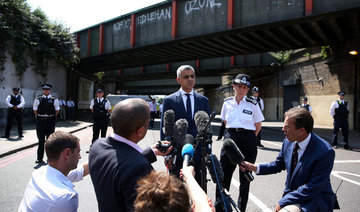
London Mayor Sadiq Khan has called on May to reverse planned police spending cuts, while she has also been criticized for her response to a fire in a London tower block last Wednesday which killed at least 79 people.
“Today’s attack falls at a difficult time in the life of this city, following on from the attack on London Bridge two weeks ago, and of course the unimaginable tragedy of Grenfell Tower last week,” May said.
She promised action to stamp out all forms of hatred, saying there had been far too much tolerance of extremism in Britain over many years. Police have said hate crimes rose after the London Bridge attack and more officers would be deployed to provide reassurance to mosques.
The Muslim Council of Britain said Monday’s attack on mosque worshippers was the most violent manifestation of Islamophobia in Britain in recent months and called for extra security at places of worship.
— With Reuters


![]()

London Finsbury Park attacker said he wanted to kill ‘many Muslim people’
London Finsbury Park attacker said he wanted to kill ‘many Muslim people’

Latest updates




© 2026 SAUDI RESEARCH & PUBLISHING COMPANY, All Rights Reserved And subject to Terms of Use Agreement.