

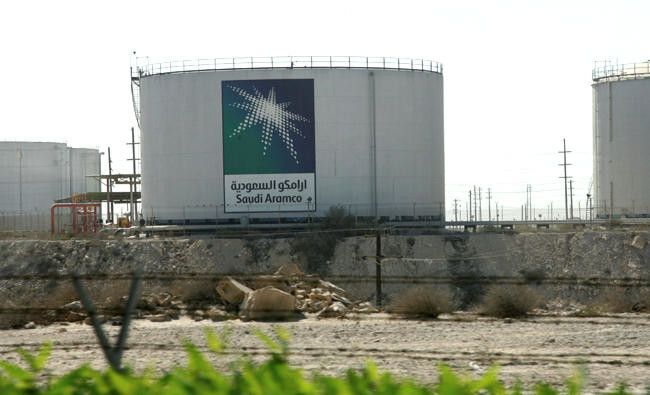
Saudi Aramco takes steps to maximize IPO valuation

Updated 20 June 2017
Follow

Saudi Aramco takes steps to maximize IPO valuation

DUBAI: The government of Saudi Arabia and Saudi Aramco are taking further steps toward maximizing the value of the state-owned oil giant in preparation for the sale of shares to citizens and international investors next year, according to reports.

The measures reportedly include moving some liabilities from Aramco to the government, as well as clarifying the relationship between the oil company and some of the non-oil projects it funds within the Kingdom.

According to a report by the Financial Times (FT), Aramco is looking to present potential investors with a set of “pristine” financial accounts designed to back up the official valuation of $2 trillion put on the company, the largest oil group in the world.

A spokesman for Aramco declined to comment on the report because the matters were still under consideration.

Another person familiar with the matter said that preparing detailed financial accounts was a normal part of the preparation process for an initial public offering (IPO) of shares on a stock exchange.  

There has been some skepticism among international energy analysts that the $2 trillion valuation figure will be reached, but — following a change to the Kingdom’s treatment of oil company taxation earlier this year — independent valuations have been moving upward toward the target.

One factor thought to be affecting investor sentiment has been Aramco’s historic financial support of non-oil projects, ranging from hospitals to sports stadiums.

The spokesman said that such projects were “in the long-term commercial interest of Saudi Aramco and have no material impact on its result.”

In addition to the measures recently taken and the taxation change, Aramco is also believed to have commissioned a new estimate of its overall reserves, vital for deciding valuation and is working with advisers on deciding a dividend policy, which will help determine investor appetite for the shares in any IPO.

The FT, citing four people briefed on the matter, said that the moves “reflected efforts to present a streamlined set of financials to investors.”

It added that an instruction has been issued to shift historical debts from foreign governments, including Jordan and Iraq, from Aramco’s accounts on to the government’s books. 

Under a separate resolution the Kingdom plans to create a mechanism — via a special tax deduction — to compensate Aramco for the financial cost of subsidizing fuels such as petrol for domestic motorists and gas for power generation, the FT added.

It also said that payments owed to Aramco by state entities, such as the national airline Saudi Arabian Airlines, which is also known as Saudia, and the domestic utility Saudi Electricity Company (SEC), will be moved to the Saudi Ministry of Finance.

Aramco is believed to be preparing historic 2015 and 2016 financial statements alongside pro-forma accounts for 2017 to investors for the first time ahead of the IPO.

The market flotation of Aramco will be by far the biggest IPO in history, with a value of $100 billion if, as has been officially suggested, 5 percent of the shares are sold on a $2 trillion valuation.

It is the centerpiece of the Vision 2030 strategy aimed at reducing the Kingdom’s dependence on oil and at transforming the national economy, and will be part of a $300 billion plan to privatize assets held by the Saudi government.

People familiar with the situation say that Aramco has been in talks with the stock exchanges in New York and London with a view to listing some of the shares on those exchanges, in addition to the Tadawul in Riyadh and possibly an Asian stock market.

• Frank Kane is an award-winning business journalist based in Dubai. He can be reached on Twitter @frankkanedubai


AI will never replace human creativity, says SRMG CEO 

Updated 30 January 2026
Follow

AI will never replace human creativity, says SRMG CEO 

  • Speaking to Maya Hojeij, senior business anchor at Asharq with Bloomberg, Jomana R. Alrashid expressed pride in SRMG platforms that had absorbed and adopted AI

RIYADH: Jomana R. Alrashid, CEO of Saudi Research and Media Group, highlighted how AI cannot replace human creativity during a session at The Family Office’s “Investing Is a Sea” summit at Shura Island on Friday. 

“You can never replace human creativity. Journalism at the end of the day, and content creation, is all about storytelling, and that’s a creative role that AI does not have the power to do just yet,” Alrashid told the investment summit. 

“We will never eliminate that human role which comes in to actually tell that story, do the actual investigative reporting around it, make sure to be able to also tell you what’s news or what’s factual from what’s wrong ... what’s a misinformation from bias, and that’s the bigger role that the editorial player does in the newsroom.”

Speaking on the topic of AI, moderated by Maya Hojeij, senior business anchor at Asharq with Bloomberg, the CEO expressed her pride in SRMG platforms that had absorbed and adopted AI in a way that was “transformative.”

“We are now translating all of our content leveraging AI. We are also now being able to create documentaries leveraging AI. We now have AI-facilitated fact-checking, AI facilities clipping, transcribing. This is what we believe is the future.”

Alrashid was asked what the journalist of the future would look like. “He’s a journalist and an engineer. He’s someone who needs to understand data. And I think this is another topic that is extremely important, understanding the data that you’re working with,” she said.

“This is something that AI has facilitated as well. I must say that over the past 20 years in the region, especially when it comes to media companies, we did not understand the importance of data.”

The CEO highlighted that previously, media would rely on polling, surveys or viewership numbers, but now more detailed information about what viewers wanted was available. 

During the fireside session, Alrashid was asked how the international community viewed the Middle Eastern media. Alrashid said that over the past decades it had played a critical role in informing wider audiences about issues that were extremely complex — politically, culturally and economically — and continued to play that role. 

“Right now it has a bigger role to play, given the role again of social media, citizen journalists, content creators. But I also do believe that it has been facilitated by the power that AI has. Now immediately, you can ensure that that kind of content that is being created by credible, tier-A journalists, world-class journalists, can travel beyond its borders, can travel instantly to target different geographies, different people, different countries, in different languages, in different formats.”

She said that there was a big opportunity for Arab media not to be limited to simply Arab consumption, but to finally transcend borders and be available in different languages and to cater to their audiences. 

The CEO expressed optimism about the future, emphasizing the importance of having a clear vision, a strong strategy, and full team alignment. 

Traditional advertising models, once centered on television and print, were rapidly changing, with social media platforms now dominating advertising revenue.

“It’s drastically changing. Ultimately in the past, we used to compete with one another over viewership. But now we’re also competing with the likes of social media platforms; 80 percent of the advertising revenue in the Middle East goes to the social media platforms, but that means that there’s 80 percent interest opportunities.” 

She said that the challenge was to create the right content on these platforms that engaged the target audiences and enabled commercial partnerships. “I don’t think this is a secret, but brands do not like to advertise with news channels. Ultimately, it’s always related with either conflict or war, which is a deterrent to advertisers. 

“And that’s why we’ve entered new verticals such as sports. And that’s why we also double down on our lifestyle vertical. Ultimately, we have the largest market share when it comes to lifestyle ... And we’ve launched new platforms such as Billboard Arabia that gives us an entry into music.” 

Alrashid said this was why the group was in a strong position to counter the decline in advertising revenues across different platforms, and by introducing new products.

“Another very important IP that we’ve created is events attached to the brands that have been operating in the region for 30-plus years. Any IP or any title right now that doesn’t have an event attached to it is missing out on a very big commercial opportunity that allows us to sit in a room, exchange ideas, talk to one another, get to know one another behind the screen.” 

The CEO said that disruption was now constant and often self-driving, adding that the future of the industry was often in storytelling and the ability to innovate by creating persuasive content that connected directly with the audience. 

“But the next disruption is going to continue to come from AI. And how quickly this tool and this very powerful technology evolves. And whether we are in a position to cope with it, adapt to it, and absorb it fully or not.”