MANILA: The Philippine government said Sunday that it would suspend offensives against communist guerrillas to reciprocate a similar plan by the insurgents and allow troops to focus on quelling a bloody siege by Daesh group-aligned militants that has dragged on for nearly a month in a southern city.
Philippine negotiator Silvestre Bello III said the government move aims to foster talks for a cease-fire accord and a peace pact with New People’s Army rebels. Troops have been battling communist and separatist militants simultaneously in the country’s south.
“The Philippine government hereby correspondingly reciprocates with the same declaration of not undertaking offensive operations against the New People’s Army,” Bello said in a statement, without specifying when such a suspension of government offensives would take effect and under what terms.
Despite the peace overtures, Philippine troops killed five communist rebels in separate clashes in the south while the guerrillas stormed a police station in a central town and seized a dozen assault rifles and pistols over the weekend, officials said.
Three communist guerrillas were killed in Davao Oriental province and two others died in Compostela Valley in separate clashes with army troops Saturday, military officials said.
In the central town of Maasin, about 50 communist rebels stormed a police station and seized 12 rifles and pistols, two-way radios, laptop computers, jewelry and a patrol car, said police Chief Superintendent Cesar Hawthorne Binag, who condemned the attack. Criminal complaints will be filed against the attackers, he said.
The rebels claimed responsibility for the attack, saying in a statement that they waged the assault to punish Maasin policemen for their alleged involvement in extortion and for failing to stop the spread of illegal drugs and gambling.
While President Rodrigo Duterte has pursued talks with the communist rebels, who have been waging one of Asia’s longest-running Marxist insurgencies, he has expressed outrage over continuing guerrilla attacks. The rebels have also protested what they said were continuing military assaults on their rural strongholds.
The accusations and other differences have hampered negotiations being brokered by Norway, causing a scheduled round of talks to be canceled last month.
The latest flaring of fighting involving the communist insurgents erupted as thousands of troops and police struggled to end a 27-day siege by militants aligned with the Daesh group in southern Marawi city. Duterte has declared martial law in the south to deal with the most daring attack yet by Daesh-linked militants that has alarmed governments in Southeast Asia.
The intense fighting, now confined in four of Marawi’s 96 villages, has left 242 militants, 56 soldiers and policemen and 26 civilians dead and turned the heartland of the mosque-dotted Islamic city into a smoldering battlefield with military aircraft bombarding militant positions with rockets and bombs in daily airstrikes.
More than 300,000 villagers of Marawi and outlying towns have been displaced and hundreds remained trapped in the Marawi fighting. The US military has deployed a spy plane and drones to help troops end the insurrection, which was started by an estimated 500 Daesh-linked militants, including foreign fighters.
More than 100 militants holding an unspecified number of civilian hostages continue to fight troops but their resistance has considerably weakened after daily battle setbacks, the military says.


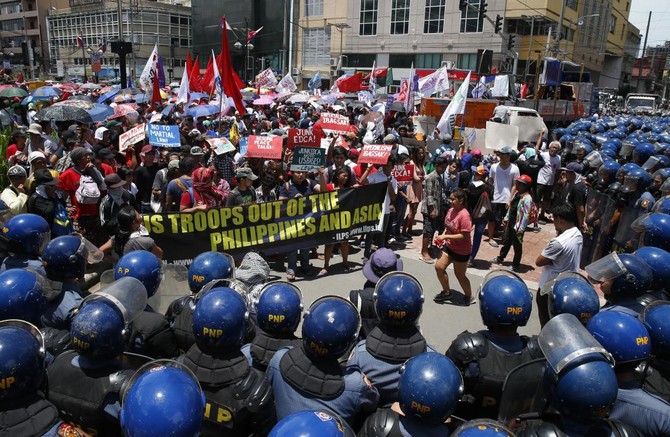
Philippines eyes truce with communist rebels amid siege
Philippines eyes truce with communist rebels amid siege

South Korea calls for resuming dialogue with North
- President Lee Jae Myung has sought to mend ties with the nuclear-armed North since taking office in June
- North Korean leader Kim Jong Un last week dashed hopes of a diplomatic thaw with Seoul
SEOUL: South Korean President Lee Jae Myung called on Sunday for dialogue with North Korea to resume, after Pyongyang last week shunned the prospect of diplomacy with its neighbor.
Since taking office in June, a dovish Lee has sought to mend ties with the nuclear-armed North, which reaffirmed its anti-Seoul approach during a party meeting last week.
“As my administration has repeatedly made clear, we respect the North’s system and will neither engage in any type of hostile acts, nor pursue any form of unification by absorption,” Lee said in a speech marking the anniversary of a historical campaign against Japan’s colonial rule.
“We will also continue our efforts to resume dialogue with the North,” he said.
North Korean leader Kim Jong Un last week dashed hopes of a diplomatic thaw with Seoul, describing its overtures as “clumsy, deceptive farce and a poor work.”
Speaking at the party congress in Pyongyang, Kim said North Korea has “absolutely no business dealing with South Korea, its most hostile entity, and will permanently exclude South Korea from the category of compatriots.”
But he also said the North could “get along well” with the United States if Washington acknowledges its nuclear status.
Speculation has mounted over whether US President Donald Trump will seek a meeting with Kim during planned travels to China.
Last year, Trump said he was “100 percent” open to a meeting.
Previous Trump-Kim summits during the US president’s first term fell apart after the pair failed to agree over sanctions relief — and what nuclear concessions North Korea might make in return.


