

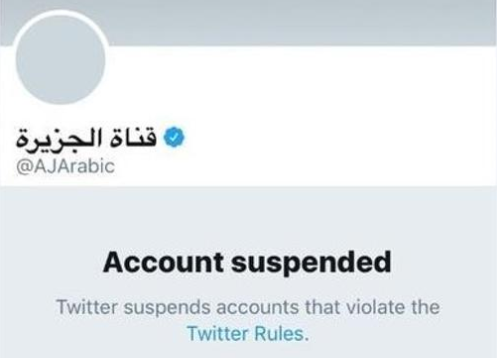
JEDDAH: Social media platform Twitter briefly suspended the main account of the Qatar-based broadcaster, Al Jazeera Arabic language channel.
Twitter offered no explanation for the suspension on Saturday, though it comes after Arab nations have blocked websites and broadcasts by Al Jazeera.
San Francisco-based Twitter did not immediately respond to a request for comment.
A spokesman for the channel said the cut may have been due to a technical problem and that all Twitter accounts affected were back online.
“Most of our Arabic accounts were blocked, but they are now up and running,” the spokesman told AFP, adding that it might take several hours for them to be fully restored.
Al Jazeera’s main Arabic-language account has almost 12 million followers. The station’s English-language account was unaffected.
The channel has been frequently accused of either supporting or promoting terrorist and militant groups in the region.
After the Sept. 11, 2001 terror attacks in the US, Al Jazeera’s Arabic-language channel was accused of being a “mouthpiece” for Osama bin Laden, because of its willingness to air Al-Qaeda video messages and what was perceived as its anti-US bias.
Dr. Hamdan Al-Shehri, a Riyadh-based Saudi political analyst and international relations scholar, described Al Jazeera as an incendiary tool for inciting trouble and was not surprised by the suspension.
“Al Jazeera has always been a sophisticated tool in the hands of the Qatari rulers who used it to interfere in the internal affairs of other countries,” he told Arab News.
“When Sheikh Hamad, the father of the current emir, rebelled against his father, he was actually rebelling against the Gulf states and the region. He used the channel to run a campaign opposing the United States and Saudi Arabia and promoting the Iranian agenda. Through the channel, he supported Al-Qaeda and Al-Qaeda’s propaganda was broadcast only on Al Jazeera. It was clear that Al Jazeera had a special link with Al-Qaeda.”
According to Al-Shehri, the idea was to incite the population by making it look as if Al-Qaeda were fighting to get rid of the Americans.
“Then Al Jazeera portrayed the terrorist group Hezbollah as a resistance group and tried to improve its image in the Arab world,” he said. “All this was part of a well-calculated plan with the aim of advancing Iran’s agenda against Saudi Arabia.”
Journalist Abdel Latif El-Menawy, the former head of Egypt’s state TV news under ousted leader Hosni Mubarak, told Arab News in a previous interview that Al Jazeera has always had an agenda.
“This was much less apparent to the general public before the 2011 uprisings in the Arab world,” he said. “But now it is clear to everyone that it is a propaganda channel reflecting the Qatari regime’s politics.”


