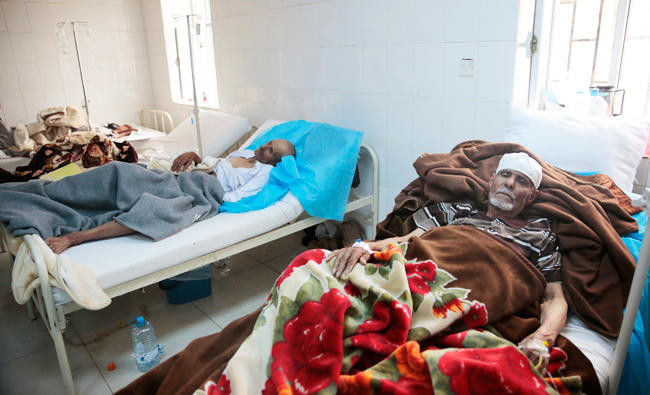
AMMAN: The death toll from a cholera outbreak is approaching 1,000 in Yemen, a war-devastated and impoverished country where “humanity is losing out to politics,” a senior UN official said Thursday.
“Time is running out to save people who are being killed or being starved and now you have cholera as well adding to that complication,” said Jamie McGoldrick, UN humanitarian coordinator in Yemen.
“We are struggling because of the lack of resources. We need some action immediately,” he said at a press briefing in the Jordanian capital.
McGoldrick gave updated figures of more than 130,000 suspected cases of cholera and over 970 deaths, with women and children accounting for half of the numbers.
“What is heartbreaking in Yemen is that humanity is losing out to the politics,” said McGoldrick.
He said a $2.1 billion humanitarian response plan for Yemen for 2017 had only been 29 percent funded.

Yemen cholera toll nears 1,000 as ‘humanity loses out to politics’
Gulf countries offer support to Yemen’s legitimate government, Saudi security
- Qatar, Kuwait say their security is based on the security of Saudi Arabia and the GCC
- Bahrain said it had confidence in the leadership of Saudi Arabia and the UAE to contain differences
LONDON: Gulf and Arab countries on Tuesday offered support to the internationally recognized government in Yemen after the UAE withdrew its forces from the country.
The statements were issued after the military coalition supporting Yemen’s government carried out airstrikes on a shipment of weapons and vehicles destined for southern separatist forces.
The shipment arrived in the port of Mukalla on board two vessels from Fujairah in the UAE.
The Emirates was asked by Rashad Al-Alimi, head of Yemen’s presidential council, to withdraw its troops from Yemen within 24 hours.
Saudi Arabia said the separatists, operating under the Southern Transitional Council and supported by the UAE, posed a direct threat to the Kingdom’s national security and regional stability by recently seizing territory in the governorates of Hadramaut and Al-Mahra.
Qatar said it was following the developments “with keen interest.”
A foreign ministry statement said Doha fully supported the legitimate Yemeni government and stressed the importance of preserving Yemen's unity and safeguarding the interests of the Yemeni people.
It added that the security of Saudi Arabia and the security of the member states of the Gulf Cooperation Council (GCC) “constitute an inseparable part of the security of the State of Qatar, reflecting the deep-rooted fraternal ties and shared destiny that unite the GCC states.”
The ministry commended the statements issued by Saudi Arabia and the UAE “which reflect a commitment to prioritizing the interests of the region.”
Kuwait also offered “unwavering support” for Yemen’s government and said the security of Saudi Arabia and GCC is the basis of its own national security.
Its foreign ministry praised the “responsible approach” taken by both Saudi Arabia and the UAE.
Bahrain, the current GCC chair, said it had confidence in the leadership of Saudi Arabia and the UAE “and their ability to contain any differences in viewpoints within the framework of a unified Gulf.”
The foreign ministry statement offered “unequivocal” support toward regional and international initiatives and efforts aimed at reaching a comprehensive and lasting political solution in Yemen.
Egypt said it had full confidence in Saudi Arabia and the UAE “to handle the current developments in Yemen with wisdom.”
Cairo will continue efforts toward a comprehensive political settlement for Yemen, the statement said.