Elephant in Sri Lankan Buddhist procession kills monk

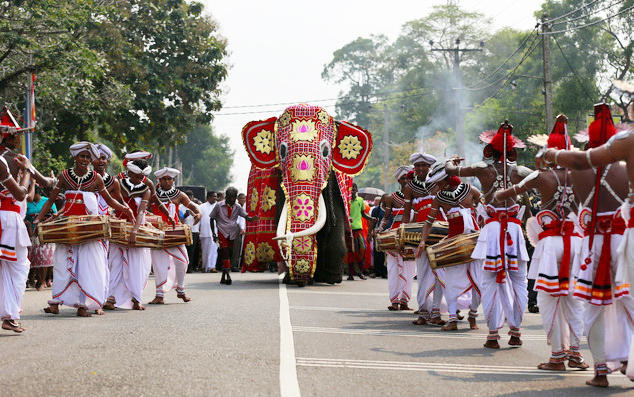
In this Oct. 20, 2016 photo, Sri Lankan traditional dancers escort a decorated elephant during an annual procession in Kirindiwela village, outside Colombo, Sri Lanka. An elephant that was part of a Buddhist procession in the coastal town of Kochchikade, not far from Colombo, attacked and killed a monk, police said Monday. (AP file photo)
Updated 12 June 2017
Follow

Elephant in Sri Lankan Buddhist procession kills monk

COLOMBO, Sri Lanka: An elephant that was part of a Sri Lankan Buddhist procession attacked and killed a monk, police said Monday.
Police spokesman Priyantha Jayakody said three elephants were walking in the procession Sunday night when one suddenly went on a rampage and attacked the monk in the coastal town of Kochchikade, about 42 kilometers (26 miles) north of Colombo. The 25-year-old monk died at a hospital early Monday.
Colorfully decorated elephants are an important part of Buddhist religious processions and festivals. Temples and wealthy families often own the animals and rent them out for such events.
However, animal rights activists say the elephants are often kept in inhumane conditions and receive insufficient food.
Authorities say there are about 127 tamed elephants that are used for processions and other religious ceremonies by Sinhalese Buddhists, who make up 70 percent of the island’s 20 million people.
Having an elephant in the backyard has long been a sign of wealth, privilege and power. For hundreds of years, elephants have been used for such religious activities and as well as for battles by ancient kings.
Sri Lanka has about 6,000 elephants, but those in the wild are threatened by habitat loss and degradation. An estimated 200 elephants are killed every year, mainly by farmers trying to protect their crops. In the 19th century there were believed to be up to 14,000 elephants.


Lunar New Year bowing service in China stokes controversy

Updated 13 February 2026
Follow

Lunar New Year bowing service in China stokes controversy

  • Customers could hire proxies to bow and show respect for family members
  • Odd jobs app UU Paotui withdraws ‌service after online outrage and mockery

BEIJING: A Chinese odd jobs mobile app has canceled a service that let users hire proxies to bow to their elderly relatives during Lunar New Year family visits, sparking scrutiny of China’s “hire-anyone-for-anything” service sector. Promotional images of the now-deleted service depicted an orange uniform-clad delivery worker on their knees bowing, forehead nearly on the floor, in front of a smiling elderly couple. Online responses ranged from outrage to mockery.
“Filial piety should not be commoditized,” one Weibo user said, referring to the culture of respect for and deference to older family members.
Visiting loved ones and offering good wishes are an important part of ‌the traditional Lunar ‌New Year holiday, although bowing is not widely practiced today.
“After ‌careful ⁠consideration, we have ⁠voluntarily removed the services that caused controversy,” said odd jobs app UU Paotui, based in central China’s Henan, in a Wednesday WeChat post.
As of Friday, the app still offered a New Year greeter service — with immediate dispatch options — but the 999 yuan ($144.77), two-hour bowing-for-hire package was no longer visible.
Buyers of the now-deleted bowing package could hire gig workers to buy and send gifts, “perform traditional etiquette,” and offer “one minute of auspicious blessings” to loved ones, among other services. The services were meant to ⁠help people living far from their families and those with mobility issues ‌maintain traditional customs, UU Paotui said, adding it would ‌offer triple compensation to customers who had already booked.
People who have moved away for work typically ‌return home to visit their families for the most important festival on the Chinese calendar, ‌creating a travel rush commonly referred to as the world’s largest annual human migration. In a nod to the increasingly virtual nature of social life in China, UU Paotui suggested replacing the in-person visits with an app could help avoid awkward social interactions.
“If you don’t want to have social anxiety during ‌the new year, the experience has to be online!” said a Monday Weibo post announcing the service.
Time-poor consumers boost proxy services
Proxy services ⁠are not uncommon in ⁠China, where labor costs are relatively low and convenience is at a premium for urban consumers.
Outside the holiday period, UU Paotui users can hire someone through the app to accompany them to hospital, feed their pets, or wait in queues at restaurants and other busy locations.
A Wednesday commentary in the People’s Daily, the Communist Party newspaper, called the bowing service “very awkward” and urged closer scrutiny of the proxy service industry.
“Real innovation should meet needs while also safeguarding values,” it said, pointing out that paying a proxy to cover work shifts, for example, could come with legal risks. The controversy comes amid increasing concern for China’s often overworked delivery workers, who can sometimes be seen sprinting through shopping malls and residential compounds to deliver an order on time.
President Xi Jinping met delivery workers on Wednesday to wish them a happy new year and acknowledge their hard work.
“The city couldn’t function without workers like you,” he said.