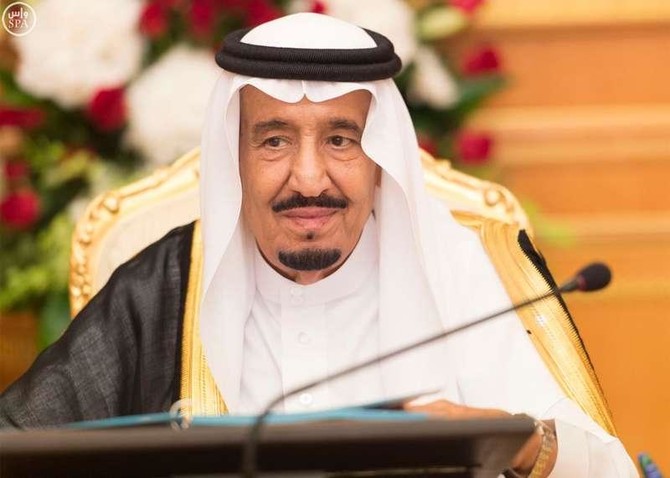
JEDDAH: A new directive has been issued by Saudi Arabia’s King Salman that requires the humanitarian needs of families made up of Saudi and Qatari nationals be taken into consideration.
And it is a move that has been mirrored in the United Arab Emirates (UAE) and Bahrain.
On the Saudi Foreign Ministry’s official Twitter account a statement was posted confirming the “deep ties” between Saudi and Qatari people.
“The Qatari people are a genuine extension of their brothers in [the] Kingdom of Saudi Arabia... King Salman addresses the humanitarian cases of Saudi-Qatari joint families, the people of Qatar are in King Salman’s heart,” the statement said.
The statement added that the Ministry of Interior has set up the hotline — +966 112 409111 — to receive cases and take appropriate action.
The people of #Qatar are in the heart of King Salman pic.twitter.com/GqQLW3dWtd
— وزارة الخارجية (@KSAMOFA) June 11, 2017
Meanwhile, the UAE and Bahrain have taken similar measures and ordered that the humanitarian needs of citizens married to Qatari nationals also be taken into account.
UAE President Sheikh Khalifa bin Zayed Al-Nahyan has instructed the authorities to address cases of Emirati-Qatari families. And like Saudi, special helplines have been set up: +971 800 2626 for the UAE and in Bahrain the number is +973 1739 9821.
An official UAE source quoted by the state news agency “WAM” said these measures “were in line with the statement issued by the UAE, that severed ties with the State of Qatar for the pretexts mentioned in the resolution and its procedures.”
Meanwhile, Bahraini Ministry of Foreign Affairs issued an official statement that said further to “severing diplomatic relations with the State of Qatar, and the measures taken as a result of its continued hostile behaviour against the Kingdom of Bahrain.
“A Royal Order was issued by King Hamad bin Isa Al Khalifa to take into account the humanitarian situation of Bahraini-Qatari families in appreciation of the brotherly Qatari people who represent a natural extension of their brothers in the Kingdom of Bahrain.”
A royal decree was issued by HM the King on consideration of humanitarian cases of joint Bahraini-Qatari familieshttps://t.co/civeD2cxX6 pic.twitter.com/fRG36jpTph
— وزارة الخارجية (@bahdiplomatic) June 11, 2017
The latest announcements mean restrictions will be eased for Qatari’s married to citizens of the three countries.
Qatari nationals living in Saudi Arabia, UAE and Bahrain were previously ordered to leave within 14 days after the three countries severed ties with Qatar last Monday, suspending land, sea and air travel links.