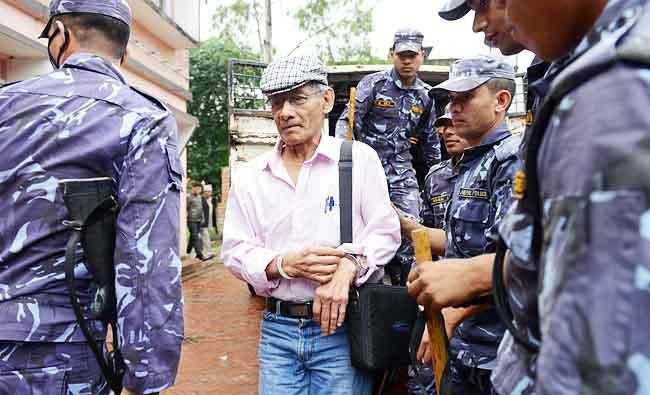
KATMANDU: A notorious French criminal who earned the nickname “bikini killer” for a string of murders throughout Asia in the 1970s, was in a Nepali hospital Friday, where he is expected to undergo open heart surgery, sources said.
Charles Sobhraj, 73, who is currently serving a life sentence, was taken to hospital for tests, his lawyer and mother-in-law Sakuntala Thapa told AFP.
The aging conman has been implicated in more than 20 killings, earning worldwide notoriety for a series of poisonings and robberies of backpackers across Asia in the 60s and 70s.
He needs to have one of the valves in his heart replaced, said Jyotendra Sharma, director of Sahid Gangalal National Heart Center, where the surgery will take place.
Senior police officer Janak Bahadur Shahi told AFP that Sobhraj will remain in hospital until after the surgery, which other sources said is expected to take place next week.
“Sobhraj has been admitted to the hospital for the surgery. The date for the operation is yet to be fixed,” said Shahi.
Sobhraj was taken to hospital in late May after suffering a heart attack and was diagnosed with a weak valve that needed to be corrected through surgery.
His lawyer said that Sobhraj wanted to return to France for the surgery — a plea that he also made in a rare telephone interview with the Indian Express newspaper earlier this week.
But prison doctor Kedar Narshingh KC said he thought Sobhraj, who also earned the sobriquet “The Serpent” for his repeated identity thefts and escapes from justice, was angling to get released from jail early.
“He is spreading rumors despite our intensive care and treatment. It is suspicious and could be a ploy to get released from the jail,” said the doctor.
The French embassy in Katmandu told AFP there were “no ongoing discussions regarding the transfer of Sobhraj to France” for treatment or to serve the remainder of his sentence.
Sobhraj — a French citizen of Vietnamese and Indian parentage — was sentenced by a Nepal court in 2004 for the killing of US tourist Connie Joe Bronzich in 1975.
It was the first time he had been convicted of murder, despite being linked to a string of killings. Two of his victims were found wearing only bikinis.
The law first caught up with him in India in 1976, when he was jailed for culpable homicide — a lesser charge than murder — for poisoning a French tourist and killing an Israeli man.
He spent 21 years in jail in India’s capital with a brief 22-day break in 1986 when he escaped by reportedly offering the guards cakes, cookies and grapes laced with sleeping pills.
Sobhraj claimed that the jailbreak was a well-crafted plan to avoid extradition to Thailand where he would have faced the death penalty for the murder of an American woman in the mid-seventies.
India’s snail-paced judiciary took years to begin prosecution against him for jailbreak and in 1995 the extradition warrant from Thailand expired. He was finally released in 1997.
In 2014, he was handed a second life sentence in Nepal for the killing of Canadian backpacker Laurent Carriere.
While in jail in Nepal, Sobhraj married his lawyer’s daughter, Nihita Biswas, who is 22 years his junior.
Biswas has herself courted notoriety, appearing in India’s hugely popular reality television show “Bigg Boss” — a spin off of the global “Big Brother” franchise — in 2011.

French ‘bikini killer’ to have heart surgery in Nepal
Trump hikes US global tariff rate to 15 percent
WASHINGTON: President Donald Trump raised the global duty on imports into the United States to 15 percent on Saturday, doubling down on his promise to maintain his aggressive tariff policy a day after the Supreme Court ruled much of it illegal.
Trump said on his Truth Social platform that after a thorough review of Friday’s “extraordinarily anti-American decision” by the court to rein in his tariff program, the administration was hiking the import levies “to the fully allowed, and legally tested, 15 percent level.”
Shortly after the court’s 6-3 ruling that rejected the president’s authority to impose tariffs under a 1977 economic emergency powers act, Trump had initially announced a new 10 percent global levy by invoking a different legal avenue.
At the same time, the Republican launched an extraordinary personal attack on the conservative justices who had sided with the majority, slamming their “disloyalty” and calling them “fools and lap dogs.”
The ruling was a stunning rebuke by the high court, which has largely sided with the president since he returned to office, and marked a major political setback in striking down Trump’s signature economic policy that has roiled the global trade order.
Saturday’s announcement is sure to provoke further uncertainty as Trump carries on with a trade war that he has used to cajole and punish countries, both friend and foe.
It is the latest move in a process that has seen a multitude of tariff levels for countries sending goods into the United States set and then altered or revoked by Trump’s team over the past year.
Several countries have said they are studying the Supreme Court ruling and Trump’s subsequent tariff announcements.
Brazil’s President Luiz Inacio Lula da Silva on Sunday urged Donald Trump to treat all countries equally.
“I want to tell the US President Donald Trump that we don’t want a new Cold War. We don’t want interference in any other country, we want all countries to be treated equally,” Lula told reporters in New Delhi.
German Chancellor Friedrich Merz said Saturday he would hold talks with European allies to formulate “a very clear European position” and joint response to Washington before he travels to the US capital in early March.
On the domestic front, Pennsylvania Governor Josh Shapiro, a Democrat, said on X it was time for Trump to “listen to the Supreme Court, end chaotic tariffs, and stop wreaking havoc on our farmers, small business owners, and families.”
The new duty by law is only temporary — allowable for 150 days. According to a White House fact sheet, exemptions remain for sectors that are under separate probes, including pharma, and goods entering the US under the US-Mexico-Canada agreement.
On Friday, the White House said US trading partners that reached separate tariff deals with Trump’s administration would also face the new global tariff.
- High court defeat -
Friday’s court ruling did not impact sector-specific duties Trump separately imposed on steel, aluminum and various other goods. Government probes still underway could lead to additional sectoral tariffs.
But it nevertheless marked Trump’s biggest defeat at the Supreme Court since returning to the White House 13 months ago. The court has generally expanded his power.
Trump heaped praise on the conservative justices who voted to uphold his authority to levy tariffs — Clarence Thomas, Samuel Alito and Brett Kavanaugh, a Trump nominee — thanking them “for their strength and wisdom, and love of our country.”
The president alleged the majority of six justices, including two nominated during his first term, had been “swayed by foreign interests.”
“I think that foreign interests are represented by people that I believe have undue influence,” he said.
Shares on Wall Street — a metric closely watched by Trump — rose modestly Friday after the decision, which had been expected.
Business groups largely cheered the ruling, with the National Retail Federation saying this “provides much-needed certainty” for companies.
In court arguments, the Trump administration said companies would receive refunds if the tariffs were deemed unlawful. But the Supreme Court’s ruling did not address the issue.
Trump said he expected years of litigation on whether to provide refunds. Kavanaugh noted the refund process could be a “mess.”
Trump said on his Truth Social platform that after a thorough review of Friday’s “extraordinarily anti-American decision” by the court to rein in his tariff program, the administration was hiking the import levies “to the fully allowed, and legally tested, 15 percent level.”
Shortly after the court’s 6-3 ruling that rejected the president’s authority to impose tariffs under a 1977 economic emergency powers act, Trump had initially announced a new 10 percent global levy by invoking a different legal avenue.
At the same time, the Republican launched an extraordinary personal attack on the conservative justices who had sided with the majority, slamming their “disloyalty” and calling them “fools and lap dogs.”
The ruling was a stunning rebuke by the high court, which has largely sided with the president since he returned to office, and marked a major political setback in striking down Trump’s signature economic policy that has roiled the global trade order.
Saturday’s announcement is sure to provoke further uncertainty as Trump carries on with a trade war that he has used to cajole and punish countries, both friend and foe.
It is the latest move in a process that has seen a multitude of tariff levels for countries sending goods into the United States set and then altered or revoked by Trump’s team over the past year.
Several countries have said they are studying the Supreme Court ruling and Trump’s subsequent tariff announcements.
Brazil’s President Luiz Inacio Lula da Silva on Sunday urged Donald Trump to treat all countries equally.
“I want to tell the US President Donald Trump that we don’t want a new Cold War. We don’t want interference in any other country, we want all countries to be treated equally,” Lula told reporters in New Delhi.
German Chancellor Friedrich Merz said Saturday he would hold talks with European allies to formulate “a very clear European position” and joint response to Washington before he travels to the US capital in early March.
On the domestic front, Pennsylvania Governor Josh Shapiro, a Democrat, said on X it was time for Trump to “listen to the Supreme Court, end chaotic tariffs, and stop wreaking havoc on our farmers, small business owners, and families.”
The new duty by law is only temporary — allowable for 150 days. According to a White House fact sheet, exemptions remain for sectors that are under separate probes, including pharma, and goods entering the US under the US-Mexico-Canada agreement.
On Friday, the White House said US trading partners that reached separate tariff deals with Trump’s administration would also face the new global tariff.
- High court defeat -
Friday’s court ruling did not impact sector-specific duties Trump separately imposed on steel, aluminum and various other goods. Government probes still underway could lead to additional sectoral tariffs.
But it nevertheless marked Trump’s biggest defeat at the Supreme Court since returning to the White House 13 months ago. The court has generally expanded his power.
Trump heaped praise on the conservative justices who voted to uphold his authority to levy tariffs — Clarence Thomas, Samuel Alito and Brett Kavanaugh, a Trump nominee — thanking them “for their strength and wisdom, and love of our country.”
The president alleged the majority of six justices, including two nominated during his first term, had been “swayed by foreign interests.”
“I think that foreign interests are represented by people that I believe have undue influence,” he said.
Shares on Wall Street — a metric closely watched by Trump — rose modestly Friday after the decision, which had been expected.
Business groups largely cheered the ruling, with the National Retail Federation saying this “provides much-needed certainty” for companies.
In court arguments, the Trump administration said companies would receive refunds if the tariffs were deemed unlawful. But the Supreme Court’s ruling did not address the issue.
Trump said he expected years of litigation on whether to provide refunds. Kavanaugh noted the refund process could be a “mess.”
© 2026 SAUDI RESEARCH & PUBLISHING COMPANY, All Rights Reserved And subject to Terms of Use Agreement.