Terror threat in spotlight on eve of UK election

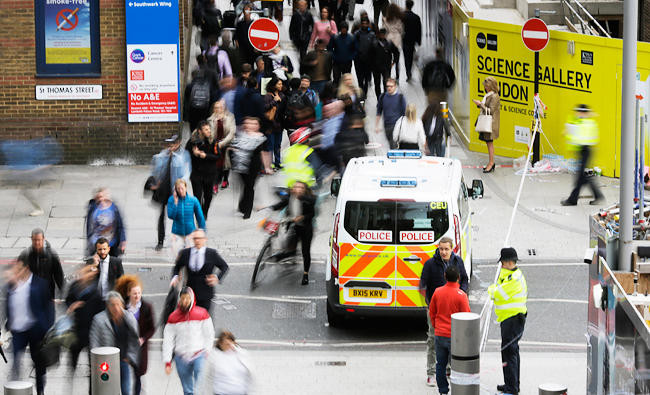
People pass a police van at a closed street in the London Bridge area of London on Tuesday. (AP)
Updated 07 June 2017
Follow

Terror threat in spotlight on eve of UK election

LONDON: The terror threat to Britain has emerged as the key campaign issue ahead of Thursday’s election, amid mounting anger over apparent security flaws after a series of deadly attacks on UK soil.
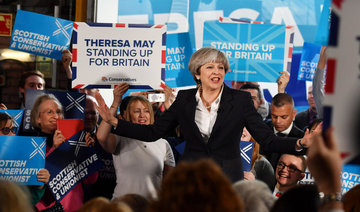
Britain’s ruling Conservatives, led by Prime Minister Theresa May, and the opposition Labour Party battled to defend their records on security on Tuesday, as further details emerged over the perpetrators of a violent attack that killed seven people in London on Saturday.
Khuram Shazad Butt, one of the attackers named, “was known to the police and MI5,” the domestic security service, but there was no intelligence to suggest the attack was being planned, police said. He had featured in a television documentary entitled “The Jihadis Next Door” and, according to British media, numerous people alarmed by his views had gone to the authorities.
It earlier emerged that the May 22 suicide bombing at the Manchester Arena was perpetrated by Salman Abedi, who was also known to British intelligence services.
May has vowed to crack down on extremists. But she is also facing criticism over the number of police officers in the UK, which reportedly declined by almost 20,000 between 2009 and 2016.
Opposition leader Jeremy Corbyn has pledged to hire thousands of officers for neighborhood duties, arguing that a grassroots approach would curb crime and radicalization.
A poll published by YouGov on Tuesday found that May is on track to win 304 seats in Britain’s Parliament, short of a 326-seat majority. Her party had 330 seats when the election was called in April.
Stephan Shakespeare, CEO and founder of YouGov, said, however, the polling firm did not believe the narrowing of May’s lead was a consequence of the terrorist attack over the weekend.
“This has been a highly volatile election, but I think May will remain in Number 10,” he told Arab News.
— With input from AFP, Reuters


Czech Prime Minister Babiš faces confidence vote as government shifts Ukraine policy

Updated 4 sec ago
Follow

Czech Prime Minister Babiš faces confidence vote as government shifts Ukraine policy

  • “I’d like to make it clear that the Czech Republic and Czech citizens will be first for our government,” Babiš said
  • Babiš has rejected any financial aid for Ukraine and guarantees for EU loans

PRAGUE: The Czech Republic’s new government led by populist Prime Minister Andrej Babiš was set to face a mandatory confidence vote in Parliament over its agenda aimed at steering the country away from supporting Ukraine and rejecting some key European Union policies.
The debate in the 200-seat lower house of Parliament, where the coalition has a majority of 108 seats, began Tuesday. Every new administration must win the vote to govern.
Babiš, previously prime minister in two governments from 2017-2021, and his ANO, or YES, movement, won big in the country’s October election and formed a majority coalition with two small political groups, the Freedom and Direct Democracy anti-migrant party and the right-wing Motorists for Themselves.
The parties, which share admiration for US President Donald Trump, created a 16-member Cabinet.
“I’d like to make it clear that the Czech Republic and Czech citizens will be first for our government,” Babiš said in his speech in the lower house.
The political comeback by Babiš and his new alliance with two small government newcomers are expected to significantly redefine the nation’s foreign and domestic policies.
Unlike the previous pro-Western government, Babiš has rejected any financial aid for Ukraine and guarantees for EU loans to the country fighting the Russian invasion, joining the ranks of Viktor Orbán of Hungary and Robert Fico of Slovakia.
But his government would not abandon a Czech initiative that managed to acquire some 1.8 million much-needed artillery shells for Ukraine only last year on markets outside the EU on condition the Czechs would only administer it but would not contribute money.
The Freedom party sees no future for the Czechs in the EU and NATO, and wants to expel most of 380,000 Ukrainian refugees in the country.
The Motorists, who are in charge of the environment and foreign ministries, rejected the EU Green Deal and proposed revivals of the coal industry.