7 dead migrants found in Libya truck

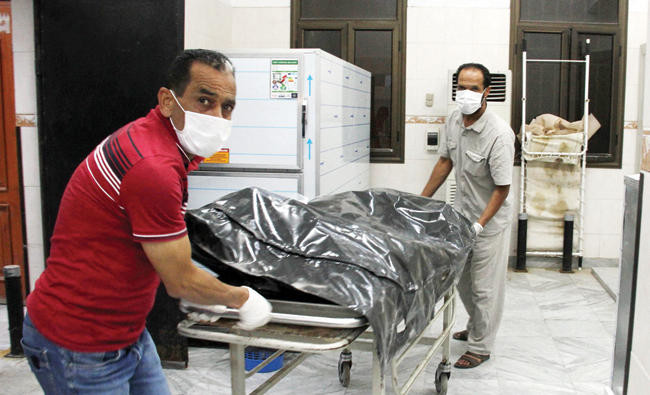
Libyan men pull a stretcher with the body of a victim who died inside a truck carrying illegal migrants, in Tripoli. (AFP)
Updated 05 June 2017
Follow

7 dead migrants found in Libya truck

TRIPOLI: Seven migrants from sub-Saharan Africa have been found dead in an abandoned refrigerator truck near the Libyan capital, a senior official in the fight against illegal immigration told AFP Monday.
“There were 35 illegal migrants on board, but seven of them had already died, and the 28 survivors have received medical treatment and are in good health,” Adel Mostafa said.
He added that the dead migrants, who were found on Sunday, had almost certainly asphyxiated.
The official said he did not know what had prompted the smuggler to abandon the vehicle and the people inside it.
Many migrants from sub-Saharan Africa are driven through southern Libya in trucks to the northern coast where they later attempt the perilous Mediterranean crossing to Italy in Europe some 300 kilometers away.
People traffickers have exploited the chaos in Libya since the 2011 uprising deposed and killed strongman Muammar Qaddafi to boost their lucrative but deadly trade.
According to International Organization for Migration and the UN Children’s Fund (UNHCR) figures, 1,481 migrants have died and 1,720 are missing since Jan. 1.
In 2016, 181,000 migrants reached Europe via Italy, 90 percent of them from Libya.
By mid-April this year, Italy had registered nearly 42,500 migrants coming by sea, 97 percent of them arriving from Libya.


Virtual museum preserves Sudan’s plundered heritage

Updated 6 sec ago
Follow

Virtual museum preserves Sudan’s plundered heritage

CAIRO: Destroyed and looted in the early months of Sudan’s war, the national museum in Khartoum is now welcoming visitors virtually after months of painstaking effort to digitally recreate its collection.
At the museum itself, almost nothing remains of the 100,000 artefacts it had stored since its construction in the 1950s. Only the pieces too heavy for looters to haul off, like the massive granite statue of the Kush Pharaoh Taharqa and frescoes relocated from temples during the building of the Aswan Dam, are still present on site.
“The virtual museum is the only viable option to ensure continuity,” government antiquities official Ikhlass Abdel Latif said during a recent presentation of the project, carried out by the French Archaeological Unit for Sudanese Antiquities (SFDAS) with support from the Louvre and Britain’s Durham University.
When the museum was plundered following the outbreak of the war between the regular army and the paramilitary Rapid Support Forces (RSF) in April 2023, satellite images showed trucks loaded with relics heading toward Darfur, the western region now totally controlled by the RSF.
Since then, searches for the missing artefacts aided by Interpol have only yielded meagre results.
“The Khartoum museum was the cornerstone of Sudanese cultural preservation — the damage is astronomical,” said SFDAS researcher Faiza Drici, but “the virtual version lets us recreate the lost collections and keep a clear record.”
Drici worked for more than a year to reconstruct the lost holdings in a database, working from fragments of official lists, studies published by researchers and photos taken during excavation missions.
Then graphic designer Marcel Perrin created a computer model that mimicked the museum’s atmosphere — its architecture, its lighting and the arrangement of its displays.
Online since January 1, the virtual museum now gives visitors a facsimile of the experience of walking through the institution’s galleries — reconstructed from photographs and the original plans — and viewing more than 1,000 pieces inherited from the ancient Kingdom of Kush.
It will take until the end of 2026, however, for the project to upload its recreation of the museum’s famed “Gold Room,” which had housed solid-gold royal jewelry, figurines and ceremonial objects stolen by looters.
In addition to the virtual museum’s documentary value, the catalogue reconstructed by SFDAS is expected to bolster Interpol’s efforts to thwart the trafficking of Sudan’s stolen heritage.